
Future AGI
Future AGI · Coding
Future AGI is a platform that helps teams evaluate, trace, guard and improve LLM apps. It tests prompts, simulates agents and catches hallucinations before they reach users.
About Future AGI
What Is Future AGI
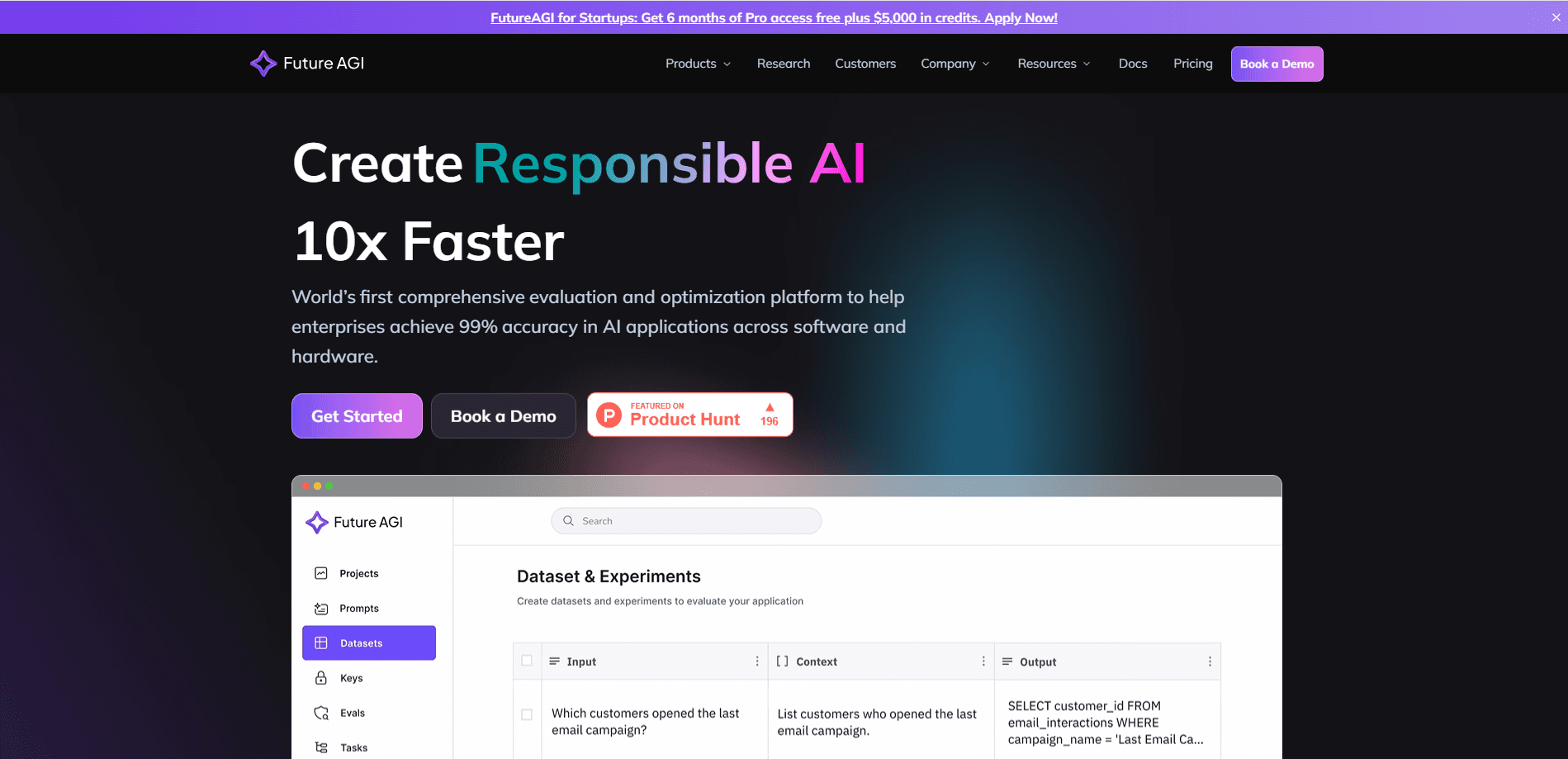
Future AGI is an AI engineering platform built around one task: catching what goes wrong in an LLM app before a user does. It bundles evaluation, observability, guardrails and optimization into a single product, and each piece starts on a free tier. Teams use it to score model outputs, trace every step of an agent run, block unsafe content and tune prompts against real data.
The problem it targets is simple to state and hard to fix. Language models hallucinate, drift off instruction and leak data, and the errors rarely show up in a demo. Future AGI puts the tools to find those errors in one place, rather than asking a team to stitch together a tracer, an eval library and a separate moderation API. It is best known for LLM observability, the part that records what an app did, alongside the evaluation tools that judge how good the result was. According to the company, more than 2,400 teams now use it, and the SDKs for evaluation are open source on GitHub.
Two limits are worth knowing before you start. The free tier resets monthly and caps tracing at 50 GB with 30-day data retention, so long-running production workloads push past it fast. And the deeper agentic evaluation runs on paid AI Credits, so the always-free parts are heuristic checks and bring-your-own-key judge calls.
Getting Started
- Sign up at app.futureagi.com and create a project for your app
- Install the traceAI SDK and point it at your LLM calls to start collecting traces
- Add an evaluation to score outputs. Pick a template or write a custom judge prompt
- Turn on guardrails on your gateway to block PII and injections in real time
- Review the error feed, then use the recommendations to fix prompts and re-run
Product Information
A quick look at Future AGI's pricing, supported platforms, and performance.
Best for
The users, tasks, and scenarios where this tool fits best.
Users
- AI engineering teams
- ML and eval engineers
- Product teams running AI features
- Solo builders and small startups
Tasks
- Prompt testing
- Hallucination detection
- Agent tracing
- Content safety screening
- Regression testing
Scenarios
- A support bot gives a wrong answer in production
- Comparing two model versions
- Pre-launch review of a new agent
- Cutting LLM spend
- Compliance check on user data
Key features
Evaluation with LLM-as-Judge and Code Evals
Future AGI scores model output in several ways, so you can pick the one that fits the check. Heuristic evals like BLEU, ROUGE and regex are free and unlimited. Code evals and the hosted Turing judge models charge per run through AI Credits, while bringing your own key for the judge costs nothing on the platform. In one call the toolkit runs a wide set of metrics across text, image and audio, from groundedness and hallucination checks to tool-correctness and PII leakage.
Tracing and Observability
The traceAI SDK captures end-to-end traces, spans and sessions so you can see exactly what an app did on a given request. It ships with 30+ libraries and 11 span types, plus 70+ filters and full-text search for digging through runs. Sessions, end users and an agent graph view tie individual calls back to the people and workflows behind them. Custom dashboards and alert monitors with Slack and email round out the view.
Guardrails and Content Protection
Guardrails sit in front of the model and screen traffic in both directions. Fifteen rule-based checks, covering PII, secrets and custom patterns, are always free, while the ML moderation model (Gemma 3n) runs on AI Credits per check. You can run guardrails in enforce, monitor or log mode and set score thresholds, and there are 15 external integrations including Lakera, Presidio and Llama Guard for teams that already standardize on those tools.
Agent Simulation with Personas
Simulation lets you test an agent against people instead of prompts. You pick from 28+ pre-built personas or write your own, and the platform runs text or voice conversations against your agent across script, dataset and graph scenarios. Transcripts and session comparisons show where the agent lost the thread, and AI scenario generation can draft new test cases from a description. Voice and text minutes are billed separately.
AI Gateway and Command Center
The Command Center is an AI gateway that sits between your app and your model providers. It routes across 15+ providers including OpenAI, Anthropic, Gemini and Bedrock, with nine load-balancing strategies, auto-failover and retry. Exact and semantic caching cut repeat calls, and rate limits, budgets and virtual keys keep spend under control. The free tier covers 100K requests and 100K cache hits a month.
Datasets, Experiments and Prompt Workbench
Datasets store forever on every plan and support 14 column types, with six ways to create them from manual entry to CSV, PDF and HuggingFace imports. Experiments let you run a dataset against multiple models or prompts and compare the results in one place. The prompt workbench adds versioning, labels and folders, plus a visual agent playground and a prompt playground where you can swap across 100+ models without platform cost.
Falcon AI Error Analysis
Falcon AI reads through your traces and pulls out the patterns a human would miss. It clusters errors across four scoring dimensions, generates insights on what keeps going wrong and auto-tags runs so you can filter by failure type. The output is a set of recommendations and immediate fixes tied to the traces that triggered them, which is the shortest path from a failed run to a prompt edit.
Pros and cons
Pros
- Generous free tier covers tracing, evals, gateway and simulation without a credit card
- Evaluation SDK is open source, so the scoring logic is auditable rather than a black box
- One platform spans tracing, evals, guardrails and prompt work, so there are fewer vendors to manage
- Bring-your-own-key judge calls cost nothing, which keeps the price low for teams with their own model access
- 15 built-in guardrails are free on every plan, including PII and secrets detection
Cons
- Free tracing caps at 50 GB with 30-day retention, so production workloads outgrow it quickly
- The strongest agentic evaluation runs on paid AI Credits, so the always-free parts are the simpler checks
- Voice simulation is metered separately and only gets 60 free minutes a month
- Pricing is usage-based across six dimensions, which makes the final bill harder to predict than a flat plan
Frequently asked questions
Future AGI is a platform for teams building LLM applications. It covers evaluation, tracing, guardrails and prompt optimization in one product, so you can score model output, follow an agent's steps, block unsafe content and improve prompts against real data. The evaluation SDKs are open source and the platform is web-based with Python and TypeScript clients.
Related content
Explore related tools, skills, and articles for Future AGI.
Future AGI Alternatives

Udon
Udon · Coding · ProductivityUdon turns an Apple Silicon Mac into a home server you run from a browser, with container controls, file shares, and an optional AI sysadmin.

offstage
offstage cloud · Coding · Productivityoffstage gives AI coding agents and CI jobs a real Mac: a fresh macOS account on Apple silicon, driven over an API and billed by the second.

BotBus
Chengdu Tuyang Tusen Technology Co., Ltd. · Coding · ProductivityBotBus lets you control AI coding agents from your phone and watch: approve commands, start tasks and read results while the code stays on your desktop.