

GoodLearns
GoodLearns · Leaning
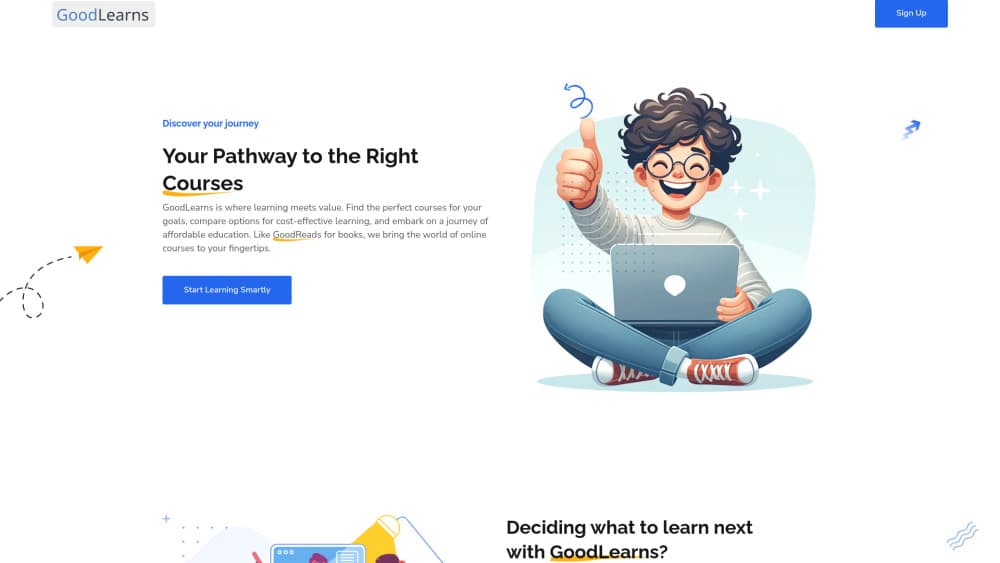
GoodLearns is a free platform for course discovery and AI course recommendations. It gathers Udemy, Coursera, and other listings so you can track online courses and share learning paths with friends.
About GoodLearns
What Is GoodLearns
GoodLearns is a web app that organizes online courses in one place. Its own description compares the product to Goodreads, with courses standing in for books: you browse a catalog, read what other learners say, and keep a list of what you want to study next. The catalog covers topics like SEO, marketing, interior design, programming, and AI tools.
Instead of hosting lessons, GoodLearns points you to courses sold by other providers. Udemy and Coursera are the two named on the homepage, and the site says it can centralize all your courses from them. That makes it a discovery layer for the online course platform market, not a classroom. You still watch the video, take the quizzes, and pay any course fee on the provider's site.
The main limit follows from that model. GoodLearns can't fix a bad course, and its listings depend on data supplied by partners. If a provider changes a price or retires a course, the page may lag behind.
Getting Started
- Create a free account with email or a social sign-in option on the signup page.
- Tell GoodLearns what you want to learn, either by picking subjects or by describing a goal.
- Review the recommended courses and save the ones that fit your budget and schedule.
- Add courses you already own from Udemy, Coursera, or another provider so they sit in one list.
- Follow friends or share your own learning path, then work through the list at your own pace.
Product Information
A quick look at GoodLearns's pricing, supported platforms, and performance.
Best for
The users, tasks, and scenarios where this tool fits best.
Users
- Self-directed learners who finish courses only when they have a plan
- Career switchers comparing options
- Friends who study together
Tasks
- Choosing a first course in a new field
- Keeping one to-do list of courses bought across Udemy and Coursera
- Building a study roadmap for a quarter
Scenarios
- A team lead who wants a shared list of upskilling courses
- A student between semesters
- Someone who keeps buying discounted courses and never starts them
Key features
AI Course Recommendations
GoodLearns asks about your interests or a subject you want to learn and returns a short list of matching courses. The pitch is precision: suggestions based on what you say, not on whatever a marketplace wants to promote. You can accept a recommendation or use it as a starting point for your own search.
One Library Across Providers
The homepage names Udemy and Coursera as sources and says you can track all your courses in one place. In practice that means one list for classes you bought on different sites, so you don't need to remember which dashboard holds which course. The site lists roughly 3,900 course pages in its public sitemap, spread across marketing, design, development, and AI topics.
Curated Learning Paths
GoodLearns lets you arrange courses into a path instead of a loose pile. A path gives order to the work: start here, then move to the next course when you finish. The feature is most useful when a topic has too many entry points and you want a sequence you can explain to someone else.
Progress Tracking and Shared Lists
Saved courses carry a status, so you can see what's queued, in progress, or done. You can also share progress with friends and compare paths. This works like a lightweight study journal. It won't replace a calendar, and it won't send reminders, but it shows momentum in one view.
Community and Peer Recommendations
The site has a social feed built around what friends are learning. You can follow other learners, see their courses, and pick up recommendations from people who share your goals. Community features depend on your network. With no friends on the platform, this part stays quiet.
Instructor Course Listings
A separate instructor page lets course creators submit their own material for inclusion. That gives independent teachers a way into the catalog beyond the big marketplaces. For learners, it means the mix includes smaller courses you won't see on a Udemy bestseller list.
Pros and cons
Pros
- Free to join, with no subscription mentioned on the site.
- Pulls Udemy, Coursera, and other listings into a single course discovery list.
- AI course recommendations cut the blank-page problem when you don't know what to study.
- Shared learning paths make it easy to coordinate with a friend or a small team.
Cons
- Lessons and payments happen on the provider's site, so refunds, certificates, and playback issues sit outside GoodLearns' control.
- The catalog leans toward marketing, design, and web skills. Learners looking for lab-based science or accredited degrees will find thin coverage.
- The social layer is only as useful as your network. Most people will start with an empty feed.
- No native mobile app is listed, so you'll use the browser on a phone.
Frequently asked questions
Yes. Signing up is free, and the site lists no paid tier or subscription. You still pay the course provider if a course isn't free on Udemy, Coursera, or another platform.
Related content
Explore related tools, skills, and articles for GoodLearns.
GoodLearns Alternatives
HireKey
HireKey · Voice & Language · Productivity · LeaningHireKey is an AI job search copilot built by a former tech recruiter. It checks role fit, tailors resumes, runs interview practice and tracks every application.

Lune
Retrograde Labs · Productivity · LeaningLune is a research search engine for scientific AI agents. It runs as an MCP server that lets Claude, ChatGPT and Cursor search peer-reviewed computer science papers and cite them.
Coddy
Coddy · Coding · LeaningCoddy is a gamified platform to learn to code through short interactive lessons in 20+ languages, with a browser editor, an AI tutor and free certificates.