

GPTFunnels
GTMFunnels Inc · Coding
GPTFunnels is an AI powered funnel builder that turns your content or a short prompt into landing pages, chatbots and lead capture workflows you can launch in minutes.
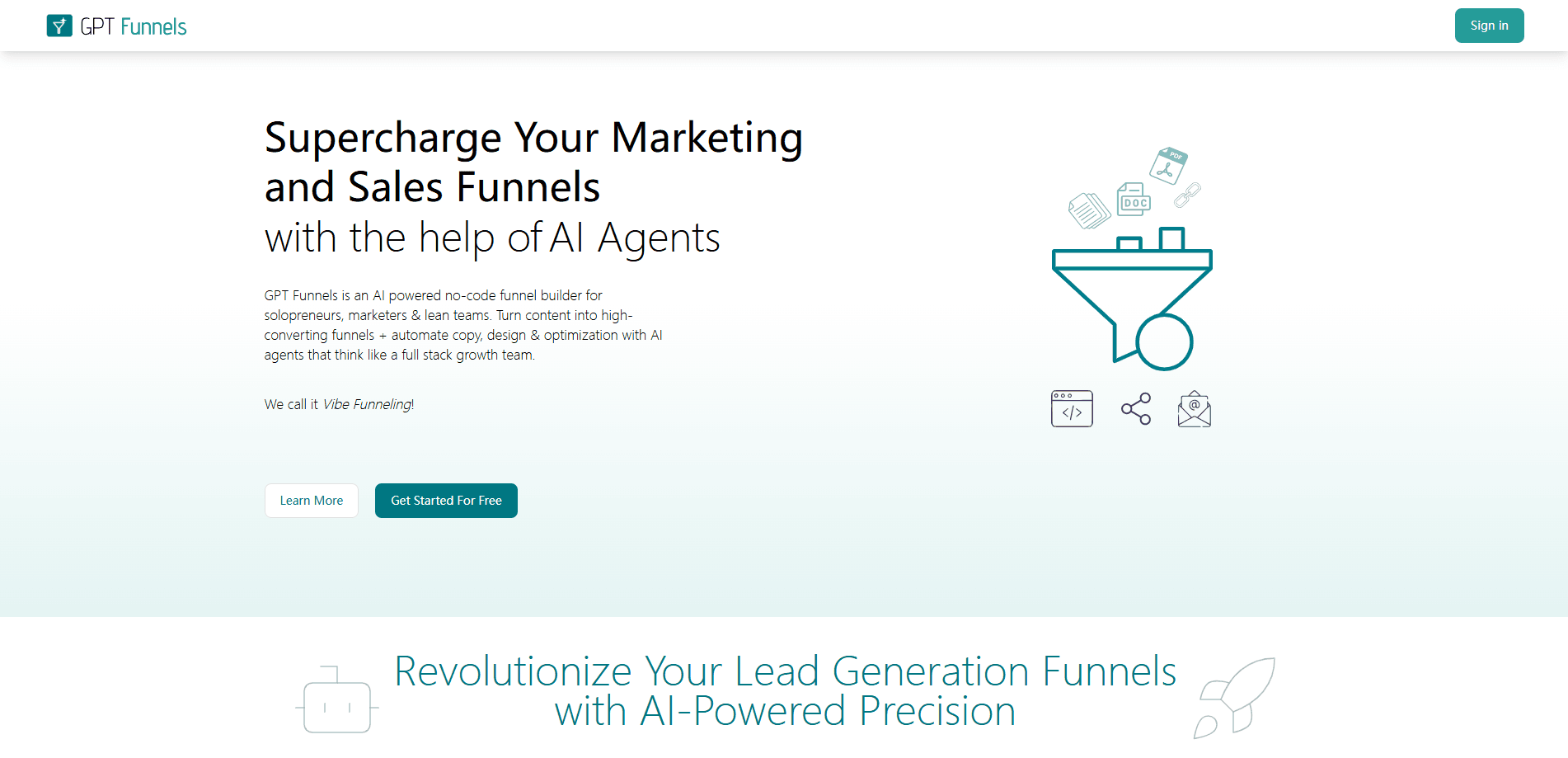
About GPTFunnels
What Is GPTFunnels
GPTFunnels is a no-code platform for building marketing funnels with AI agents. You hand it existing material such as documents, a website URL or a written goal, and its agents assemble a landing page, a chatbot, a quiz or a sales page for you. The company markets it to solopreneurs, marketers and lean teams who need funnels but don't have designers or developers on hand.
The pitch rests on speed. Most funnel builders still make you drag blocks around, write copy and wire up integrations by hand. GPTFunnels instead generates a funnel from a prompt or an existing blueprint, then lets its agents monitor the result, run experiments and suggest changes. Funnels are published as standalone microsites, embedded in your own site, or shared through a custom domain.
The catch is the moving parts. AI generation depends on the sources and brand details you feed it, so a vague prompt yields a vague funnel. Several blueprints and features sit behind a paid plan, and anything that touches payments or CRM sync needs you to connect those accounts first.
Getting Started
- Create a free account on the GPTFunnels site with an email and password.
- Describe your offer or share existing content, and pick a funnel blueprint such as lead gen, quiz or sales page.
- Let the AI agents generate the pages, copy and forms, then adjust anything in the editor.
- Publish the funnel as a standalone page, an embed or on a custom domain.
- Connect tools like Stripe, Google Calendar or Slack so agents can take payments and book meetings.
Product Information
A quick look at GPTFunnels's pricing, supported platforms, and performance.
Best for
The users, tasks, and scenarios where this tool fits best.
Users
- Solopreneurs and one-person marketing teams
- Marketers at lean startups
- Sales teams handling inbound leads
Tasks
- Turning a document or website into a landing page
- Building a chat funnel
- Taking payments in a funnel
Scenarios
- Launching a campaign on a tight deadline
- Running recurring market research
- Keeping several campaign assets consistent
Key features
Funnel generation from a prompt or your content
You describe the offer or point the tool at existing material, and the agents produce a complete funnel with copy, layout and forms. The company frames the process as going from idea to live funnel in minutes, which is the core reason teams pick it over drag-and-drop builders.
AI agents that run on your knowledge base
Each agent answers from a knowledge base you build by uploading documents or connecting sources such as Notion and Google Docs. You can give agents their own persona, tools and model, then let them power chat widgets and funnel steps. This is what separates a GPTFunnels funnel from a static page.
AI chatbot and support agents
A chat widget drops onto any site through a JavaScript snippet. Agents qualify leads, answer support questions, log cases to a CRM and hand off to a human in Slack when they hit their limits. The company lists both a sales agent and a support agent as ready-made templates.
Sales funnels with built-in Stripe checkout
You connect a Stripe account through OAuth and add an order form to sell directly inside a funnel, with no third-party checkout tool in between. Product search and payment both run through your own Stripe catalog, so buyers stay on the page.
Workflow funnels for scheduled research
Workflow funnels chain agent tasks that run daily, weekly or on a custom cadence. They suit competitor tracking, prospect research and reporting, with results pushed to Slack or saved to your dashboard. You set what the agent looks for and how it structures findings.
Integrations across your marketing stack
The platform connects to Salesforce, HubSpot, Slack, Google Calendar, Gmail, LinkedIn, Instagram, WordPress and Shopify, plus REST and OAuth APIs. Agents use these connections to book meetings, send emails, sync contacts and publish posts. There's also a developer API key for programmatic access on paid plans.
Pros and cons
Pros
- Turns a prompt or existing content into a working funnel quickly, which cuts the time a small team spends on page setup.
- Agents work from your own knowledge base, so chat answers reflect your product instead of generic replies.
- Stripe checkout is built in, letting a funnel sell products without a separate payment tool.
- A free plan and a $29 per user monthly Pro tier keep the entry cost low for testing.
Cons
- Output quality leans on the sources and brand details you provide, so thin inputs lead to thin funnels.
- Several blueprints, custom agents and the developer API sit behind a paid plan, which limits what the free tier can do.
- Payment, CRM and calendar features need you to connect those third-party accounts before they work.
- The brand shows up under both GPTFunnels and GTMFunnels, which can confuse people looking for the right site.
Frequently asked questions
GPTFunnels is used to build marketing funnels with AI. You describe your offer or share existing content, and its agents generate landing pages, chatbots, quizzes and sales pages, then help you publish and test them. It targets marketers and small teams rather than developers.
Related content
Explore related tools, skills, and articles for GPTFunnels.
GPTFunnels Alternatives

Udon
Udon · Coding · ProductivityUdon turns an Apple Silicon Mac into a home server you run from a browser, with container controls, file shares, and an optional AI sysadmin.

offstage
offstage cloud · Coding · Productivityoffstage gives AI coding agents and CI jobs a real Mac: a fresh macOS account on Apple silicon, driven over an API and billed by the second.

BotBus
Chengdu Tuyang Tusen Technology Co., Ltd. · Coding · ProductivityBotBus lets you control AI coding agents from your phone and watch: approve commands, start tasks and read results while the code stays on your desktop.