

Harvey
Harvey · Productivity · AI Assistant
Harvey is an AI platform for legal and professional services that helps law firms and in-house teams research, draft, and review work with cited, review-ready answers.
About Harvey
What Is Harvey
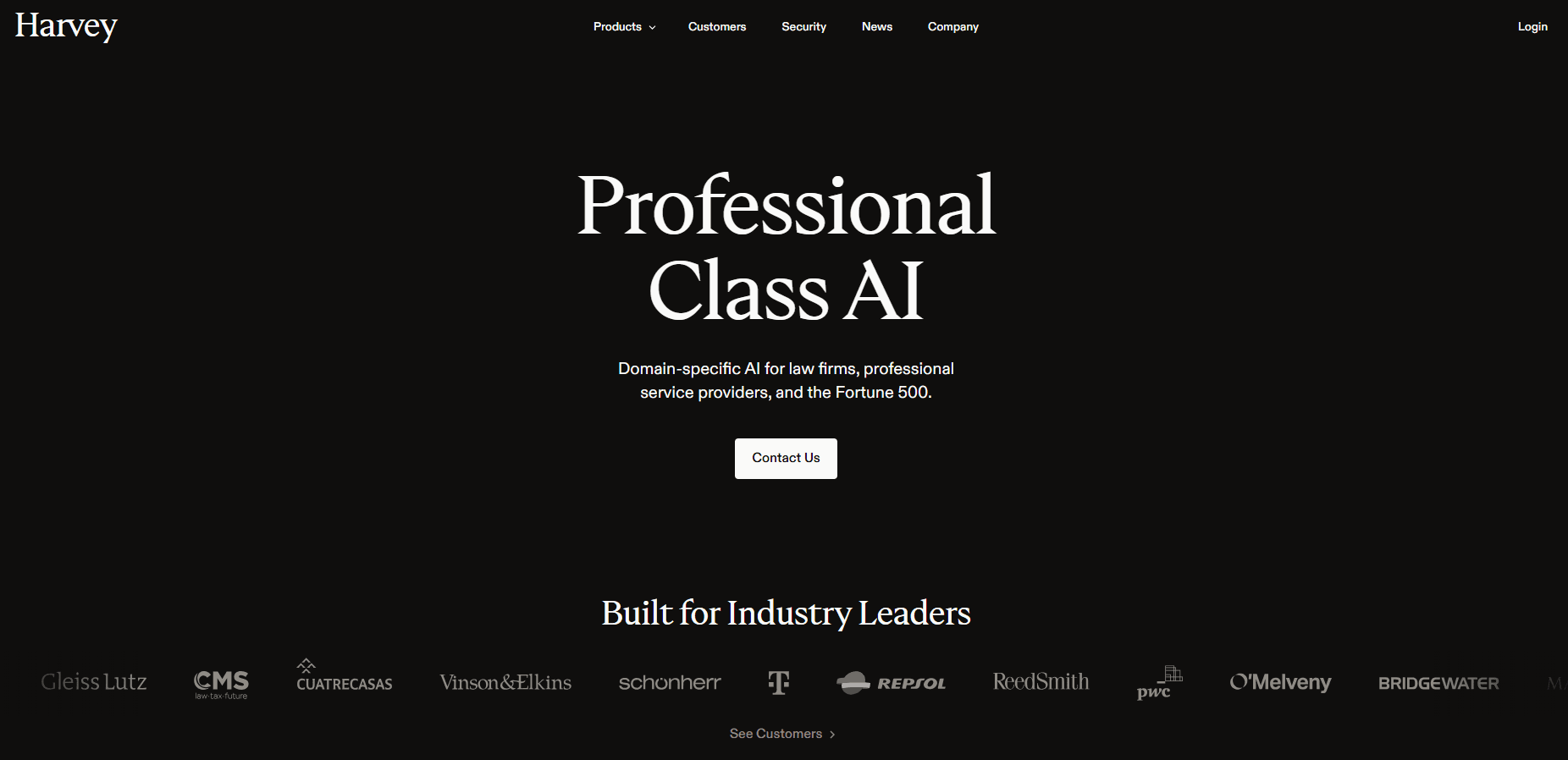
Harvey is an AI platform built for legal and professional services work. This legal AI software helps law firms and corporate legal departments research questions, draft documents, review contracts, and analyze large sets of files. It connects the reasoning of a large language model to legal data sources and your own documents, then returns cited results a lawyer can check.
The company built Harvey around the way legal work actually happens, not as a generic chatbot with a legal label. Teams run tasks in agents, store and search documents in Vault, and pull context from tools they already use. The vendor reports that more than 200,000 lawyers use Harvey across 3,000 law firms and legal departments, including 80 of the AmLaw 100.
The catch is access. Harvey sells to organizations, not individuals, so there's no free tier and no posted price. Onboarding runs through a sales process, and the value scales with the volume of documents and matters a team handles. A single user or a small firm without heavy document work won't get much from it.
Getting Started
- Request a demo through the Harvey website and describe your practice area and current workflow.
- Work with Harvey to connect your document systems, like iManage, NetDocuments, or SharePoint.
- Set up Spaces for a team or a matter and load the documents you want the platform to draw on.
- Run a task, such as a contract review or a research memo, and check the citations before you rely on the output.
Product Information
A quick look at Harvey's pricing, supported platforms, and performance.
Best for
The users, tasks, and scenarios where this tool fits best.
Users
- Associates and junior lawyers
- In-house legal teams
- Litigation and transactional teams
- Knowledge and research teams
Tasks
- Contract review
- Legal research
- Document drafting
- Document analysis at scale
- Workflow automation
Scenarios
- A firm with a steady contract backlog
- An in-house team facing a regulatory change
- A deal team working from a large data room
Key features
Agents
You describe the task, and Harvey plans the work, runs it, and returns a review-ready result with citations attached. Agents suit multi-step jobs like building a research memo or comparing several drafts. The point is that the output arrives with its sources, so a lawyer can trace each claim rather than taking it on trust.
Vault
Vault is where legal documents live. Teams store, organize, and bulk analyze large sets of files, then run questions against the whole set. For work like due diligence or discovery, that turns a room of documents into something you can query instead of read line by line.
Workflows
Harvey ships pre-built workflows and lets firms build their own. A workflow applies the same steps to a task every time, which is what makes a repeatable process reliable across matters. It fits firms that want a defined procedure rather than a fresh prompt each run.
Knowledge
Knowledge handles research across legal, regulatory, and tax questions. It pulls from trusted sources and returns answers with citations, drawing on more than 500 regional knowledge sources and partners like LexisNexis. For a research-heavy matter, that shortens the lookup work without removing the lawyer's judgment.
Spaces
Spaces are shared work areas. A team, a client, or a matter gets its own environment where the relevant documents and instructions sit together, so work stays scoped and organized. That structure matters when outside counsel and in-house teams both need access without mixing files.
Works Where You Work
Harvey runs in Word, Outlook, iManage, NetDocuments, SharePoint, and web browsers, plus a mobile app. It also pulls context from tools like Google Drive, Ironclad, and Aderant. Legal work happens inside these systems, so fitting into them beats asking a team to change tools.
Pros and cons
Pros
- Answers arrive with citations, which lets a lawyer verify a claim before relying on it.
- Search and analysis span your own documents plus trusted external sources in one place.
- It fits into Word, Outlook, and document management systems rather than replacing them.
- Agents and workflows handle multi-step, repeatable tasks, so routine work takes less manual effort.
- A Spaces structure keeps a team's or a matter's documents scoped and organized.
Cons
- There is no free plan and no public pricing, so you can only get a quote through sales.
- Built for organizations, so it isn't practical for an individual lawyer without firm support.
- AI output still needs a lawyer's review, which means the platform supports the work rather than removing it.
- The value depends on connecting your document systems, which takes setup effort up front.
- Feature depth across agents, Vault, and workflows can be more than a small team needs at the start.
Frequently asked questions
Harvey is an AI platform for legal work. It helps lawyers and legal teams research questions, draft documents, review contracts, and analyze large sets of files, returning answers with citations they can check.
Related content
Explore related tools, skills, and articles for Harvey.
Harvey Alternatives

Base Code
Base44 (Wix) · Coding · ProductivityBase Code is a shared cloud development environment from Base44. Teammates describe changes to an existing GitHub codebase in chat, preview them live and send them back as pull requests.

Knocket
Knocket (Tencent RTC team) · Productivity · Business · ChatbotKnocket is a free live chat and contact page tool that lets visitors message you from your website, app, or a shareable link, with every reply handled from Telegram or one inbox.

FloorGen
Vinit Kumar (FloorGen) · Productivity · China AIFloorGen is a browser-based floor plan maker that turns a sentence or a sketch into an editable 2D plan and a 3D walkthrough. Export to PDF, DXF or video, and draw without an account.