
Pearl
Pearl · Image · AI Assistant
Pearl is dental AI software for dental image analysis: it reads 2D and 3D X-rays, flags caries and bone loss, and adds tools for scheduling and insurance.
About Pearl
What Is Pearl
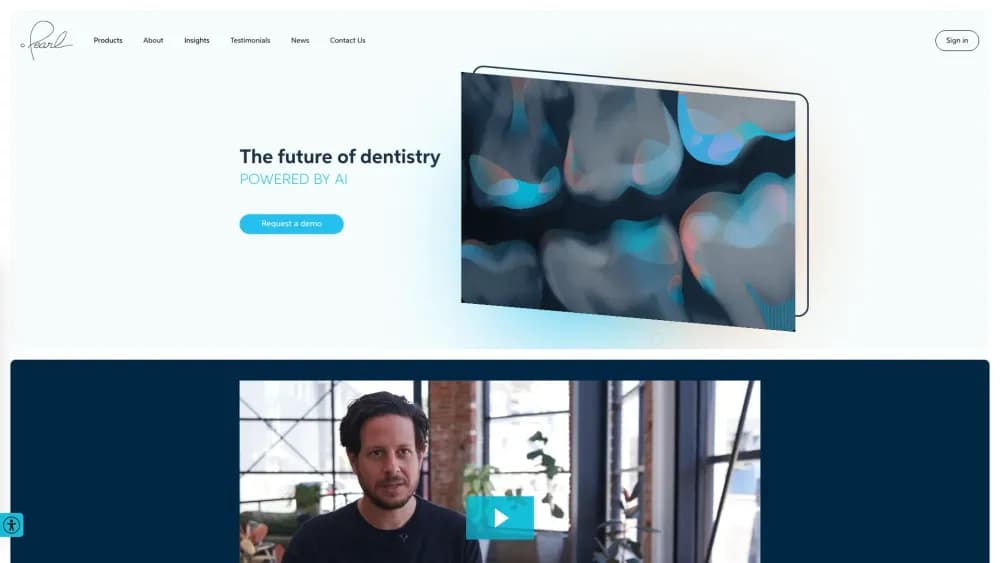
Pearl is a dental AI platform sold to practices, dental groups, and DSOs. Its core job is reading radiographs: every bitewing, periapical, and panoramic image that comes out of the imaging system gets scanned within seconds, and suspicious areas are outlined in color on top of the original picture. A dentist still decides what the finding means, but the software makes sure nothing obvious gets overlooked on a rushed Tuesday afternoon.
The company started in 2019 in Los Angeles and now lists 26 FDA clearances, 40+ integrations with imaging and practice management systems, and customers in more than 120 countries. Second Opinion is the flagship for 2D X-rays. Second Opinion 3D handles CBCT scans and is the part that made Pearl the first dental AI vendor cleared for both 2D and 3D work. Practice Intelligence wraps those clinical tools with front desk software: smart call lists, insurance verification, and reporting for owners who run several locations.
The catch is access and price. Pearl doesn't publish prices. You book a demo, sales scopes your imaging setup and practice size, and the quote comes back privately. Small single operatory offices may find the cost hard to justify against the time it saves, and pathology detection inside CBCT scans is limited to Canada while clearances elsewhere are pending.
Getting Started
- Book a demo through the Pearl site and send over your imaging system and practice management software so the team can confirm compatibility.
- Sign the quote and let Pearl's integration team connect the account to your X-ray capture flow, a setup the company says usually takes hours rather than weeks.
- Set which findings you want highlighted and how they display, then run a handful of past cases to see how the overlays look on your own images.
- Train the team on the patient-facing reports and tooth-part mapping so hygienists and front desk staff use the same visuals in conversations.
- Turn on the practice management modules you bought, such as smart scheduling or insurance precheck, and check the reporting dashboard weekly.
Product Information
A quick look at Pearl's pricing, supported platforms, and performance.
Best for
The users, tasks, and scenarios where this tool fits best.
Users
- Private practice dentists
- Dental group owners
- Hygienists and front desk staff
- Dental educators
- Implant and oral surgery teams
Tasks
- Reading 2D radiographs
- Reviewing CBCT scans
- Explaining treatment to patients
- Verifying insurance before visits
- Filling gaps in the schedule
Scenarios
- A single-location practice with a full hygiene schedule
- A DSO standardizing care across locations
- Implant and oral surgery consults
- Pediatric visits
Key features
Dental X-Ray Analysis with Second Opinion
Second Opinion is the real-time pathology detection engine inside this X-ray reading software. It reads bitewing, periapical, and panoramic images the moment they're captured and marks up to 18 findings, from incipient caries and millimeter bone loss to calculus and impacted teeth. Pearl reports over 95% accuracy on its own models and cites a published study where operator diagnostic accuracy rose from 82% to 98% with the software in use. Findings land inside the imaging system you already work in, so nobody has to open a second program mid-exam.
Second Opinion 3D for CBCT
CBCT scans hold a lot of information that most dentists only partly review, simply because stepping through hundreds of slices takes time. Second Opinion 3D segments key anatomy automatically, including the inferior alveolar canal, maxillary sinus, nasal space, airway, mandible, and individual teeth, then color-codes it. Radiograph reading in 3D goes further: pathology detection for the TMJ, carotid artery calcifications, and sinus radiopacities is cleared in Canada only for now, and the scan can be exported in 2D formats for radiologist referrals.
Patient-Facing Visuals and Health Reports
The overlays are built to be shown, not just read. Each finding comes with a colored outline, a percentage of the tooth affected, and a view that separates enamel, dentin, and pulp involvement. Comparison mode puts an earlier scan next to a current one so a patient can see disease progressing. Exportable health reports carry the annotated images home, which matters when someone leaves the chair and needs to explain the treatment plan to a spouse.
Practice Intelligence Front Desk Tools
Practice Intelligence is the operational half of the platform. It builds smart call lists, sorts patients by urgency or treatment type, runs automated chart audits, and gives each clinician a daily huddle view of scheduled and unscheduled needs. The company says practices save more than 20 hours a week on insurance work, largely because Precheck verifies benefits directly instead of through portals and phone calls.
Imagecheck Quality Control
Bad X-rays cause bad AI output, so Pearl added a check before analysis. Imagecheck flags underexposure, cone cuts, and positioning errors at capture time, which gives the operator a chance to retake the image while the patient is still seated. That saves a second appointment for a scan that was never going to pass a claim review.
Integrations with Imaging and Practice Software
Pearl runs inside the tools practices already use rather than as a separate destination. The company lists more than 40 imaging and practice management partners, including DEXIS, Carestream, Romexis, Sidexis, Apteryx XVWeb, SOTA Cloud, Open Dental, Eaglesoft, Curve, and Dentally. There's also a standalone web app at secondopinion.hellopearl.com for practices whose system isn't on the list.
Progress Tracking That Matches ADA Categories
Caries overlays measure how deep decay has traveled through enamel and dentin toward the pulp, and the results line up with standard ADA caries categories. The output states how far along the lesion is, which changes whether the plan is watchful waiting, a filling, or a crown.
Pros and cons
Pros
- Reads 2D X-rays and 3D CBCT scans in one platform, backed by 26 FDA clearances and clearances for bitewing, periapical, panoramic, and CBCT imaging.
- Runs inside the imaging system, so there's no separate viewer to open and no change to how the team captures images.
- The colored overlays and tooth-part maps make conversations with patients concrete, and Pearl reports an average 30% lift in case acceptance.
- Practice Intelligence covers scheduling, recall, and insurance checks, so the AI work connects to revenue instead of sitting in a clinical silo.
- Setup is handled by Pearl's integration team and generally finishes within hours rather than weeks.
Cons
- No public pricing. You can't compare cost against competitors without sitting through a sales demo, and small practices report that the subscription is a real budget line.
- CBCT pathology detection is currently cleared in Canada only, so dentists in the US and most other markets get segmentation without pathology alerts.
- The workflow assumes a compatible imaging system. Practices on older or unusual software may end up using the standalone web app and losing the automatic in-workflow reading.
- AI still needs a clinician to interpret it. Over-relying on highlights can push unnecessary treatment, and Pearl's own guidance puts the dentist in charge of the final call.
Frequently asked questions
Pearl analyzes dental X-rays and CBCT scans and highlights suspicious areas such as decay, bone loss, calculus, and periapical radiolucencies. It also sells front desk software for scheduling, recall, and insurance verification, plus reporting for multi-location groups.
Related content
Explore related tools, skills, and articles for Pearl.
Pearl Alternatives

Google EmbeddingGemma 2
Google DeepMind · Writing · Image · CodingGoogle EmbeddingGemma 2 is a 740M-parameter open model that turns text, code, images, audio, and video frames into vectors in one 768-dimension space, running on phones and laptops.

Tractionwave
TractionWave · Image · MarketingTractionWave is an AI attention heatmap tool for static ads. Upload a PNG or JPG and it returns predicted attention, ranked hotspots, and fixes before you spend budget.

Imejis.io
Imejis.io · Image · MarketingImejis.io is an AI design studio for agents and marketing teams. Describe an image in plain words, and it writes the copy, builds the layout, reflows it to every size, then exports a finished file.