

Is Your Site Agent-Ready? by Cloudflare
Cloudflare · Image · Marketing
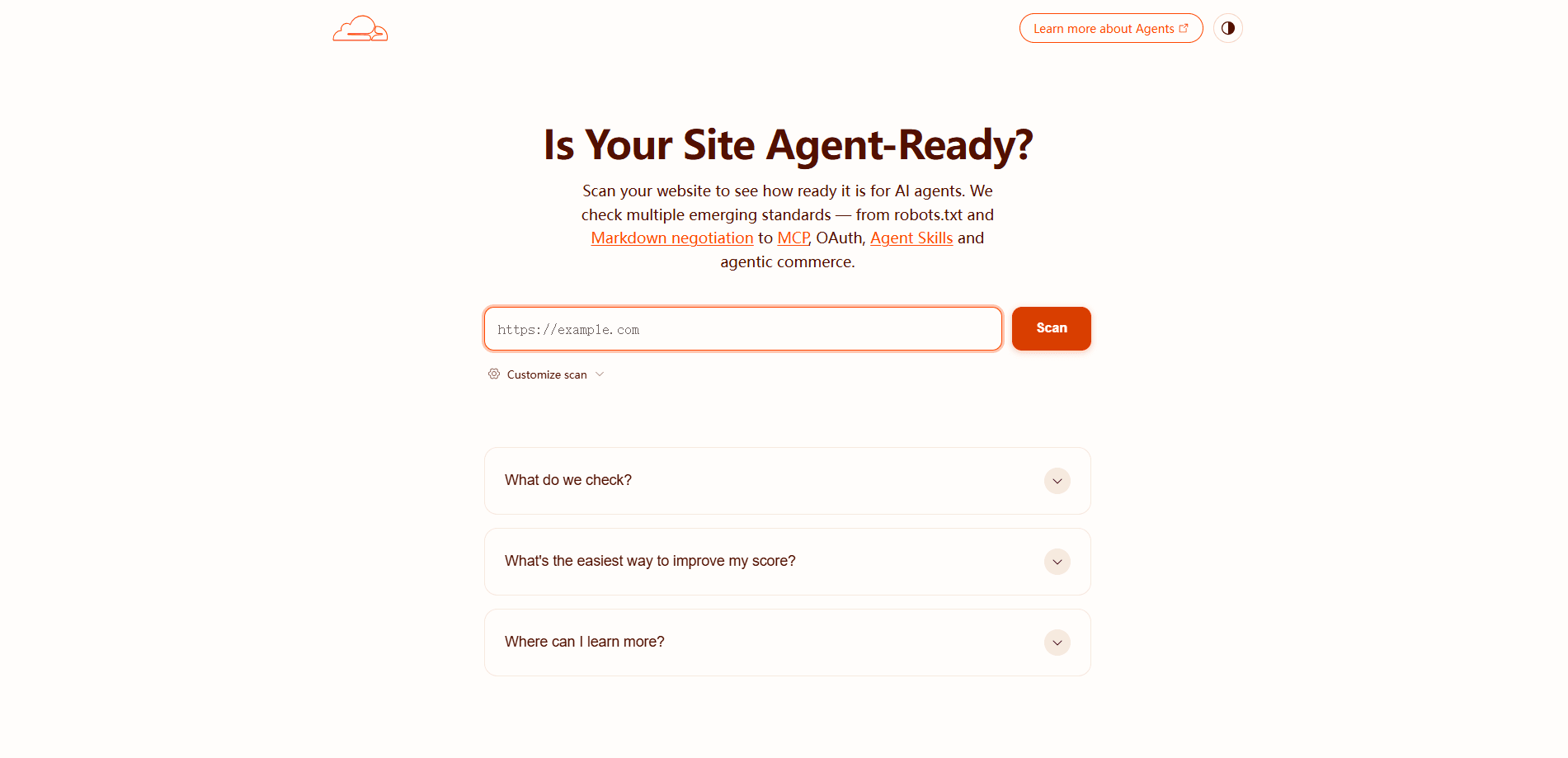
Is Your Site Agent-Ready? by Cloudflare is a free web scanner that scores how well a website works with AI agents. You enter a URL, and it runs checks across five categories: discoverability, content accessibility, bot access control, protocol discovery, and commerce. It's built for site owners, developers, and product teams who want to know whether machines can find, read, and transact with their pages before agents become a normal source of traffic.
About Is Your Site Agent-Ready? by Cloudflare
What Is Is Your Site Agent-Ready?
Is Your Site Agent-Ready? is a free diagnostic tool from Cloudflare that answers one question: can AI agents actually use your website? It crawls a single URL and reports which of the emerging agent standards your site already supports and which ones it misses, covering everything from robots.txt and sitemaps to newer specs like Markdown negotiation, MCP server cards, and agentic commerce protocols.
The tool exists because the web is shifting. Search crawlers used to be the main non-human visitors. Now AI agents browse pages, pull structured content, call APIs, and sometimes buy things. Most sites weren't built with that in mind, and the gaps only show up when you test for them directly. A missing robots.txt rule or an unlisted MCP card won't break a page for humans, but it can quietly cut a site off from agent traffic. That's the core of website agent compatibility, and it's easy to overlook.
The biggest limitation is scope. It checks one URL at a time, so a large site needs many scans. The recommendations it hands back are AI-generated, and Cloudflare says so on the page: they should be reviewed with professional judgment before anyone acts on them. Treat the score as a starting point, not a finished audit. AI agent readiness is a moving target, so a single scan won't stay accurate forever.
Getting Started
- Open isitagentready.com in a browser.
- Paste the full URL of the page you want to test, such as your homepage.
- Optionally pick a site type (Content Site or API / Application) to narrow which checks run.
- Start the scan and wait for the results page to load.
- Read the category breakdown, then copy the improvement instructions into your coding agent if you want help fixing the gaps.
Product Information
A quick look at Is Your Site Agent-Ready? by Cloudflare's pricing, supported platforms, and performance.
Best for
The users, tasks, and scenarios where this tool fits best.
Users
- Site owners who want a quick read on whether agents can access their pages, with no setup beyond a URL.
- SEO and growth teams adding agent-readiness to their technical audits, since the checks overlap with crawl and indexing basics.
- Developers building API or MCP-backed products who need to confirm their discovery files are published, as long as they can act on the fixes.
Tasks
- Auditing a homepage for robots.txt and sitemap gaps that block AI crawlers.
- Checking whether a site serves Markdown via content negotiation so agents skip the HTML parse.
- Finding missing MCP server cards, OAuth discovery, or Agent Skills files before launch.
- Spotting gaps in agentic commerce protocols like x402 and UCP for stores that want machine-driven purchases.
Scenarios
- Right after a site relaunch, to confirm nothing that agents rely on got dropped in the rebuild.
- Before pitching agent or API integrations, to show clients exactly what's missing.
- During technical SEO reviews, where crawlability and agent access now overlap.
- When a competitor starts showing up in AI-generated answers and you want to know why.
Key features
Five-Category Scoring
The scan splits results into Discoverability, Content Accessibility, Bot Access Control, Protocol Discovery, and Commerce. Each category groups related checks, so you can see whether a problem sits in your crawl setup or in the newer protocol layer. That split matters. The fixes live in very different places.
Discoverability Checks
This category looks at the files and signals agents use to find content: robots.txt, sitemap presence, Link response headers, and DNS for AI Discovery (DNS-AID), all of which sit at the very entry point of how machines locate pages. These are the same basics search engines care about, extended for agents that don't behave exactly like crawlers.
Content Accessibility via Markdown Negotiation
The tool tests whether your site returns Markdown when an agent requests it, using Cloudflare's Markdown for Agents standard. When it works, an agent gets clean text instead of raw HTML it has to strip. Cloudflare's own example cut a blog post from roughly 16,180 tokens to 3,150, an 80% drop.
Bot Access Control
Here it checks AI bot rules in robots.txt, Content Signals, and Web Bot Auth. This is where you tell the world which bots may read your content and on what terms. Getting it wrong usually means being ignored or blocked by default, not being penalized.
Protocol Discovery
This is the widest category, covering MCP Server Cards, Agent Skills, WebMCP, API Catalogs, OAuth discovery, OAuth Protected Resource, Auth.md, A2A Agent Cards, and ARD manifests, which together tell automated tools what you offer. If you run APIs or agent tools, these files are how agents learn what you offer and how to authenticate.
Commerce Readiness
For stores, the scanner looks for x402, MPP, UCP, and ACP, four emerging protocols for agent-driven payments and checkout. None are mainstream yet. Checking early tells you where the market is heading and whether your stack can follow. Low stakes now, maybe high stakes later.
Copyable Fix Instructions
Once the scan finishes, the tool generates improvement steps you can paste straight into a coding agent like Cursor, Claude Code, or Copilot, which is handy because fixing crawl files and protocol manifests by hand is slow. It turns the report from a list of problems into something you can hand to a developer or an AI assistant. Handy. Fixing crawl files by hand is tedious.
Pros and cons
Pros
- Free, no account needed, and a scan takes seconds.
- Groups 20-plus checks into five clear categories, so gaps are easy to triage.
- Covers newer standards like MCP, Agent Skills, and x402 that most SEO tools skip.
- The generated fix instructions are copy-paste ready for coding agents.
Cons
- Scans one URL at a time, so auditing a whole site means running it repeatedly.
- The recommendations are AI-generated, and Cloudflare explicitly warns they may be wrong.
- No public API, so you can't wire the checks into your own monitoring.
- Many of the standards it tests are still emerging, which means low scores are common and not always a real problem.
Frequently asked questions
It runs 20-plus checks across five categories: discoverability, content accessibility, bot access control, protocol discovery, and commerce, spanning familiar items like robots.txt and sitemaps plus newer ones such as MCP server cards and Markdown negotiation.
Related content
Explore related tools, skills, and articles for Is Your Site Agent-Ready? by Cloudflare.
Is Your Site Agent-Ready? by Cloudflare Alternatives

Google EmbeddingGemma 2
Google DeepMind · Writing · Image · CodingGoogle EmbeddingGemma 2 is a 740M-parameter open model that turns text, code, images, audio, and video frames into vectors in one 768-dimension space, running on phones and laptops.

Tractionwave
TractionWave · Image · MarketingTractionWave is an AI attention heatmap tool for static ads. Upload a PNG or JPG and it returns predicted attention, ranked hotspots, and fixes before you spend budget.

Imejis.io
Imejis.io · Image · MarketingImejis.io is an AI design studio for agents and marketing teams. Describe an image in plain words, and it writes the copy, builds the layout, reflows it to every size, then exports a finished file.