

LabelMob
LabelMob · Business
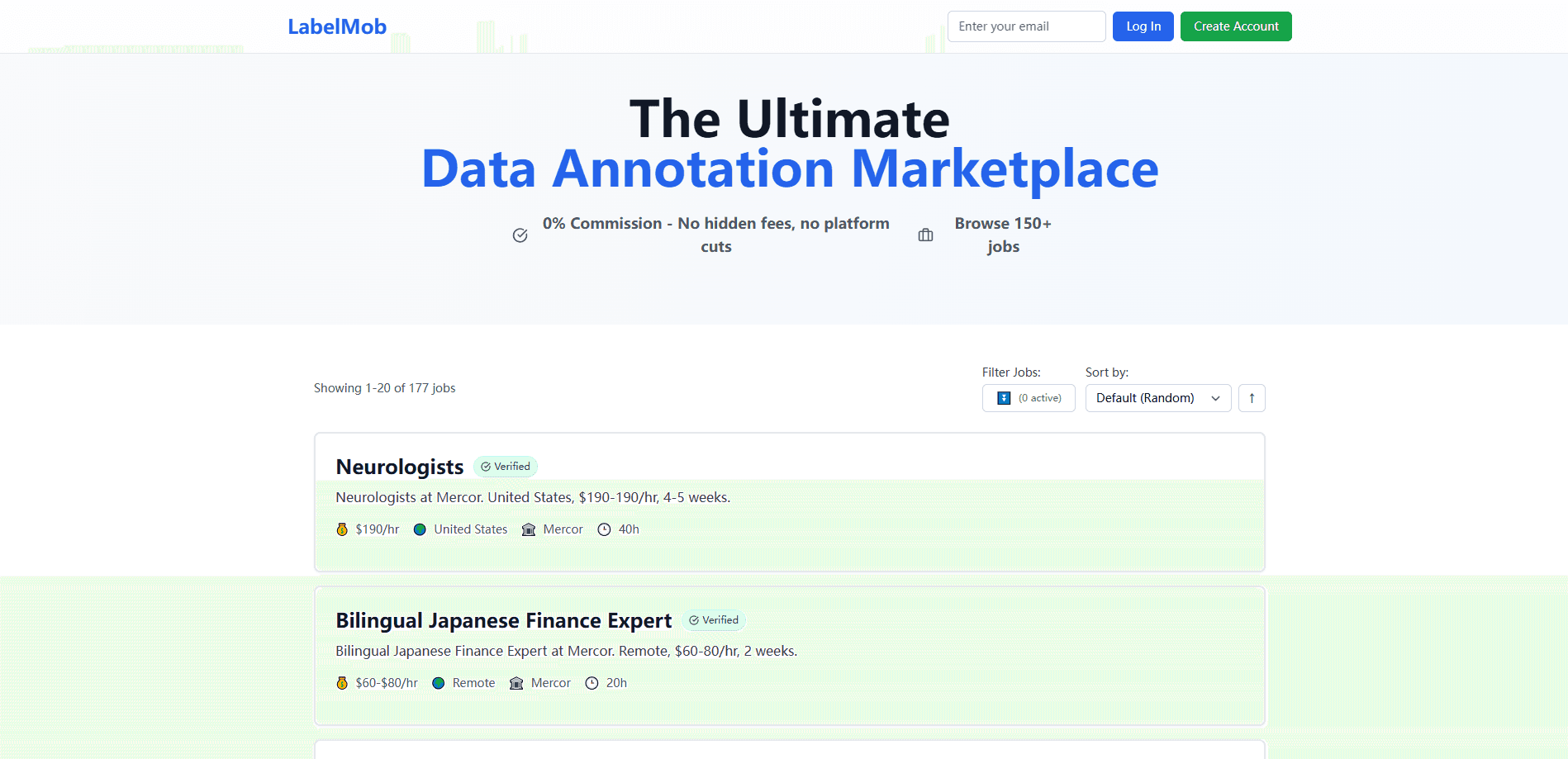
LabelMob is a commission-free marketplace platform that connects AI companies with verified expert annotators for data annotation services. Instead of building an in-house labeling team or signing a long contract with a managed vendor, you post your project and the platform matches it with vetted specialists who handle image annotation, text annotation and other labeling work. Simple as that. The commission-free structure means the platform doesn't take a cut between client and annotator, which keeps rates competitive and lets both sides deal directly. It's aimed at AI teams that need reliable training data without the usual middleman markup.
About LabelMob
What Is LabelMob
LabelMob is a data annotation marketplace. It sits between AI companies that need labeled training data and the verified experts who produce it. It's an alternative to classic annotation outsourcing, where you hand the job to an agency and wait. The core idea is simple: cut out the broker. On most outsourcing platforms, a layer of fees gets skimmed off every job, which inflates what clients pay and shrinks what annotators earn. LabelMob calls itself commission-free, so the price you agree on is closer to what the worker actually gets.
The platform targets the people who build and train AI models and keep hitting the same wall: good data is expensive to source, slow to collect, and hard to verify. That wall stops projects cold. LabelMob's answer is a pool of pre-vetted annotators you can tap for image, text, audio and video labeling tasks, rather than a fixed roster you have to hire and manage yourself.
The catch is that a marketplace model depends on the talent pool. Quality varies by domain, and niche tasks (medical imaging, low-resource languages, rare dialects) may have thin coverage. A two-sided marketplace lives or dies on supply. If your project is highly specialized or enormous, you should confirm capacity before committing to a deadline.
Getting Started
- Sign up on the LabelMob website as a client and describe your annotation project, including the data type and volume.
- Post the task with your labeling guidelines, quality bar and deadline so annotators know what's expected.
- Review matching annotators and their verified profiles, then agree on scope and rate directly.
- Upload your dataset and let the annotator complete the labeling work.
- Check the delivered annotations against your own samples, request revisions if needed, and export the finished dataset for model training.
Product Information
A quick look at LabelMob's pricing, supported platforms, and performance.
Best for
The users, tasks, and scenarios where this tool fits best.
Users
- AI startups
- Data science teams
- Domain experts looking for work
Tasks
- Image annotation
- Text annotation
- Audio and video labeling
- Dataset verification
Scenarios
- Scaling a labeling push before a model deadline
- Testing a new data type
- Filling a niche skill gap
Key features
Commission-Free Marketplace Model
The defining feature is how LabelMob handles money. Most annotation platforms and agencies add a margin on top of the annotator's rate, and that fee is invisible to the client. Does the platform need a cut to survive? LabelMob says it charges no commission, so it isn't skimming a percentage off each job. For clients, that can mean lower effective rates for the same work. For annotators, it means a bigger share of what the client pays. Both sides win on paper. The tradeoff is that a no-commission platform has to make money another way, so check the current pricing page for any listing or subscription terms before you budget.
Verified Expert Annotators
LabelMob leans on a pool of annotators it describes as verified experts, rather than an open freelance free-for-all. Verification is meant to screen out workers who can't meet a quality bar, which matters because bad labels quietly poison a training set. Garbage in, garbage model. The value of this depends entirely on how deep the verification goes and how many experts sit in your specific domain. For common tasks like image boxes or text tagging, supply is usually healthy. For rare skills, ask about availability first.
Project Matching
You describe the job, and the platform matches it with annotators who fit the task. That's the standard marketplace mechanic, and it saves the sourcing legwork of posting somewhere and filtering a flood of generic applicants. Matching quality decides whether you get someone who understands your domain or someone who just clicked the right checkbox. It matters. The clearer your guidelines, the better the match tends to be. Vague briefs get vague work.
Multi-Format Annotation Support
The platform covers the data types most AI teams actually work with: image annotation for vision models, text annotation for language models, and audio and video labeling for speech and multimodal work. That spread covers the basics. Having one place to source all of them saves you from stitching together a different vendor for every modality. It won't cover every exotic format, but for the standard set it keeps things in one workflow. Fewer tabs, fewer invoices.
Direct Client-Annotator Dealings
Because there's no commission layer, clients and annotators negotiate and work more directly. That transparency helps both sides, but it also puts more of the quality-control burden on you. You're not paying a managed-service firm to shepherd the project and guarantee the output, so expect to write tight guidelines and review samples yourself. That work is real. Owning that process is a real cost, even when the rates look great.
Pros and cons
Pros
- The commission-free model can lower effective rates versus agencies that add a hidden margin.
- Verified annotator pool aims to screen for quality instead of accepting anyone who signs up.
- Support for image, text, audio and video annotation covers the common AI training data types in one platform.
- Marketplace matching saves the time you'd spend sourcing and filtering freelancers on your own.
- Direct dealings between client and annotator give both sides more control over the terms.
Cons
- Quality still depends on the individual annotator, and you carry more of the review burden without a managed-service layer.
- Niche domains and rare languages may have limited annotator supply, so capacity isn't guaranteed on specialized work.
- There's no public API, so automating dataset handoff and tracking isn't an option for teams that need it.
- A commission-free platform has to fund itself some other way, so the exact cost structure is worth confirming on the site.
Frequently asked questions
LabelMob is a data annotation marketplace that connects AI companies with verified expert annotators. Companies post labeling projects, and the platform matches them with specialists who produce the training data used to build and improve AI models.
Related content
Explore related tools, skills, and articles for LabelMob.
LabelMob Alternatives
Liveplan
Palo Alto Software · BusinessLivePlan is business plan software that helps founders and small business owners turn an idea into a funder-ready plan. It combines AI-assisted writing, market research with cited sources, and connected financial forecasting so your income statement, cash flow, and balance sheet move together when you change one number. Over 1.5 million businesses have used it to plan, forecast, and track performance against real accounting data. That's a lot of founders. It's also a signal the tooling survived contact with real lenders.

Swms
Swms AI · Writing · Productivity · BusinessSwms is an AI safety compliance tool that turns a plain description of a job into ready-to-use safety documents. Describe your project, trade, and known hazards, and it writes a safe work method statement, job hazard analysis, safe work procedure, RAMS, or safety data sheet in seconds. It also ships with Oscar, a chat assistant that answers workplace safety questions in any language. Teams in construction, mining, transport, and warehousing use it to cut the paperwork that usually eats into a workday.

Rows
Rows (Superhuman) · Productivity · BusinessRows is an AI spreadsheet and data analysis tool that imports live data from more than 50 sources, then lets you work with it using plain language instead of SQL queries or nested formulas. You can pull numbers out of PDFs, connect ad platforms, databases, and bank accounts, and ask the AI to build reports, merge datasets, or set up models that recalculate themselves. It runs in the browser, works like a spreadsheet, and now sits under the Superhuman umbrella.