

LearnSmarter.ai
LearnSmarter.ai · Leaning
LearnSmarter.ai was an AI learning platform that turned self-growth books, decision frameworks, and virtual mentors into book insights, short courses, and goal-setting tools.
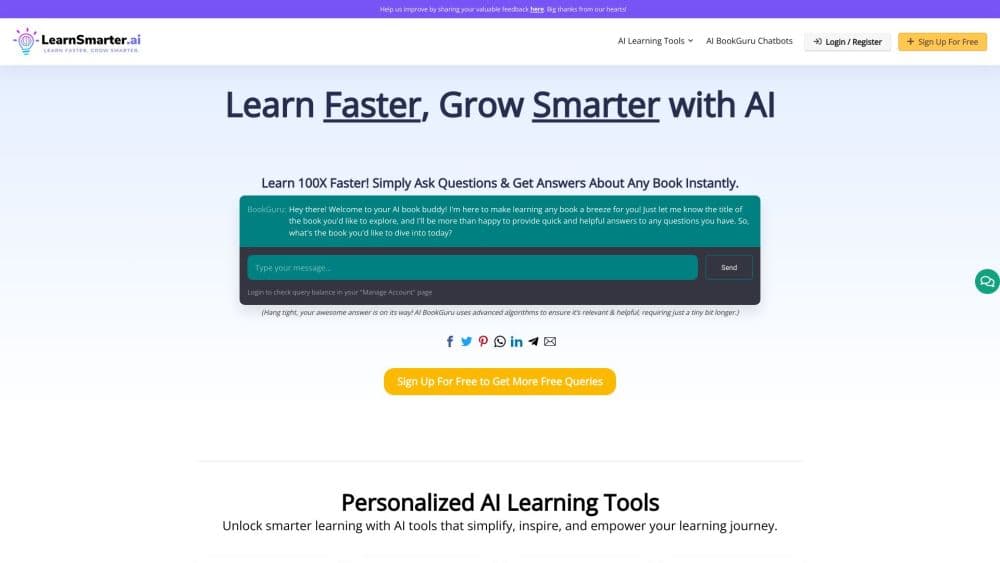
About LearnSmarter.ai
What Is LearnSmarter.ai
LearnSmarter.ai was a web app for people working on personal development rather than passing an exam. You picked a topic you wanted to improve, such as time management or decision making, and the platform served up condensed book insights, short courses, AI mentors to talk to, and small tools for setting goals or weighing a choice. The idea followed the "personal MBA" formula: read less, extract faster, apply sooner.
The audience was adults who read productivity and self-help titles but never finished them. Instead of a 300 page book, you got the core arguments in a session, then a set of prompts designed to turn them into a habit or a decision. That framing is why the tool sat closer to a coaching app than to a study app built around coursework.
The limits showed up early. Content leaned on popular English self-help titles, which left little for technical, academic, or professional certification study. Insight from a book isn't the same as practice on a skill, so the platform worked best as a starting point. And the service has since shut down: recorded shut down around April 2025, and by October 2026 the domain redirects to a GoDaddy for-sale page. Anyone who found a yearly plan bought in September 2024 lost access to the workspace and its saved material.
Getting Started
- Open learnsmarter.ai in a browser and create an account with an email address.
- Choose a goal or a topic, such as better focus, clearer decisions, or a new habit, and let the platform suggest books and courses for it.
- Read the condensed book insights or take a fast track course, then use the built-in frameworks when a real decision shows up.
- Chat with an AI character or ask the AI BookGuru to expand on a point, then save the summary to review later.
- Open the goal setting tool to turn what you learned into a dated action plan you could actually follow.
Product Information
A quick look at LearnSmarter.ai's pricing, supported platforms, and performance.
Best for
The users, tasks, and scenarios where this tool fits best.
Users
- Adults working on soft skills
- Career changers testing a direction
- Lifelong learners who stall on long books
- Coaches and mentors looking for prompts
Tasks
- Extracting the core argument from a self-development book
- Making a decision you keep postponing
- Breaking a goal into weekly actions
- Understanding a dense concept in plain words
- Testing a topic before committing to a course
Scenarios
- A quiet Sunday with a new habit in mind
- A crossroad after a job offer
- A team lead who wants to sharpen how the group thinks
- Filling a gap in a skill you use at work
Key features
AI BookGuru for Book Insights
The centerpiece was a chat assistant built around a library of popular self-development titles. You picked a book, read a condensed set of insights, and then asked follow-up questions about how a specific chapter applied to your own situation. It was built for the reader who wants the argument in twenty minutes rather than the full narrative arc, and the follow-up chat was what separated it from a static summary page.
Fast Track Courses
Courses were short and topic driven rather than semester length. Each one stacked several related books into a single learning path, so material on habit formation or negotiation arrived together with the frameworks that make it usable. You could finish one in an afternoon, which suited people who wanted a working grasp of a topic before the next project or job change.
Thinking Frameworks and Decision Tools
A set of named thinking models came built in: a pros and cons list maker, regret minimization, first principles thinking, the five whys, and Socratic questioning. Each one was a guided exercise, not a blank page, so you answered prompts in order and ended up with a written comparison. For a decision that keeps sliding down the list, that structure is the useful part.
AI Characters as Mentors
The platform offered AI characters modeled on well known figures and common coaching roles, including industry leaders, a life coach, and a therapist style persona. You could talk through a problem in that voice, which worked as a brainstorming partner when you had no one to think out loud with. Treat it as a prompt for your own thinking rather than expert advice, and it stays useful.
Goal Setting and Personalized Plans
The goal setting tool applied named methods, such as SMART goals, the 25 item priority cut, and a visualization exercise, to turn an intention into a dated plan. Beyond that, the platform assembled a personalized learning plan that mixed books and courses around your chosen goal. It gave a route through the library instead of a search box and a shrug.
Knowledge Gap Analysis
An assessment step looked at what you already knew about a topic and pointed at what to learn next. For someone who had read widely and felt stuck, a gap list is more actionable than another recommendation, because it says which piece is missing rather than what is generally popular.
Pros and cons
Pros
- Book insights come with a chat layer, so you can push past the summary into how a specific idea applies to your week.
- Named thinking frameworks are guided exercises with prompts, which is easier for a decision you keep avoiding than a blank note.
- Short courses bundle related books, giving one path through a topic instead of five tabs of recommendations.
- A free plan let you read the material before paying, with a three day trial of the paid tier on top.
- The goal setting tool produced something you could act on immediately, a plan with dates rather than a reading list.
- AI mentor characters gave a place to think out loud on a topic you had nobody to discuss with.
Cons
- The service closed. The domain now points to a GoDaddy for sale page, so there's no way to sign up, log in, or export saved notes.
- Content depended on popular English self-help books, so anyone after a technical skill, a certification, or an academic subject found little there.
- Book insight and a planning prompt aren't practice, so the product could start a change but not sustain it without you doing the work elsewhere.
- Support was thin. Forum style help pages were the main channel, and no email or chat response came quickly when an account issue came up.
Frequently asked questions
No. The domain was listed for sale by October 2026, and the site now redirects to a GoDaddy marketplace page. Third party directories recorded a shutdown around April 2025. Any saved notes, plans, or course progress lived inside the account and can't be retrieved from the platform.
Related content
Explore related tools, skills, and articles for LearnSmarter.ai.
LearnSmarter.ai Alternatives

HireKey
HireKey · Voice & Language · Productivity · LeaningHireKey is an AI job search copilot built by a former tech recruiter. It checks role fit, tailors resumes, runs interview practice and tracks every application.

Lune
Retrograde Labs · Productivity · LeaningLune is a research search engine for scientific AI agents. It runs as an MCP server that lets Claude, ChatGPT and Cursor search peer-reviewed computer science papers and cite them.
Coddy
Coddy · Coding · LeaningCoddy is a gamified platform to learn to code through short interactive lessons in 20+ languages, with a browser editor, an AI tutor and free certificates.