

TextMine: AI Powered Knowledge Base
TextMine Limited · Productivity · Marketing · Leaning
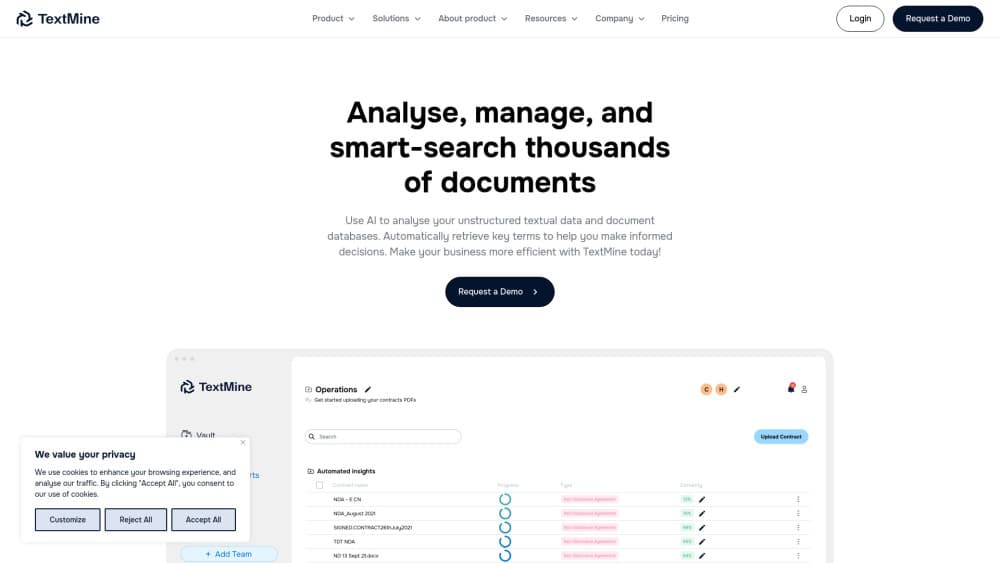
TextMine is an AI knowledge base that turns contracts, filings and policies into searchable, evidence-backed records your team and its agents can query.
About TextMine: AI Powered Knowledge Base
What Is TextMine
TextMine is a document intelligence platform built in London for regulated teams. It reads the paperwork that piles up in compliance, legal and finance work, pulls out the facts those teams care about, and keeps every extracted value tied to the page, clause and version it came from.
The product started life as Legislate and now runs as a wider platform. Legislate still exists inside it as the archive where reviewed documents land. Around that archive sit Knowledge Bases for shared source libraries, Vault for extraction and review, Records for structured facts, and Workflows for routing. The point is a knowledge base you can defend in an audit, not a chatbot that summarizes whatever it read last.
That emphasis on evidence shapes what the tool is good at. Analysts spend less time hunting through PDFs and more time deciding. The tradeoff is that TextMine is sold to organizations, not individuals. There's no self-serve signup, no published price list, and no free tier you can poke at on a Sunday afternoon. Someone at your company has to own the setup work: document types, tags, review rules, and the schemas that decide what gets extracted.
Getting Started
- Request a demo and have a workspace provisioned for your team.
- Connect sources: upload PDFs, Word files, spreadsheets and scans, or sync through the API and integrations.
- Define document types and the tags or questions each type should answer.
- Process documents in Vault, then review and approve the extracted values in the editor.
- Publish validated documents to Legislate, where they become searchable archive records you can export, query through agents, or serve to other systems.
Product Information
A quick look at TextMine: AI Powered Knowledge Base's pricing, supported platforms, and performance.
Best for
The users, tasks, and scenarios where this tool fits best.
Users
- Compliance and risk analysts
- Legal and contract teams
- Operations teams in lending, trade finance and accounts payable
- Technology teams
Tasks
- KYC and AML file reviews
- Contract intelligence
- Invoice and vendor reconciliation
- Building an internal knowledge base
Scenarios
- A contract audit with a hard deadline
- Portfolio questions that need counting, not guessing
- Handing evidence to auditors or regulators
Key features
Evidence-Linked Extraction
TextMine pulls fields, clauses, entities, tables and whole passages out of long documents, including scans. Every extracted value keeps its source page, clause reference, document version, confidence score and approval state. That link is what separates it from a summarizer: evidence-backed answers, and a click back to the sentence that produced the number.
Knowledge Bases With Grounded Answers
A Knowledge Base is a shared library of source material: uploaded files, Vault documents, Legislate archive records and business records. You ask questions across that curated set and get answers with references to the sources used. It's the part most teams mean when they say they want an AI knowledge base, and the AI document search built on it suits repeated questions rather than one-off chat.
Legislate as the Validated Archive
Legislate is the validated document archive, holding the documents your team already reviewed and signed off. Search runs across reviewed facts, clauses, dates, counterparties and approvals, so invalid or unreviewed material doesn't pollute results. You can filter into governed views, choose which columns to export, and download audit-ready CSVs. Anything that needs another pass goes back to Vault.
Human Review in Vault
Vault is the working surface: upload, classify, extract, then validate. Low-confidence or high-risk answers route to a reviewer with the full source in view. Reviewers approve, correct or send a document back for reprocessing. This step is why the archive stays trustworthy, and it's also where most of the implementation effort sits.
Workflows and Playbooks
Playbooks codify review logic: the checks, clause positions and redline rules a team applies every time. Workflows chain the steps, from intake through extraction, approval, notification and handoff to another system. Once a review pattern repeats, it stops needing a person to remember it.
Public API, MCP and Enterprise Controls
The public API and an MCP server expose documents, records and workflows to your own applications and to AI agents. Access sits behind SSO, granular role-based permissions and exportable audit logs, with private AWS VPC and Azure VNet options. TextMine holds ISO27001 accreditation and publishes its controls through a trust center.
Pros and cons
Pros
- Every answer carries its evidence: source page, clause, version, confidence and approval, which is the difference between a usable record and a plausible guess.
- The archive only holds reviewed documents, so search results don't mix validated facts with raw extractions.
- Handles the ugly input that regulated teams actually have: scans, filings, tables and multi-hundred-page agreements.
- Strong enterprise plumbing out of the box: SSO, role-based access, audit logs, private cloud deployment, API and MCP.
Cons
- No published pricing and no self-serve trial, so you can't budget or test it without a sales conversation.
- Setup is a project: document types, tags and playbooks need an internal owner before the tool earns its keep.
- Smaller teams with a few hundred documents a year will likely find the enterprise model heavier than they need.
- The breadth of surfaces (Vault, Legislate, Workbench, Records, Agents) takes time to learn, and picking the right one for a task isn't obvious at first.
Frequently asked questions
TextMine extracts data from business documents and turns it into a searchable, evidence-backed knowledge base. Teams use it for KYC reviews, contract intelligence, invoice processing and policy lookups, where the answer has to be traceable to a source page.
Related content
Explore related tools, skills, and articles for TextMine: AI Powered Knowledge Base.
TextMine: AI Powered Knowledge Base Alternatives

Foley
Hanamori Labs, LLC · Voice & Language · Productivity · AI AssistantFoley is a voice to-do list that turns a spoken sentence into a filed task, complete with project, date and time, then helps you plan the day around what is already there.

OpenScreen 2
OpenScreen (open-source project) · Video · ProductivityOpenScreen 2 is a free, open-source screen recorder and demo video editor for Windows, macOS, and Linux, with automatic zooms, styled frames, local captions, and agent edits.

Ghost Core
Ghost · Productivity · AI AssistantGhost Core is a $3,499 screenless personal AI computer that runs local AI models on its own hardware, builds context from your apps and devices, and acts without waiting for a prompt.