

Luminance
Luminance Technologies Ltd · Productivity · AI Assistant
Luminance is enterprise AI for contract intelligence. It reviews and redlines agreements, surfaces risks across a contract portfolio and routes work through automated workflows. Pricing is quoted.
About Luminance
What Is Luminance
Luminance is a contract intelligence platform, and the closest comparison is the crop of point tools sold as AI contract review or contract AI software. Legal, procurement, finance and sales teams use it to review incoming contracts against their own playbooks, draft redlines, and search a whole contract portfolio for obligations, renewal dates and commercial risks. The company started in Cambridge and has been shipping legal AI since 2015, which makes it one of the older names in this category.
The core pitch is context. A general chatbot can read a contract and summarize it, but it won't tell you what your business agreed last time. Luminance tries to know what your organization has already accepted from the same counterparty, which fallback clause is approved, and what a deviation costs you. That memory lives in the platform rather than in individual lawyers' heads.
The limits are practical, not technical. There's no self-serve signup and no public price list, so you need to talk to sales and usually run a pilot before you see a return. The product is built around English-language commercial contracts for large enterprises, and small firms will find both the setup effort and the cost hard to justify.
Getting Started
- Request a demo from the Luminance site. A solutions team walks through negotiation, repository and workflow modules against your own contract types.
- Agree on a scope. Most deployments start with one use case, such as supplier contract review or NDA intake, rather than a company-wide rollout.
- Load your standards. Your playbooks, approved templates, fallback positions and previous contract positions get encoded into the platform so it can flag deviations.
- Connect your documents. Contracts arrive through Microsoft Word and Outlook, DocuSign or your document management system. Luminance also indexes existing repositories to build the portfolio view.
- Review and monitor. Teams work inside Word or the web app, then track obligations, renewals and bottlenecks from the workflow dashboard.
Product Information
A quick look at Luminance's pricing, supported platforms, and performance.
Best for
The users, tasks, and scenarios where this tool fits best.
Users
- In-house legal teams at large companies
- Procurement departments
- Finance and revenue teams
- Law firms and legal advisors
Tasks
- First-pass review of supplier and sales contracts
- Drafting redlines in Word
- Auditing an existing contract portfolio
- Tracking renewals and obligations
- Answering business questions about terms
Scenarios
- A supplier sends a 60-page master services agreement and the legal team has two days
- Annual renewal season across hundreds of vendor contracts
- High-volume NDAs flowing to sales
- Due diligence before an acquisition
Key features
Playbook-Driven Contract Review
For AI contract negotiation, Luminance turns your negotiation playbook into structured standards by extracting preferred positions, fallback language and review criteria. Every incoming contract gets checked against those standards, and deviations show up in a step-by-step checklist rather than a wall of flags. The practical effect is that a reviewer sees the five clauses that matter instead of rereading 60 pages.
Automated Redlining in Microsoft Word
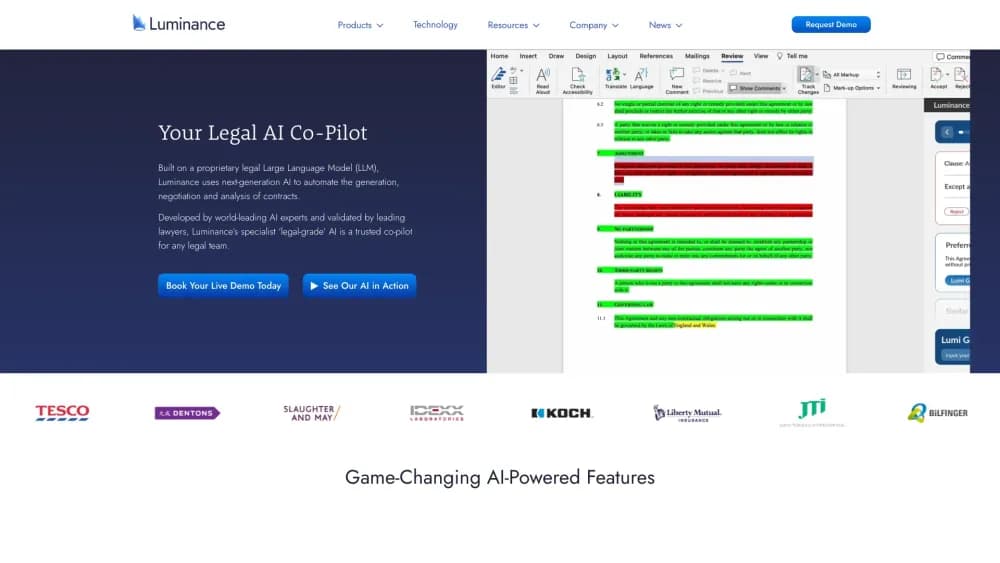
Approved language gets inserted directly into Word documents as tracked changes, so a lawyer reviews an edit instead of drafting from scratch. The platform also generates context-aware markups for clauses your playbook doesn't cover yet. It integrates with Word, Outlook, DocuSign and LexisNexis, which means contract work stays in tools teams already open every day. For firms standardized on Office, that Microsoft Word AI layer is the part that gets used daily.
Contract Repository and Portfolio Search
The repository connects related agreements and amendments so the full picture of what has been agreed sits in one place. Teams can compare thousands of contracts against playbooks at once, filter the results dynamically, and pull structured reports. According to Luminance, customers use it to spot upcoming renewals, financial exposure and missed payments without manual tracking.
Lumi, the Question-Answering Assistant
Lumi works as an AI legal assistant for the whole portfolio: you ask a plain-language question and get an answer with the source document cited. Finance can ask which contracts auto-renew next quarter; procurement can ask which suppliers have unilateral price increase rights. Answers come back in seconds, and the citation is what makes the output usable in a meeting.
Workflow Automation and Routing
Contracts move from intake to signature through a shared workflow that assigns tasks and approvals to the right team. This is contract automation in the narrow sense: routing and approvals, not just clause detection. Predefined conditions push a contract forward automatically, and every action lands in an audit trail. Luminance says one customer cut its workflow from eight steps to three; that's the vendor's figure, not an independent benchmark.
Model-Opinionated Architecture and Luna Crescent
Luminance routes each task to whichever model suits it on accuracy, speed and cost, rather than relying on one provider. Its own model, Luna Crescent, handles high-volume extraction and classification. A validation layer with independent judges and grounded critics checks high-impact outputs and flags uncertainty when a human should step in.
Security and Compliance Posture
The platform holds ISO 27001 certification and undergoes SOC 2 Type II examinations, with independent penetration testing on a regular schedule. For legal teams, those certificates are often the gate that decides whether a tool gets approved at all. Data stays within the customer's tenant and outputs are auditable.
Pros and cons
Pros
- Review quality is grounded in a decade of legal data and encoded playbooks, which shows in how well it handles clause-level deviations.
- It works inside Word, Outlook and DocuSign, so adoption doesn't require a new system for every lawyer.
- The repository gives finance and procurement self-serve answers, cutting the queue of routine questions sent to Legal.
- Security certifications and audit trails meet the bar enterprise legal departments actually apply.
- Workflow automation covers intake through signature, which many contract review tools leave to email. If you need contract lifecycle management beyond signature, check the repository and workflow modules together.
Cons
- There's no published pricing and no free tier, so a small team can't test the product without a sales conversation. Most legal AI platforms in this bracket behave the same way.
- Setup takes real work: encoding playbooks and cleaning up the repository is a project, not an afternoon.
- The product assumes large-scale commercial contract work in English, so solo practitioners and other languages get less value.
- Vendor-published time savings are large but unverified, and the real gain depends on how much of your review is routine.
Frequently asked questions
Luminance reviews contracts against your own playbook, suggests redlines, and searches an existing contract portfolio for risks, obligations and renewal dates. It's a contract intelligence platform built around AI contract review and portfolio analysis, not a general chatbot.
Related content
Explore related tools, skills, and articles for Luminance.
Luminance Alternatives

Base Code
Base44 (Wix) · Coding · ProductivityBase Code is a shared cloud development environment from Base44. Teammates describe changes to an existing GitHub codebase in chat, preview them live and send them back as pull requests.

Knocket
Knocket (Tencent RTC team) · Productivity · Business · ChatbotKnocket is a free live chat and contact page tool that lets visitors message you from your website, app, or a shareable link, with every reply handled from Telegram or one inbox.

FloorGen
Vinit Kumar (FloorGen) · Productivity · China AIFloorGen is a browser-based floor plan maker that turns a sentence or a sketch into an editable 2D plan and a 3D walkthrough. Export to PDF, DXF or video, and draw without an account.