

MathGPT
MathGPT LLC · Leaning
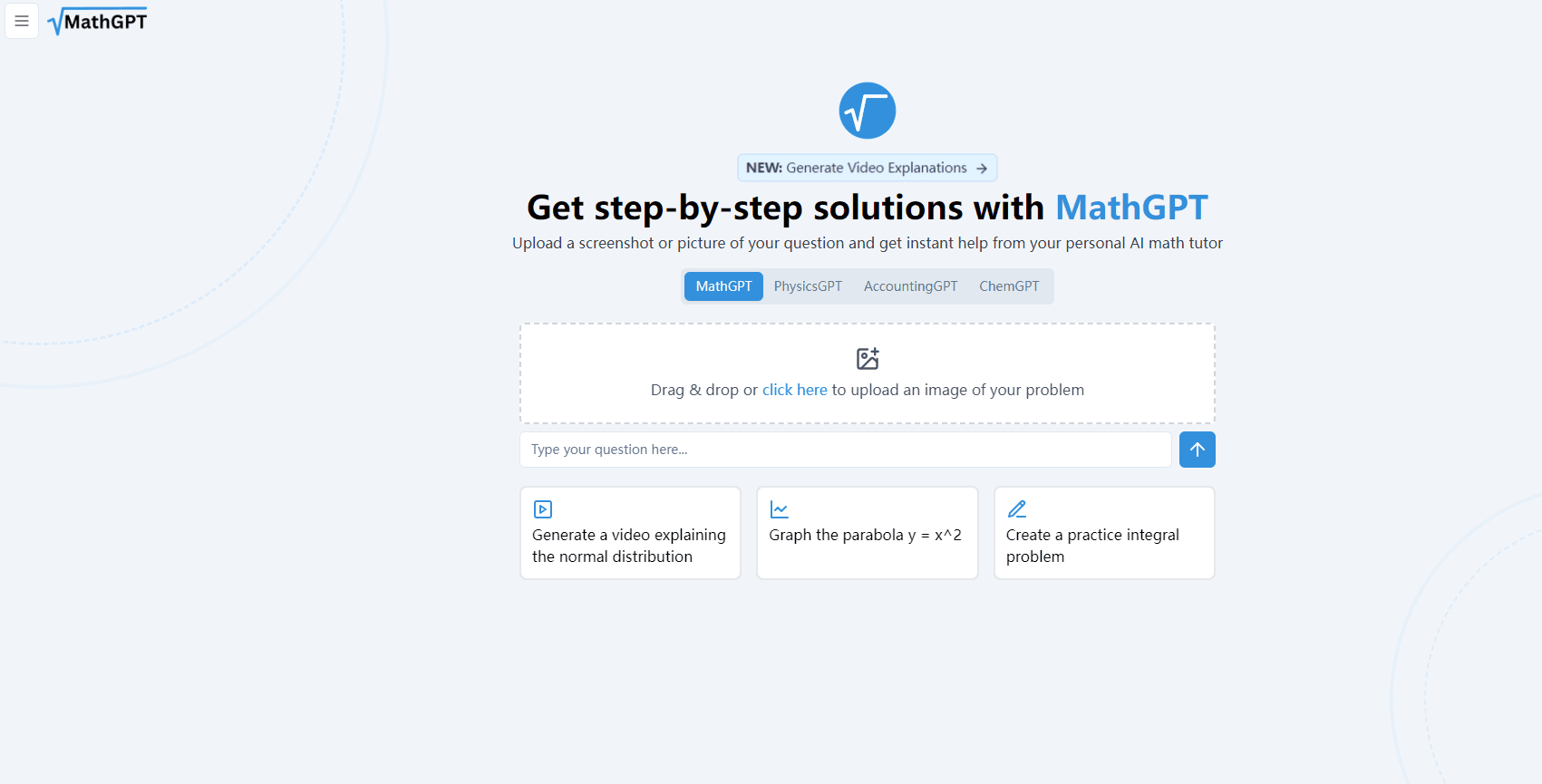
MathGPT is an AI math solver and AI math tutor that reads a typed problem or a photo, gives step by step math solutions, and turns answers into videos, practice tests, and flashcards.
About MathGPT
What Is MathGPT
MathGPT is an AI math solver and homework helper built by two Cornell engineering students, now operated by MathGPT LLC. It reads typed problems, uploaded screenshots, and PDFs, then returns a worked solution with every step shown and explained. The company says its solver beats popular general AI models on math, and the App Store listing claims more than 15 million students use it. Treat both as vendor numbers until you compare it against your own problem set.
The idea is closer to an AI math tutor than a calculator. You can ask follow-up questions about any step, generate a practice exam on the topic you just studied, and turn a single question into a narrated video. MathGPT doesn't stop at arithmetic either. Separate workspaces cover physics, chemistry, accounting, statistics, and engineering, so the same photo-to-solution flow handles a free-body diagram or a balance sheet.
Most of the friction sits in the free plan and the scope. The free tier caps questions and video explanations, so heavy users hit the ceiling fast. Coverage leans on STEM subjects, which means it isn't a full study suite for every course. And the tool rewards students who engage, since a passive user who only wants the final answer gets less from it than someone willing to work through the steps.
Getting Started
- Open math-gpt.org or install the app on iOS or Android. A free account starts with no card.
- Ask a question by typing it, snapping a photo, or uploading a PDF or screenshot of the problem.
- Read the step-by-step solution, then ask follow-up questions on any step you don't follow.
- Generate a practice test, a flashcard set, or an animated video for that topic, and check your work against the feedback.
- Open the graphing calculator when you want to see the function, and track what you've covered in your chat history.
Product Information
A quick look at MathGPT's pricing, supported platforms, and performance.
Best for
The users, tasks, and scenarios where this tool fits best.
Users
- High school and college students
- Students who learn visually
- Learners in STEM beyond math
Tasks
- Working through a homework set
- Studying for an exam
- Reviewing before a test
Scenarios
- The night before a final
- Learning a topic your class rushed
- Checking a graphing question
Key features
Step-by-step solver
The core tool returns a full solution in typeset math, with each step stated and explained rather than skipped. MathGPT was built to close the gap where general chatbots hand over an answer without showing the method. You can ask follow-up questions on any step, so the solver doubles as a tutor.
AI video explanations
Any question can become a short animated video with a voiceover and diagrams. The company calls this the first on-demand video feature of its kind for homework questions. It helps visual learners who don't get far with written steps, and the video re-solves the same problem so you can follow along.
Practice tests and quizzes
Once you finish a topic, generate a practice exam that tracks progress, grades your work, and gives feedback. You can ask follow-up questions on anything you miss. It turns a one-off answer into a study loop, which is where the learning actually sticks.
GeoGebra graphing calculator
MathGPT's graphing calculator runs on GeoGebra, so you can plot functions and interact with the graph tied to your problem. Complex equations become easier to read when you see the curve, and you don't have to switch to a separate tool.
Flashcards and study guides
A flashcard generator builds a custom set from any topic you name, aimed at vocabulary and memorization. Study guides break a concept down from the ground up, covering formulas, definitions, and key ideas. Both export the material into a form you can review offline.
Multi-subject workspaces
Beyond math, dedicated spaces cover physics, chemistry, accounting, statistics, and engineering. The same input flow handles a diagram or a spreadsheet-style problem, so a student juggling several STEM courses doesn't need a separate tool for each one.
Built-in calculator library
The app bundles a long list of calculators, from algebra, integral, derivative, and limit tools to fraction, percentage, and scientific notation converters. Each one returns a worked explanation rather than a bare number, which keeps the focus on understanding the process.
Pros and cons
Pros
- Step-by-step teaching: every solution is explained and justified, so students learn the method instead of copying a final answer.
- Visual learning tools: AI videos, GeoGebra graphs, and flashcards cover people who don't learn from written steps alone.
- Broad STEM coverage: math sits alongside physics, chemistry, accounting, statistics, and engineering in one place.
- Free tier with no card: the free plan gives daily questions, video explanations, and study tools, so you can test it before paying.
- Student pricing: MathGPT Unlimited runs $9.99 a month or $6.99 a month billed yearly, which is cheaper than most human tutoring.
Cons
- Free plan is capped: the free tier limits questions, video explanations, and study guides per day, so regular users hit the ceiling quickly.
- Math and STEM focus: it covers math and related sciences well, but it isn't a full study platform for every school subject.
- Results depend on the student: the tutor rewards users who ask questions and engage, so a copy-paste mindset gets less value.
- No public API advertised: the site markets a consumer learning tool, so teams wanting to embed the solver have no documented developer option.
Frequently asked questions
MathGPT solves math and STEM problems step by step and tutors students through them. You type a question or upload a photo, and it returns a full worked solution, follow-up help, and tools like practice tests, flashcards, and AI videos.
Related content
Explore related tools, skills, and articles for MathGPT.
MathGPT Alternatives

HireKey
HireKey · Voice & Language · Productivity · LeaningHireKey is an AI job search copilot built by a former tech recruiter. It checks role fit, tailors resumes, runs interview practice and tracks every application.

Lune
Retrograde Labs · Productivity · LeaningLune is a research search engine for scientific AI agents. It runs as an MCP server that lets Claude, ChatGPT and Cursor search peer-reviewed computer science papers and cite them.
Coddy
Coddy · Coding · LeaningCoddy is a gamified platform to learn to code through short interactive lessons in 20+ languages, with a browser editor, an AI tutor and free certificates.