

Medical Chat
Medical Chat · Leaning · AI Assistant
Medical Chat is an AI medical assistant for clinicians. It ranks likely diagnoses, gives dosing guidance, and cites PubMed or guideline sources for each answer.
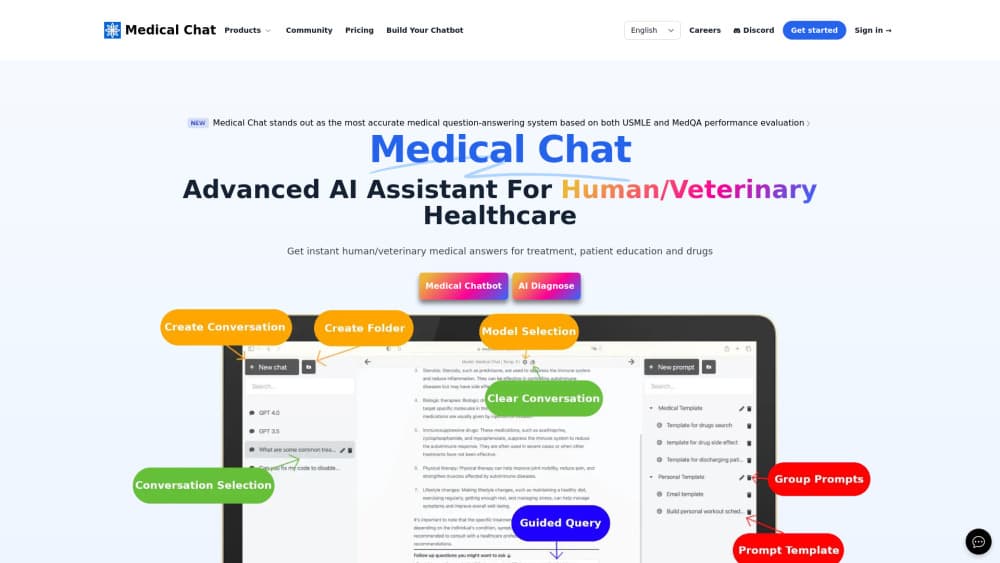
About Medical Chat
What Is Medical Chat
Medical Chat is a browser based AI medical assistant aimed at people who make clinical calls for a living: physicians, residents, nurse practitioners, and veterinary teams. You describe a case the way you'd say it out loud on rounds, and it returns a ranked differential, the red flags worth chasing, and the guideline lines behind the recommendation.
The draw is speed with a paper trail. Rather than opening three tabs to confirm a dosing threshold, you get the number and the citation sitting next to it. The company reports 98.1% on a 1,273 question USMLE style set in its own evaluation. That's a vendor figure, published by Medical Chat and not audited by an outside body, so treat its USMLE accuracy as a claim to check rather than a settled fact.
It isn't a diagnostic device and it doesn't replace clinical judgment. Answers can be wrong, citations still need reading, and the free allowance runs dry quickly. Use it as a fast reference, not an authority.
Getting Started
- Create an account with an email address. The 14 day trial doesn't ask for a card.
- Choose what you're querying: the flagship Medical Chat model, the GPT-4 family, or Anthropic models on the Professional plan.
- Type the case, then upload an ECG, photo, or lab panel if your plan includes file and image input.
- Read the ranked differential, open the inline citations, and export the encounter as a SOAP or H&P draft.
Product Information
A quick look at Medical Chat's pricing, supported platforms, and performance.
Best for
The users, tasks, and scenarios where this tool fits best.
Users
- Emergency and internal medicine physicians
- Residents and medical students
- Veterinary clinicians
Tasks
- Working up a differential
- Checking dosing and interactions
- Drafting encounter notes
- Reading images and labs
Scenarios
- A night shift with no specialist awake
- An atypical presentation
- Journal club or teaching prep
Key features
Ranked Differential Diagnosis
Medical Chat returns a differential ordered by likelihood, with pre test probabilities, red flags, and workup steps tied to named guidelines. The ordering is the useful part. A plain list of possibilities makes you do the ranking yourself, and that's where anchoring creeps in. Most differential diagnosis AI tools stop at the list, while this one pushes toward the next test.
Inline Citations From Named Sources
Every clinical claim is supposed to carry a source: PubMed, UpToDate, NICE, or a specialty society guideline. Citations sit in the answer rather than in a bibliography at the bottom, so you can check a dosage claim without scrolling. When a source is missing, that gap is worth noticing.
Structured Report Export
The diagnosis report view turns a conversation into a document shaped like a note: SOAP, H&P, or discharge summary. You edit the draft and paste it into your EHR. It saves typing on repetitive sections, and it still needs a read through before anything is signed.
Side by Side Model Comparison
On paid plans you can query Medical Chat, GPT, Claude, and Gemini with one prompt and compare the reasoning. Disagreement between models is a signal in itself, especially on edge cases where one model hedges and another commits. It's a quick way to spot an answer that only looks confident.
Image and Lab Input
Upload an ECG, chest X ray, dermatology photo, or lab panel and the assistant returns structured findings with measurement callouts. This turns the product from a text clinical AI chatbot into something closer to a reading aid. Accuracy on images varies by modality, so verify anything you'd act on.
HIPAA First Data Handling
The company signs business associate agreements with its foundation model providers and keeps zero chat history on the flagship model. It reports SOC 2 Type II attestation and EU data residency for GDPR. For a hospital IT review, those documents matter more than benchmark scores.
Pros and cons
Pros
- Citations appear inline, which makes fact checking a single step instead of a separate search.
- The differential arrives ranked with probabilities, so the output reads like a workup plan.
- Report export covers SOAP, H&P, and discharge formats, cutting note typing.
- A free tier and a 14 day trial let you test the medical chatbot for doctors before paying.
- Compliance paperwork, including BAAs and a SOC 2 Type II report, is published rather than promised.
Cons
- The 98.1% accuracy figure comes from the vendor's own evaluation, and no independent replication is published.
- Paid plans meter message credits, so heavy daily use can push you into add on purchases.
- It runs in a browser only. There's no native mobile app for bedside use on a phone.
- API documentation isn't publicly available, so teams that want to build on it have to ask sales first.
Frequently asked questions
It's used for point of care questions: building a differential, checking a dose, interpreting an ECG or lab panel, and drafting the note afterward. Think of it as a reference tool that talks back, not a system that manages patients.
Related content
Explore related tools, skills, and articles for Medical Chat.
Medical Chat Alternatives
HireKey
HireKey · Voice & Language · Productivity · LeaningHireKey is an AI job search copilot built by a former tech recruiter. It checks role fit, tailors resumes, runs interview practice and tracks every application.
Lune
Retrograde Labs · Productivity · LeaningLune is a research search engine for scientific AI agents. It runs as an MCP server that lets Claude, ChatGPT and Cursor search peer-reviewed computer science papers and cite them.
Coddy
Coddy · Coding · LeaningCoddy is a gamified platform to learn to code through short interactive lessons in 20+ languages, with a browser editor, an AI tutor and free certificates.