

mymediktor
Teckel Medical S.L. · AI Assistant
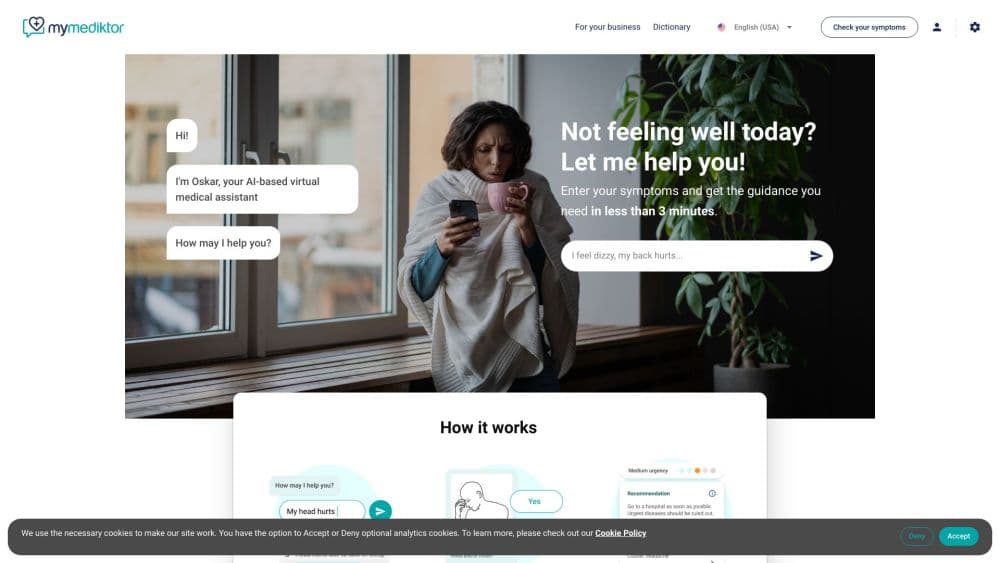
Mediktor is an AI symptom checker and virtual medical assistant. You describe how you feel in your own words, and it returns a probable pre-diagnosis plus guidance on what to do next.
About mymediktor
What Is Mediktor
Mediktor is a conversational AI health assistant built by the Barcelona company Teckel Medical. It works like a guided medical interview: you type your symptoms in your own language, and the system asks follow-up questions a doctor might ask, then narrows down to a short list of possible conditions and a suggestion for the next step. The public consumer version, mymediktor, runs in the browser and as a symptom checker app, and it takes about three minutes from a first symptom to a result.
The company sells the same engine to healthcare businesses as a white-label service. Hospitals, insurers, and telemedicine providers embed it so their members get an assessment before a call or visit. Mediktor says its tool is used across 35 countries in 18 languages, and that it has reached more than 50 million users. The underlying engine is clinically validated, and the company holds medical device certifications for it.
Two limits are worth knowing up front. It gives guidance, not a diagnosis, so it never replaces a doctor. And it's built around a structured questionnaire over free-form chat, so it works best when you can answer specific questions rather than discuss a vague, ongoing concern.
Getting Started
- Open mymediktor at myapp.mediktor.com or install the mobile app. You can start an assessment without setting up a paid account.
- Enter your first symptom in plain language, such as sore throat or chest tightness. Pick the language you're comfortable in.
- Answer the follow-up questions. The assistant asks about duration, severity, and related signs, one screen at a time.
- Read the result. You get a list of possible conditions and a recommended level of care, from self-care at home to seeing a professional urgently.
- Hand off if needed. If the assessment points to a condition, you can share the summary with a clinician or move to a partner service that takes it from there.
Product Information
A quick look at mymediktor's pricing, supported platforms, and performance.
Best for
The users, tasks, and scenarios where this tool fits best.
Users
- People checking a new symptom before booking a visit
- Patients between appointments
- Care navigators and health insurers
Tasks
- Triaging a set of symptoms
- Deciding whether to go to the emergency room
- Pre-visit intake
- Screening at scale for a health plan
Scenarios
- A late-night symptom you're unsure about
- Choosing between self-care and a doctor visit
- Launching a patient-facing tool for a healthcare brand
Key features
Conversational Symptom Assessment
The core is a guided interview that behaves like a careful intake. You start with your main complaint, and the assistant asks adaptive follow-up questions about timing, severity, and associated signs. It relies on natural language processing, so you can describe symptoms in everyday words instead of medical terms. The interview takes about three minutes on average, and it ends with a ranked list of possible conditions rather than a single guess.
Clinical Validation and Certification
Mediktor leans on clinical evidence rather than pure language model output. The company says it has run clinical trials on the engine, including work with Hospital Clínic de Barcelona, and holds medical device certifications for the technology. That matters when you're a provider or insurer choosing a tool, because it signals the system has been tested against real patient data, not just shipped and left to self-report.
Pre-Diagnosis and Care Guidance
The output isn't limited to a condition list. Mediktor returns a likely pre-diagnosis together with a recommended urgency level, from self-care to seeking help right away. For a patient, that turns a vague worry into a concrete next step, which is where a pre-diagnosis tool earns its place. For a provider, it means the tool can triage demand and point people toward the right service instead of sending everyone down the same path.
Natural Language and Multilingual Support
You can describe symptoms in your own words and in your own language. Mediktor supports 18 languages, which lets a health system serve a mixed population without building separate tools for each group. The natural language layer also means users without a clinical vocabulary can still get a useful assessment, which broadens who the tool actually reaches.
White-Label Platform for Businesses
For organizations, Mediktor ships as a white-label SaaS. You pick the services you want, apply your own branding to the interface, and embed it in your app or site. The company says integration can be live in under four weeks. That makes it a deployable triage layer for insurers, hospitals, and telemedicine platforms rather than a standalone consumer app only.
Human-Like Avatars
Mediktor pairs its NLP engine with human-like avatars for the front end. The goal is to make a symptom interview feel less like a form and more like a conversation, which can raise completion rates. It's a presentation choice rather than a clinical one, but for a patient-facing product the difference in how an assessment feels can affect whether people finish it.
Pros and cons
Pros
- A structured interview returns a pre-diagnosis and care guidance in about three minutes, so you get a direction fast.
- 18 supported languages and natural language input make it usable for people without a medical vocabulary.
- Clinically validated, with medical device certifications, which gives providers and insurers a tested tool rather than an unproven chatbot.
- The white-label option lets a business deploy it under its own brand and integrate in a few weeks.
- The consumer version is free, so you can try the assessment before any business commitment.
Cons
- It offers guidance, not a diagnosis, so it can't replace a doctor or resolve anything that needs an exam or test.
- The structured questionnaire suits specific, describable symptoms and fits poorly when your problem is vague or ongoing.
- Consumer pricing for paid features isn't published, so you can't compare paid tiers without contacting the company.
- The white-label product is quote-based, which means a business can't estimate cost from the site alone.
Frequently asked questions
Mediktor is used to assess symptoms and suggest what to do next. You describe how you feel, answer a short set of follow-up questions, and get a probable pre-diagnosis plus a recommended urgency level. Companies also embed it as a first-contact triage tool for their members.
Related content
Explore related tools, skills, and articles for mymediktor.
mymediktor Alternatives
Agibot
Agibot · Productivity · AI Assistant · ChatbotAgibot is a personal AI agent for Mac that keeps running after you close the window, runs routines on a schedule, and works from Telegram or Slack with your own API keys.

Foley
Hanamori Labs, LLC · Voice & Language · Productivity · AI AssistantFoley is a voice to-do list that turns a spoken sentence into a filed task, complete with project, date and time, then helps you plan the day around what is already there.

Ghost Core
Ghost · Productivity · AI AssistantGhost Core is a $3,499 screenless personal AI computer that runs local AI models on its own hardware, builds context from your apps and devices, and acts without waiting for a prompt.