

Melete
Melete · Productivity · AI Assistant · Chatbot
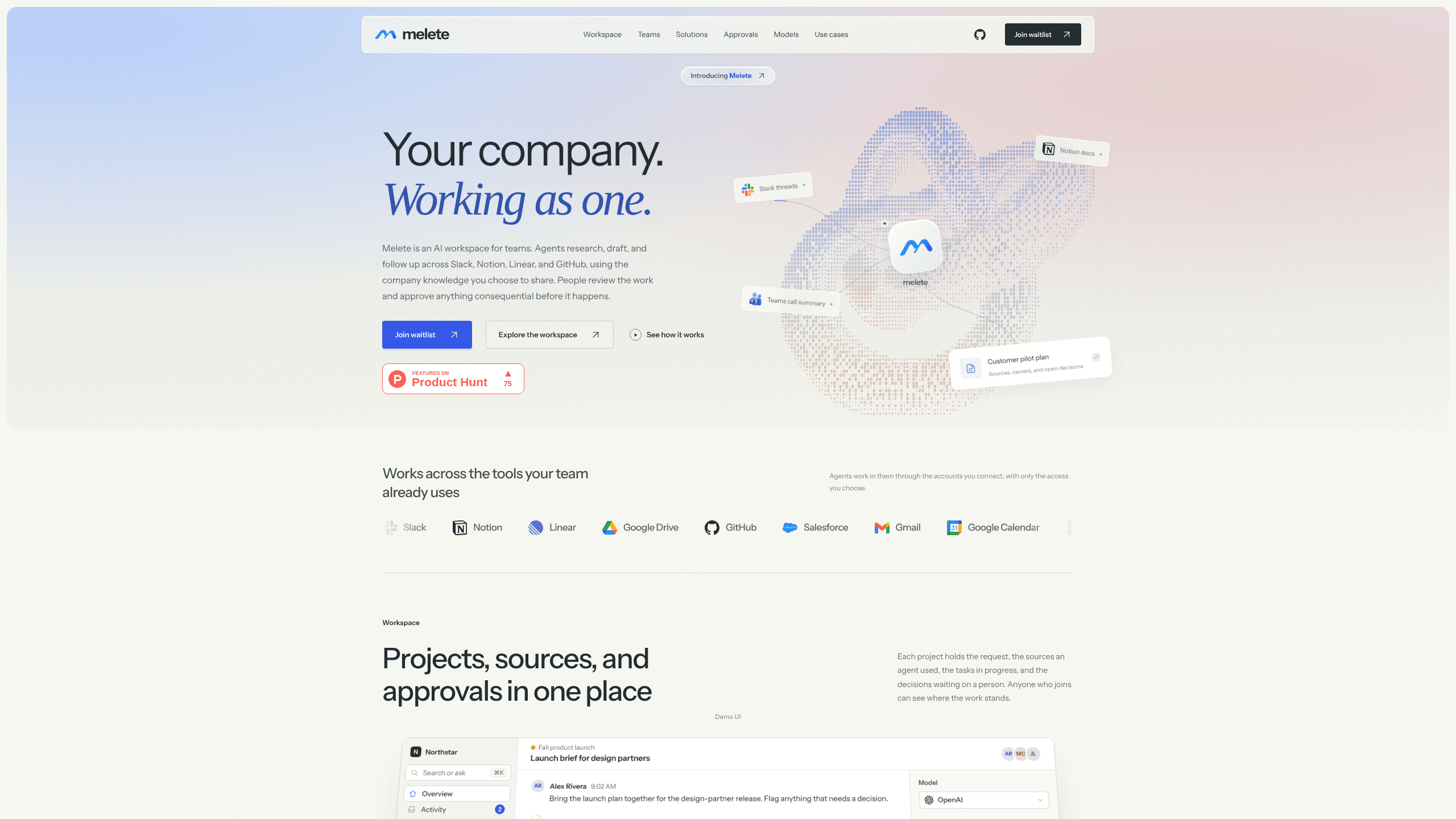
Melete is an AI workspace for teams where agents research, draft, and act in Slack, Notion, Linear, and GitHub. Shared memory and approval gates keep people in control.
About Melete
What Is Melete
Melete is a team AI workspace built around agents that carry work from a request to a reviewed handoff. You describe the outcome you need. An agent pulls context from the tools you connect, does the reading and drafting, and brings the result back to a named person before anything leaves the building.
Each project holds the request, the sources an agent used, the tasks in progress, and the decisions waiting on a human. That structure is the point: a teammate who joins mid-week can open the project and see where the work stands without asking for a summary first.
It also runs as a personal AI agent without a company workspace, so individuals can keep their own tasks and memory separate from team work. The trade-off is maturity. The hosted cloud version is still a waitlist, self-hosting asks for Docker and a model provider key, and the project shipped its first public code in September 2026.
Getting Started
- Pick a route: join the cloud waitlist at waitlist.melete.si, or install the open-source version yourself with one command on a machine running Docker.
- Connect a model provider in Settings, Models. OpenAI, Anthropic, Google, and any OpenAI-compatible server work, and the key stays outside the agent's environment.
- Connect only the sources one workflow needs, such as a Slack channel, a Notion page, or a GitHub repository, and start with read-and-draft access.
- Hand over a recurring task, for example a weekly update. The agent gathers context in an isolated workspace and returns a draft with its sources attached.
- Set which actions need approval, review the first results, then widen access once the workflow holds up.
Product Information
A quick look at Melete's pricing, supported platforms, and performance.
Best for
The users, tasks, and scenarios where this tool fits best.
Users
- Small teams with recurring handoffs
- Founders and operators without an ops hire
- Individual professionals
Tasks
- Weekly status reports
- Customer handoffs
- Launch briefs
Scenarios
- A team that already runs on Slack, Notion, and Linear and wants an agent inside those tools instead of another dashboard.
- A company that must keep data on its own servers, where the self-hosted AI agent route matters more than a polished cloud app.
- A pilot workflow, such as one recurring report, before a wider rollout across departments.
Key features
Shared memory with visible scopes
Melete remembers decisions, terminology, and preferences, and every memory carries a scope: the whole company, one project, or one person. Each entry links back to the source it came from, and a correction takes effect right away. This is the part that separates it from a chat tool, since AI agent memory survives new tasks and new models.
Approval gates with a written record
You choose which actions need a person. External messages, payments, and deletes can all wait, and the reviewer sees exactly what will happen before deciding. Every task keeps a record of what the agent read, what it proposed, who approved it, and what changed, which is what makes AI agent approvals usable in a company setting.
Connectors to the tools a team already uses
Agents work through the accounts you connect, with only the access you grant. The list covers Slack, Notion, Linear, Google Drive, GitHub, Salesforce, Gmail, Google Calendar, Google Sheets, Outlook, Teams, Figma, Trello, Asana, Zoom, and Dropbox. A task can touch only the channels, folders, and repositories attached to it.
An isolated workspace for each task
Every task gets a browser, files, and code tools in its own environment, separate from anyone's laptop. Heavy jobs run in a sandbox on E2B, Modal, or Daytona, and a separate browser handles forms and logins. When a task is interrupted, it resumes without repeating steps that already finished, and an action Melete can't confirm gets marked unconfirmed instead of retried.
Model choice that survives a switch
You can run OpenAI, Anthropic, or Google models, use a different provider for each workflow, or point Melete at a local model server with an OpenAI-compatible API. Projects, memory, and documents stay put when you switch, and provider keys stay outside the agent's environment. That makes it a model-agnostic AI agent in practice, not only in the marketing copy.
Open-source core you can host
The agent runtime is Apache-2.0 and lives on GitHub, so you can read how tasks run, how approvals are enforced, and how memory is stored. A one-line installer sets up the self-hosted version on Linux, macOS, or Windows with Docker, and the same repository documents backups, HTTPS, and removal. An open-source AI agent with a readable runtime is rare in this category, and it's the main reason a cautious IT team can say yes.
Personal mode and shared rooms
Individuals can use Melete with no company setup, and their tasks stay apart from team projects. A preview feature called rooms lets a household talk to one agent together, with each person approving changes to their own calendar and keeping private free/busy details hidden.
Pros and cons
Pros
- Memory is readable and correctable, with a source link on every entry and scopes that keep private notes out of shared projects.
- Approval gates show the exact action before it happens, and the decision stays attached to the task.
- The open-source core and Docker install mean a team can keep data on its own hardware and audit the code.
- Model choice is real: hosted providers, a local server, or a mix, with memory intact after a switch.
- Each task runs in an isolated environment, so research and scripts don't tie up a teammate's machine.
Cons
- The hosted cloud version is a waitlist with no published price, so you can't budget for it or test it today.
- Self-hosting needs Docker, a terminal, and a model provider key, which puts it out of reach for teams without technical staff.
- Model usage is billed by your provider, and Melete doesn't cap that spend, so a long-running task can cost more than expected.
- The product is young, with preview features such as rooms and a small integration surface compared with established suites.
Frequently asked questions
Melete is an AI workspace for teams. People hand work to agents that research, draft, and act across connected tools, and each task keeps its sources, owner, and approvals together in one project.
Related content
Explore related tools, skills, and articles for Melete.
Melete Alternatives

Base Code
Base44 (Wix) · Coding · ProductivityBase Code is a shared cloud development environment from Base44. Teammates describe changes to an existing GitHub codebase in chat, preview them live and send them back as pull requests.

Knocket
Knocket (Tencent RTC team) · Productivity · Business · ChatbotKnocket is a free live chat and contact page tool that lets visitors message you from your website, app, or a shareable link, with every reply handled from Telegram or one inbox.

FloorGen
Vinit Kumar (FloorGen) · Productivity · China AIFloorGen is a browser-based floor plan maker that turns a sentence or a sketch into an editable 2D plan and a 3D walkthrough. Export to PDF, DXF or video, and draw without an account.