
MentionDrop
MentionDrop · Productivity · Marketing
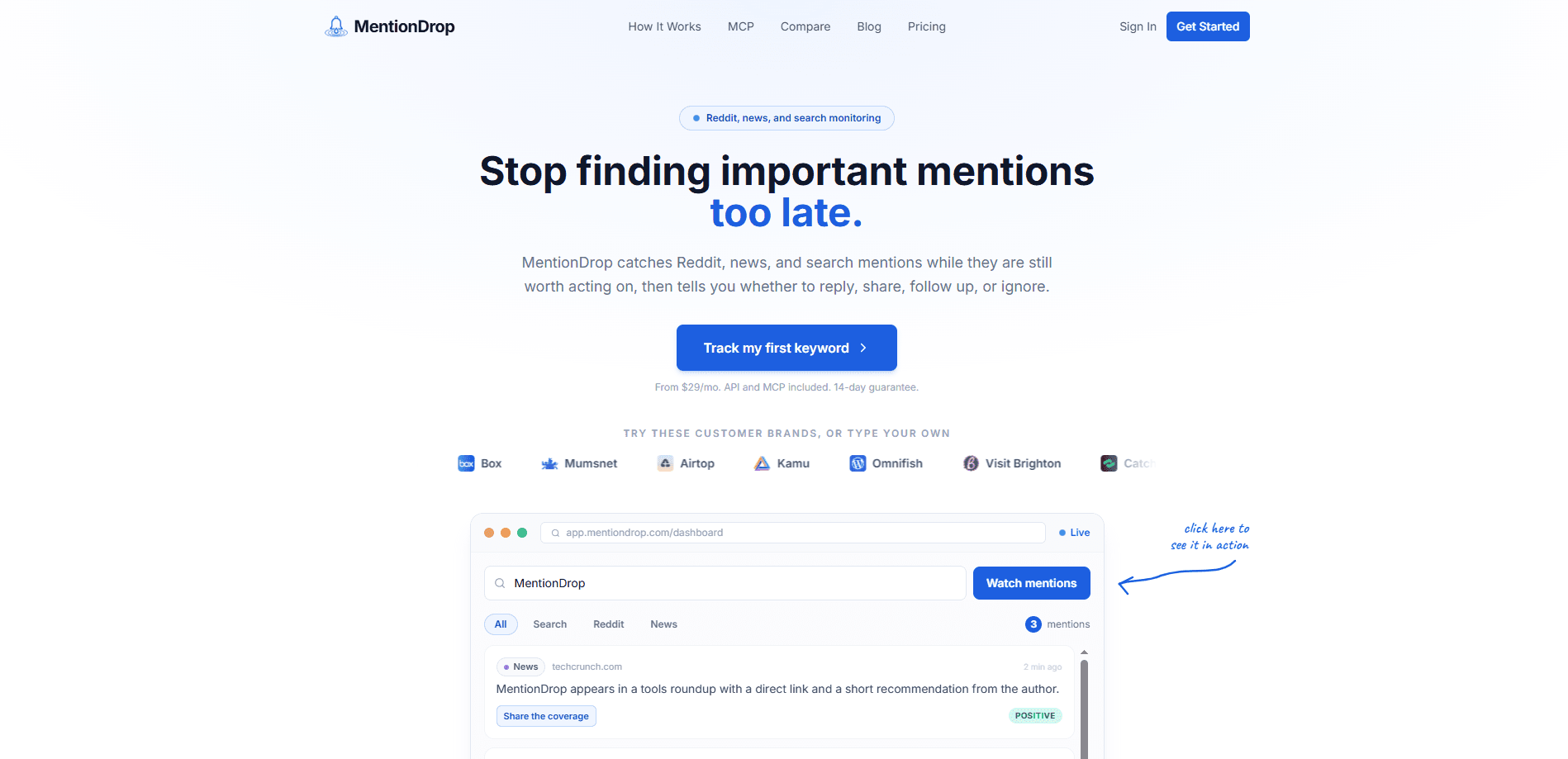
MentionDrop is an AI-powered brand mention monitoring tool for brands, products, and competitors. You add keywords, and it watches Reddit, Google News, search results, and selected public web pages, then sends you AI-summarized alerts with sentiment and suggested next steps. Alerts arrive by email, Slack, webhook, or the HTTP API, so signals can land straight inside your team's tools.
About MentionDrop
What Is MentionDrop
MentionDrop is brand mention monitoring built around a small, focused promise: catch the mentions worth acting on, not every mention on the internet. You give it keywords, it watches a defined set of sources, and it hands back short AI summaries instead of a noisy firehose that buries the two mentions you actually needed to see this week.
The tool tracks three kinds of terms: your own brand, your products, and your competitors. Mentions get scored for sentiment and relevance, grouped into digests, and paired with suggested actions. When something looks important, you can generate a reply draft without leaving the dashboard. Reddit is the source most teams start with, which makes Reddit brand monitoring the natural first job for it.
The biggest limit is coverage. This isn't full-web or real-time monitoring, no matter what the category name suggests. Freshness varies by source, and the Ahrefs Firehose is an optional feed that stays off unless you turn it on. If you need guaranteed coverage of every corner of the internet, you'll be disappointed.
Does that make it useless? Not at all, as long as you pick the right keywords and check the digest once a day.
Getting Started
- Create an account on the MentionDrop site and pick the Starter or Pro plan after the trial.
- Add keywords for your brand, products, and competitors, and set a relevance threshold for each.
- Connect a delivery channel: email, Slack, a webhook, or an API key for your own tools.
- Review incoming mentions in the feed, mark them relevant or not, and check the grouped digest.
- Generate a reply draft for any mention that deserves a response.
Product Information
A quick look at MentionDrop's pricing, supported platforms, and performance.
Best for
The users, tasks, and scenarios where this tool fits best.
Users
- Brand managers at small teams
- Solo founders and indie makers
- Growth and marketing teams
Tasks
- Tracking brand mentions
- Watching competitor mentions
- Turning mentions into replies
- Routing signals into automations
Scenarios
- Launch week monitoring
- Daily reputation checks
- Agent-driven workflows
- Early market research
Key features
AI Summaries and Sentiment on Every Mention
Each mention comes back with a short summary, a sentiment read, and a relevance score. That means you can skim ten mentions in the time it used to take to read one thread. The point is triage speed, not deep analysis. You still decide what matters.
Keyword Tracking for Brands and Competitors
MentionDrop monitors brand, product, and competitor names, and each keyword gets its own role, context, and relevance threshold, which helps the tool separate a genuine signal from a passing reference that only looks like one.
Multi-Channel Alert Delivery
Alerts go out by email, Slack, and webhook. Nothing forces you to sit inside a dashboard. Not ideal for everyone, but it works. For teams that live in Slack, this is the difference between noticing a mention now and noticing it a week late.
HTTP API and MCP Integration
The v1 API is account-scoped and covers mention listing, keyword management, grouped digests, mention feedback, and reply drafts. MCP support means an AI assistant can query your mentions directly, and the same API backs the n8n and Claude integrations. If your team already runs automations, this is the part that earns its keep.
Grouped Digests
The digest endpoint sorts mentions into owned-brand, competitor, demand, and reply-worthy groups. No flat list. Instead you get buckets that map to decisions: what to defend, what to compare, and what to answer.
Reply Draft Generation
For a mention that needs a response, MentionDrop can generate a reply or outreach draft on demand. It's a starting point, not a finished reply, but it cuts the blank-page problem for community managers. You'll still rewrite most of it.
Noise Filters
Low-value mentions get filtered before they reach you. You tune this with per-keyword relevance thresholds, so a common brand word doesn't drown out the mentions that matter. Set it too high and you'll miss things you care about, which is the tradeoff every filtering tool asks you to make.
Pros and cons
Pros
- AI summaries and sentiment make a long mention feed skimmable in seconds.
- Delivery by email, Slack, webhook, and API fits teams that don't want another dashboard.
- Competitor share-of-voice grouping turns raw mentions into a comparison view.
- An account-scoped API plus MCP support makes it useful inside automations and AI agents.
- A 14-day money-back guarantee lowers the risk of trying a paid-only tool.
Cons
- There's no free plan, so testing it past the guarantee means paying $29/mo at minimum.
- Coverage is bounded, not full-web or real-time, so niche sources may be missed.
- The Starter plan caps you at 5 keywords and 90 days of mention history, which is tight for larger brands.
Frequently asked questions
It watches a defined set of sources, which the site lists as Reddit, Google News, search results, and selected public web results. It's not a full-web crawler, so coverage depends on the source. The Ahrefs Firehose is an optional feed that stays disabled by default.
Related content
Explore related tools, skills, and articles for MentionDrop.
MentionDrop Alternatives

Base Code
Base44 (Wix) · Coding · ProductivityBase Code is a shared cloud development environment from Base44. Teammates describe changes to an existing GitHub codebase in chat, preview them live and send them back as pull requests.

Knocket
Knocket (Tencent RTC team) · Productivity · Business · ChatbotKnocket is a free live chat and contact page tool that lets visitors message you from your website, app, or a shareable link, with every reply handled from Telegram or one inbox.

FloorGen
Vinit Kumar (FloorGen) · Productivity · China AIFloorGen is a browser-based floor plan maker that turns a sentence or a sketch into an editable 2D plan and a 3D walkthrough. Export to PDF, DXF or video, and draw without an account.