

Merge
Merge · Business
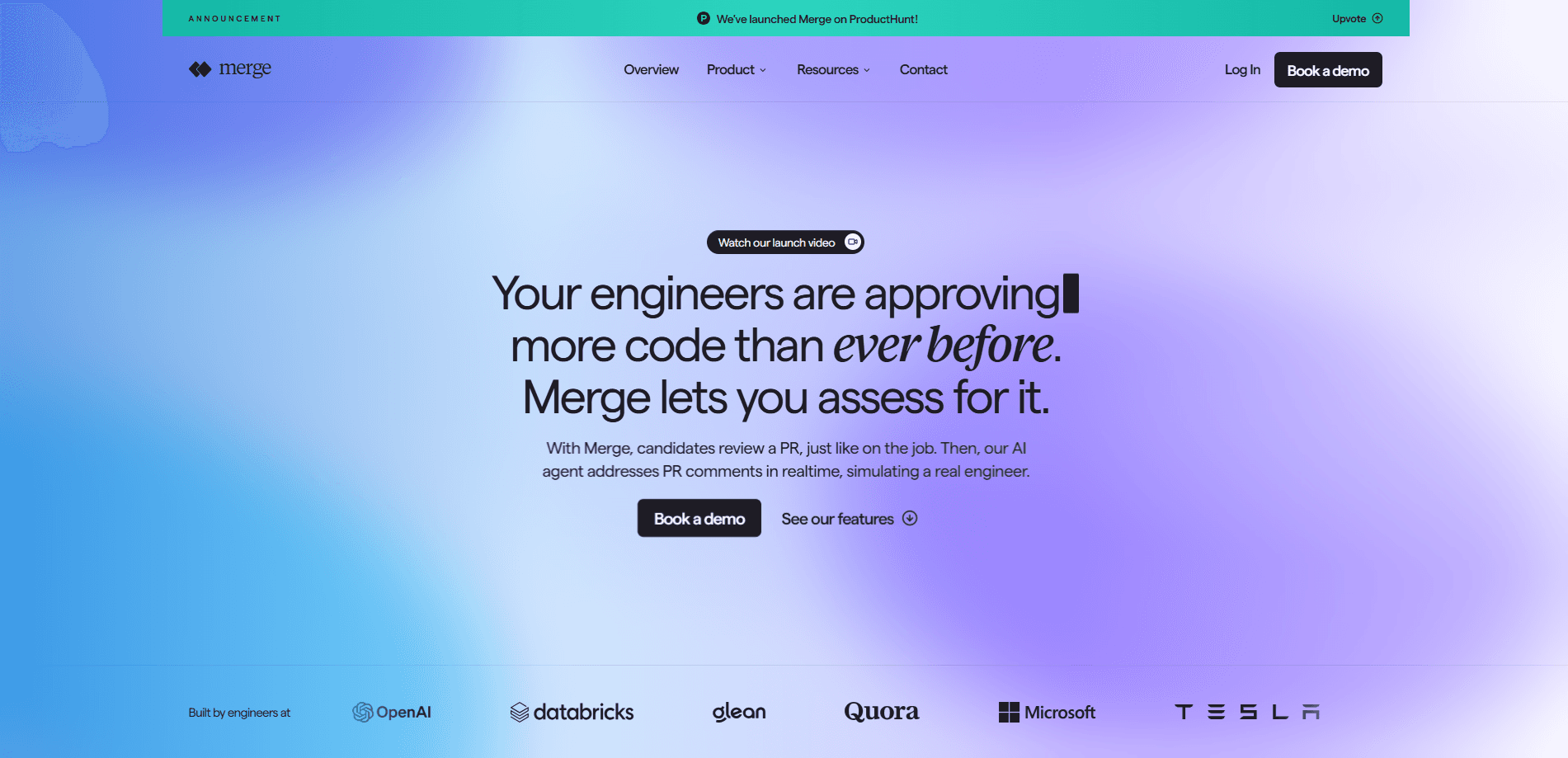
Merge is an AI-native code review assessment platform that evaluates engineering candidates by handing them a realistic pull request to review, just like they would on the job. Instead of asking people to solve algorithm puzzles, Merge measures how a candidate reads code, spots risk, and responds when an AI agent pushes back with generated revisions. Hiring teams get a scorecard that ties candidate comments to code quality, risk detection, and revision judgment, plus a token-use efficiency signal that shows how well someone works alongside AI.
About Merge
What Is Merge
Merge is a hiring assessment platform built around one idea. The best way to judge an engineer is to watch them review real code. Candidates open a pull request, leave comments the way they would in a normal review, and then an AI agent responds to those comments in real time. It plays the role of a teammate who defends their choices or revises the code.
That loop is what separates Merge from a take-home exercise or a live coding quiz. A candidate who only knows how to grind LeetCode problems will struggle to notice an SQL injection risk or a broken retry path, while a strong reviewer will surface issues in plain prose. The report that comes out the other end is meant to be discussed by a hiring team, not just filed away. That's the whole pitch.
The main limitation is that Merge is young. Pricing isn't published on the site, so you'll need to talk to the team before you commit. The platform is web-based with no public API, which matters if your hiring stack needs to sync results automatically. It's also firmly a recruitment tool. Want AI to review your production codebase? That's a different product.
Getting Started
- Sign up on the Merge site and set up your hiring workspace.
- Pick or customize an assessment for the role you're filling. Set the language, seniority, and the kind of code the candidate will face.
- Invite the candidate by email so they can open the pull request review when they're ready.
- Watch the candidate review the PR as the AI agent replies to their comments and simulates a real engineer.
- Read the scorecard in the dashboard and walk your hiring panel through the candidate comments, risk findings, and token-use efficiency.
Product Information
A quick look at Merge's pricing, supported platforms, and performance.
Best for
The users, tasks, and scenarios where this tool fits best.
Users
- Engineering hiring managers at startups
- Senior software engineers who sit on interview panels
- Technical recruiters screening for mid-level to senior roles
Tasks
- Screening backend candidates on review judgment
- Measuring how efficiently a candidate works with AI
- Building a role-specific assessment
Scenarios
- A small team with no formal interview loop needs a repeatable way to compare candidates, and Merge gives them one template to reuse.
- A hiring panel is split on a candidate after a phone screen, so the review scorecard gives everyone the same evidence to argue from.
- You're hiring engineers who will live inside AI coding tools, and you want to see how naturally they collaborate with an AI agent rather than how fast they type.
Key features
Realistic Review Loop
Candidates review a pull request the way they would during a normal workday, leaving comments, raising concerns, and suggesting fixes. Then the AI agent answers in real time, pushing back or applying revisions, so the exercise becomes a conversation instead of a static form. That back-and-forth is the part that reveals how a candidate thinks when their reasoning gets tested. No script to memorize. Just code.
AI-Generated PR Revisions
When a candidate leaves a comment, Merge's AI agent can revise the code and hand it back, standing in for the engineer who wrote the PR. This simulates the messy reality of review conversations, where you rarely get the last word and have to defend or drop a suggestion based on new evidence. Most candidates never expect the code to change under them. It does.
Custom Role-Specific Assessments
You calibrate each assessment to the role you're hiring for. Set the language and difficulty, then choose the kind of code the candidate faces. It's your call. That means a hiring manager for a payments team can test for the risks that matter in payments instead of running everyone through the same generic problem.
Hiring-Ready Reporting
The report connects candidate comments to code quality, risk detection, and revision judgment, then lands on practical hiring recommendations. The point is to give a panel something concrete to discuss instead of a single opaque score that nobody can read.
Token Use and Efficiency
Merge shows how efficiently a candidate works with AI, including token use, estimated cost, and how many PR revisions they needed. For teams that expect engineers to work alongside agents daily, this is a signal that older assessment tools don't capture at all. Cheap tokens aren't the goal. Good judgment is.
Candidate Review Signal From Invite to Decision
The platform runs the full flow from sending the invite to producing the decision signal, so you don't have to stitch together a test, a review tool, and a scoring spreadsheet. The candidate never leaves the browser, and your team sees everything in one place. Simple as that.
Pros and cons
Pros
- The review loop mirrors real engineering work, so the signal lands closer to job performance than a timed algorithm test.
- Role-specific customization lets hiring teams test for the risks and patterns that actually matter in their codebase.
- Token-use and cost reporting gives a concrete read on how well a candidate collaborates with AI tools.
- The scorecard is built for a hiring discussion, with findings tied back to specific candidate comments.
Cons
- Pricing isn't published, so you can't estimate cost per hire without contacting the team first.
- No public API is listed, which means results can't easily be piped into an ATS or custom hiring dashboard.
- Because it's a new platform, there's little public track record yet, and you'll likely want a trial run before rolling it out broadly.
Frequently asked questions
Merge is used to assess engineering candidates by having them review a realistic pull request while an AI agent responds like a teammate. It works as a pull request review test that replaces or supplements algorithm quizzes with a signal built on real code review judgment.
Related content
Explore related tools, skills, and articles for Merge.
Merge Alternatives
Liveplan
Palo Alto Software · BusinessLivePlan is business plan software that helps founders and small business owners turn an idea into a funder-ready plan. It combines AI-assisted writing, market research with cited sources, and connected financial forecasting so your income statement, cash flow, and balance sheet move together when you change one number. Over 1.5 million businesses have used it to plan, forecast, and track performance against real accounting data. That's a lot of founders. It's also a signal the tooling survived contact with real lenders.

Swms
Swms AI · Writing · Productivity · BusinessSwms is an AI safety compliance tool that turns a plain description of a job into ready-to-use safety documents. Describe your project, trade, and known hazards, and it writes a safe work method statement, job hazard analysis, safe work procedure, RAMS, or safety data sheet in seconds. It also ships with Oscar, a chat assistant that answers workplace safety questions in any language. Teams in construction, mining, transport, and warehousing use it to cut the paperwork that usually eats into a workday.

Rows
Rows (Superhuman) · Productivity · BusinessRows is an AI spreadsheet and data analysis tool that imports live data from more than 50 sources, then lets you work with it using plain language instead of SQL queries or nested formulas. You can pull numbers out of PDFs, connect ad platforms, databases, and bank accounts, and ask the AI to build reports, merge datasets, or set up models that recalculate themselves. It runs in the browser, works like a spreadsheet, and now sits under the Superhuman umbrella.