

Meshcapade Me
Meshcapade GmbH (part of Epic Games since 2026) · Image
Meshcapade Me was a browser-based 3D avatar creator that turned photos, measurements, or text into rigged human models built on SMPL. The platform shut down on April 18, 2026.
About Meshcapade Me
What Is Meshcapade Me
Meshcapade Me was the self-serve side of Meshcapade, a German company spun out of the Max Planck Institute for Intelligent Systems in 2018. The company built SMPL, a statistical body model that packs human shape and pose into roughly a hundred parameters. Researchers use it, game studios use it, and clothing companies use it to size garments without a fitting room.
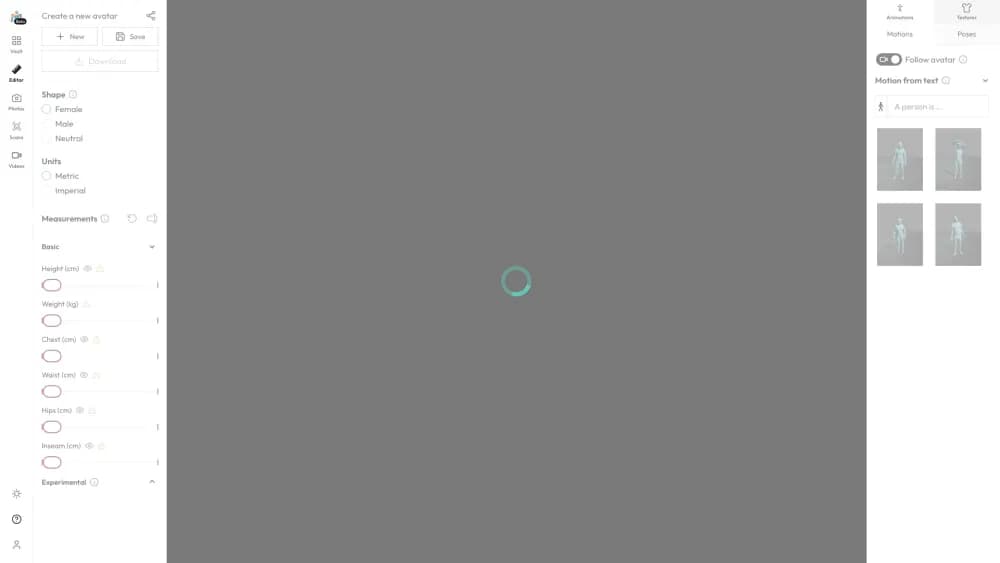
Meshcapade Me put that model behind a web interface. You uploaded a photo, typed a few measurements, or described a person in words, and the site returned a 3D body you could rotate, adjust, and download. No scanner, no marker suit, no modeling software.
The catch: none of it works anymore. Meshcapade became part of Epic Games, and the online platforms closed on April 18, 2026. Avatars that lived in the cloud are gone, and the site now points visitors to Epic's digital human work. This page covers what the tool did, who got value from it, and what to use instead.
Getting Started
- Create a free Meshcapade Me account with an email address and password.
- Pick an input method: upload a full-body photo, enter height and a handful of circumferences, or write a short text description.
- Adjust the generated body with height, weight, and shape sliders until the proportions look right.
- Pose the avatar and export it in FBX, GLB, or OBJ for Blender, Maya, Unity, or Unreal Engine.
Steps 1 through 3 no longer work. The account system went offline with the rest of the platform, and downloads stopped on the same day.
Product Information
A quick look at Meshcapade Me's pricing, supported platforms, and performance.
Best for
The users, tasks, and scenarios where this tool fits best.
Users
- Game and VFX artists who needed a human base mesh fast
- Apparel and ergonomics teams doing fit studies
- Researchers without scanning hardware
Tasks
- Building a background crowd for a scene
- Checking garment fit before sampling
- Prototyping a digital human for a product demo
Scenarios
- A studio needs fifty extras for a virtual environment and has no budget for scanning actors. Body shape from measurements covered it, but the studio now has to source those meshes elsewhere.
- A robotics team wants human motion reference for safe-collaboration testing. SMPL skeletons map cleanly onto simulation rigs, which is why the format outlived the app.
- A student learning rigging wants a clean human mesh to practice on. The free tier made that easy while it lasted.
Key features
Avatar From a Single Photo
Upload one full-body photo and the service estimated body shape from it. It handled different poses and body sizes, which matters because most people do not stand in a T-pose for a web app. The result arrived as a complete mesh with a skeleton already inside it.
Measurement-Based Body Building
Instead of a photo, you could type height, weight, chest, waist, and hip numbers. Meshcapade trained this path on scanned bodies, so the output matched real anthropometric data rather than an artist's guess. Tailors and fit technicians got the most out of it.
Text to Avatar
A short description like "tall man, athletic build, mid thirties" produced a matching body. This was the fastest route and the least precise one. It worked well for background characters and badly for anyone who needed a specific person.
SMPL Body Model Inside
Every avatar came out in the SMPL format, the same model used across academic computer vision and commercial animation. That compatibility is the reason the export dropped into Blender, Maya, Unity, and Unreal without repair work. A rigged avatar in a standard format saves a day of cleanup per character.
Browser-Based Shape and Pose Editing
Sliders for height, weight, muscle, and proportions updated the mesh live. You could pose the figure and check silhouette before exporting. No plugin, no install, no GPU requirement.
Developer API and Plugin Support
Meshcapade offered an API for generating bodies and motion at scale, plus plugins for Blender, Maya, and Unreal Engine. Studios used it to batch-generate characters inside an existing pipeline. The API moved with the rest of the platform when it closed, and Epic now handles that work.
Pros and cons
Pros
- Output arrived rigged and in a standard format, so it dropped straight into a game engine or 3D app.
- Body proportions followed real anthropometric data, not an artist's approximation.
- Three input routes covered different users: photo for speed, measurements for accuracy, text for convenience.
- The free tier let students and hobbyists try 3D human modeling before paying anything.
Cons
- The platform is gone. Meshcapade Me closed on April 18, 2026, and no new avatars can be created.
- Cloud-stored avatars went with it, so anyone who did not export locally lost their work.
- Photo input struggled with loose clothing, odd lighting, and cropped limbs, which pushed users toward measurements.
- Pricing was never cheap for occasional users, and the paid tiers made sense only for teams producing avatars regularly.
Frequently asked questions
It shut down. Meshcapade joined Epic Games, and the Meshcapade shutdown took every online platform offline on April 18, 2026. The domain now redirects to a notice pointing to Epic's digital human projects.
Related content
Explore related tools, skills, and articles for Meshcapade Me.
Meshcapade Me Alternatives

Google EmbeddingGemma 2
Google DeepMind · Writing · Image · CodingGoogle EmbeddingGemma 2 is a 740M-parameter open model that turns text, code, images, audio, and video frames into vectors in one 768-dimension space, running on phones and laptops.

Tractionwave
TractionWave · Image · MarketingTractionWave is an AI attention heatmap tool for static ads. Upload a PNG or JPG and it returns predicted attention, ranked hotspots, and fixes before you spend budget.

Imejis.io
Imejis.io · Image · MarketingImejis.io is an AI design studio for agents and marketing teams. Describe an image in plain words, and it writes the copy, builds the layout, reflows it to every size, then exports a finished file.