

Metabase
Metabase, Inc. · Image · Coding
Metabase is an open source business intelligence tool that lets teams explore data, build dashboards, and share insights without writing SQL.
About Metabase
What Is Metabase
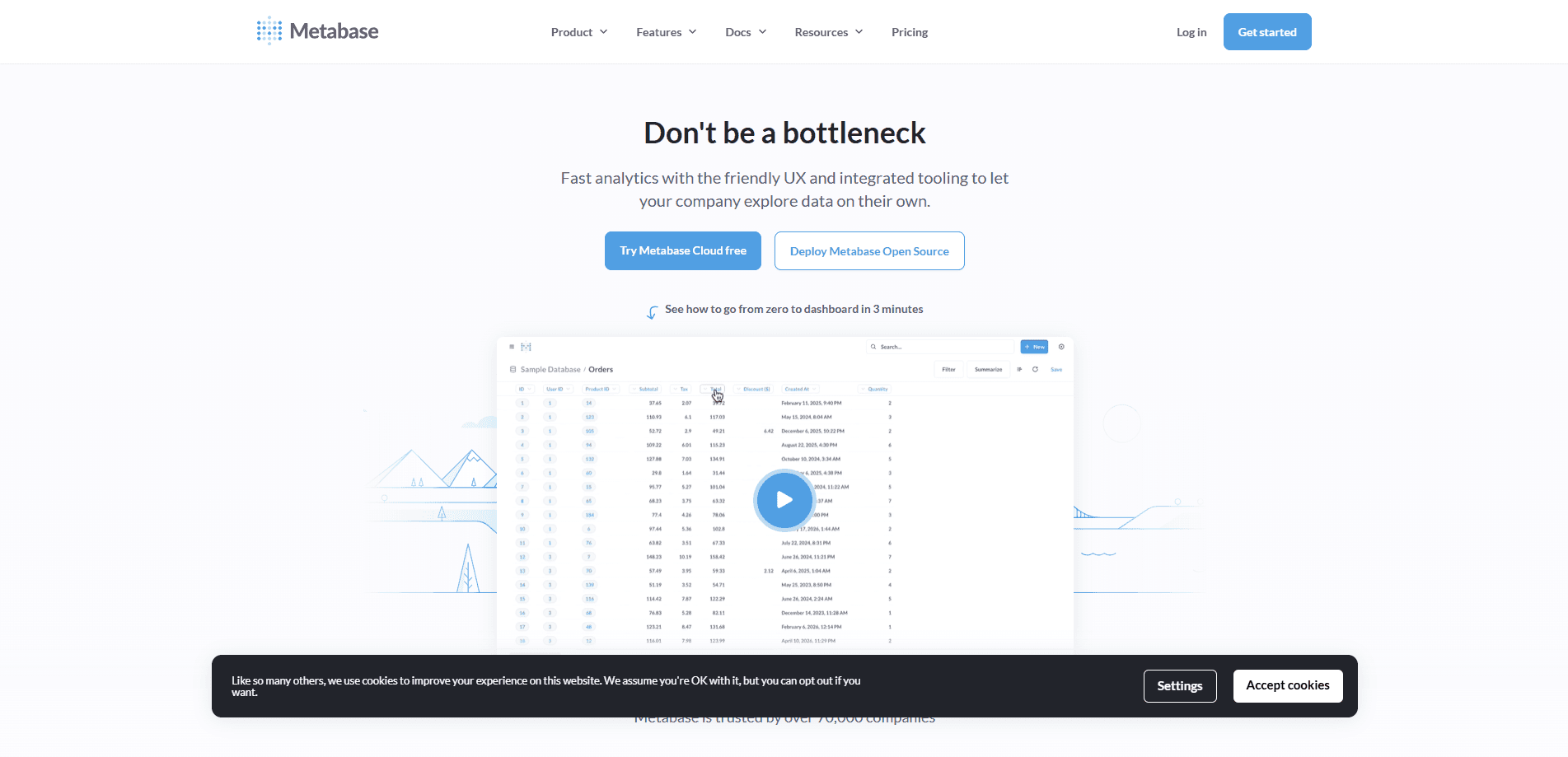
Metabase is an open source business intelligence and BI tool that connects to your database and turns it into charts, dashboards, and reports that everyday people can use. Its data visualization and dashboards handle the reporting, so it doubles as a lightweight BI software layer for teams that want self-service analytics and data exploration without a heavy stack. Instead of waiting on an analyst to write a query, anyone on the team can click through a visual query builder to pull answers, or drop into a SQL editor when they need more control.
The company promotes a five-minute setup, and it ships both a hosted cloud option and a self-hosted version you run on your own servers. Around 20 database connectors cover the common warehouses and transactional systems, so most teams can point it at data they already have.
The main limit is scope. Metabase is built for exploration and reporting rather than heavy data engineering or complex modeling, so teams that need deep transformation pipelines often pair it with a separate tool. The open source core is free, while more advanced embedding, permissions, and support features sit on paid plans.
Getting Started
- Sign up for a cloud trial or download the open source version and run it with Docker or the JAR file.
- Connect a data source by adding your database credentials, and Metabase scans the tables automatically.
- Build a question with the visual query builder, or write your own SQL for complex logic.
- Save the result as a chart, add it to a dashboard, and share it by link, email, or Slack.
Product Information
A quick look at Metabase's pricing, supported platforms, and performance.
Best for
The users, tasks, and scenarios where this tool fits best.
Users
- Business teams who need answers from data without leaning on SQL, since the query builder handles joins, filters, and aggregations with clicks.
- Data analysts and developers who want a lightweight BI layer over existing warehouses and still need a full SQL editor for tricky logic.
- Product managers and marketers tracking KPIs on shared dashboards they can filter and drill into on their own.
Tasks
- Building dashboards from live data
- Embedding analytics into a product
- Scheduling reports and alerts
Scenarios
- A small team that wants self-service analytics without paying enterprise BI license fees.
- A SaaS company that needs to show usage data inside its own app for customers.
- A startup that stores data in a warehouse and needs a fast way to explore it before investing in a heavier stack.
Key features
Visual Query Builder
The query builder lets people assemble questions by clicking through tables, columns, and filters instead of writing SQL. It handles joins and aggregations that usually require code, which is what opens data exploration up to non-technical teammates. Advanced users can still switch to the SQL editor when the visual path runs out.
Dashboards and Visualizations
Charts and dashboards collect answers into one view, with filters, cross-filters, and drill-through so people can slice data themselves. Sharing works through a link, and scheduled delivery pushes a dashboard to email or Slack. This is the core of how Metabase turns raw tables into something a team actually reads.
Embedded Analytics
Metabase can sit inside your own product so customers see and explore reporting without leaving it. The Modular Embedding SDK brings interactive pieces like the query builder into a React app, and white-label options let you match your own branding. This matters for companies that sell analytics as part of their product.
Data Studio
Data Studio is the workspace for cleaning up and curating datasets, defining reusable metrics and segments, and tracking how content depends on other content. Source tables become models that teammates query without rebuilding joins each time, which keeps definitions consistent across the team.
Permissions and Single Sign-On
Admins control who sees what at the collection, row, table, and dashboard level, so sensitive data stays closed off. Metabase ties into common identity providers through SAML, JWT, OIDC, LDAP, and SCIM provisioning, which lets one login govern access for hundreds or thousands of users.
Built-in AI Analyst
Metabot, the built-in AI analyst, answers questions in natural language and can generate SQL and Python for transforms. Teams can bring their own Anthropic, OpenAI, Amazon Bedrock, or Azure OpenAI model so prompts and data stay inside their own infrastructure. It also exposes an MCP server and an Agent API for building agentic tools on top of the semantic layer.
Pros and cons
Pros
- The open source core is free to self-host, which keeps costs low for teams that have the infrastructure.
- Non-technical users can build their own questions and dashboards, cutting the load on data teams.
- Around 20 database connectors mean most common warehouses and databases work out of the box.
- Embedding options, from guest embeds to a React SDK, suit companies that sell analytics inside their product.
- Ships as both cloud and self-hosted, so regulated or offline teams can run it on their own servers.
Cons
- It is built for exploration and reporting, so heavy data transformation or complex modeling usually needs another tool.
- Row-level permissions, SSO mapping, and white-label embedding sit on paid plans, which raises the cost as needs grow.
- Some features use usage-based pricing, like transform runs and the Metabase AI service, so costs can climb with volume.
- Advanced deployment like air-gapped setups is limited to the Enterprise plan and costs extra.
- Users are billed per person who signs in, so large organizations pay more as headcount grows.
Frequently asked questions
Metabase is an open source business intelligence tool for exploring data, building dashboards, and sharing reports. Teams connect a database, ask questions with a visual builder or SQL, and turn the answers into charts and dashboards.
Related content
Explore related tools, skills, and articles for Metabase.
Metabase Alternatives

Google EmbeddingGemma 2
Google DeepMind · Writing · Image · CodingGoogle EmbeddingGemma 2 is a 740M-parameter open model that turns text, code, images, audio, and video frames into vectors in one 768-dimension space, running on phones and laptops.

Tractionwave
TractionWave · Image · MarketingTractionWave is an AI attention heatmap tool for static ads. Upload a PNG or JPG and it returns predicted attention, ranked hotspots, and fixes before you spend budget.

Imejis.io
Imejis.io · Image · MarketingImejis.io is an AI design studio for agents and marketing teams. Describe an image in plain words, and it writes the copy, builds the layout, reflows it to every size, then exports a finished file.