

MGX (MetaGPT X)
DeepWisdom · Coding
MGX (MetaGPT X) is an AI development platform from DeepWisdom that builds apps from a plain-language description using a team of AI agents. You type the idea and it handles planning, coding and deployment.
About MGX (MetaGPT X)
What Is MGX (MetaGPT X)
MGX, short for MetaGPT X, is a web platform from DeepWisdom that spins up a virtual software team the moment you describe what you want. Instead of one chatbot writing snippets, it fields several AI agents with fixed jobs: a team lead, a product manager, an architect, an engineer, a data analyst and a deep researcher. They pass work to each other the way a small studio would, so a single sentence can turn into a product requirements doc, a system design, running code and a test pass.
It builds on MetaGPT, the open-source multi-agent framework DeepWisdom released in 2023. That project proved a team of language models could follow a software company's workflow when each role hands off structured documents. MGX takes the same idea and wraps it in a browser product with a live view, so you watch each agent work in the left panel while the project preview updates on the right. MGX launched on February 19, 2025, and hit number one on Product Hunt for both the day and the week.
The main limit is project complexity. MGX is strong on prototypes, small web apps, dashboards and internal tools, but a large production system still needs humans to review, secure and extend the code. You also spend credits as agents work, so long or messy prompts cost more. Treat the output as a solid starting point, not a finished enterprise codebase.
MGX also fits a wide range of no-code app development needs, and its natural language programming model means the platform doubles as an AI app builder for people who never trained as engineers. This MGX review covers what the tool does well and where an MGX pricing plan makes sense for regular use.
Getting Started
- Sign up at mgx.dev with an email or a linked account and claim your starting credits.
- Describe the app you want in plain language, including the main features and the users it serves.
- Watch the agents split the work, then review the PRD, architecture and code they produce.
- Preview the running app, send follow-up requests to fix or add things, and refine each round.
- Export the project or deploy it when the result matches what you had in mind.
Product Information
A quick look at MGX (MetaGPT X)'s pricing, supported platforms, and performance.
Best for
The users, tasks, and scenarios where this tool fits best.
Users
- Non-coders with an app idea
- Indie developers and founders
- Product and data teams
Tasks
- Building a web app or landing page
- Prototyping a data dashboard
- Turning a spec into a plan
Scenarios
- Testing an idea on a weekend
- Speeding up early planning
- Learning how software gets built
Key features
Multi-Agent Team
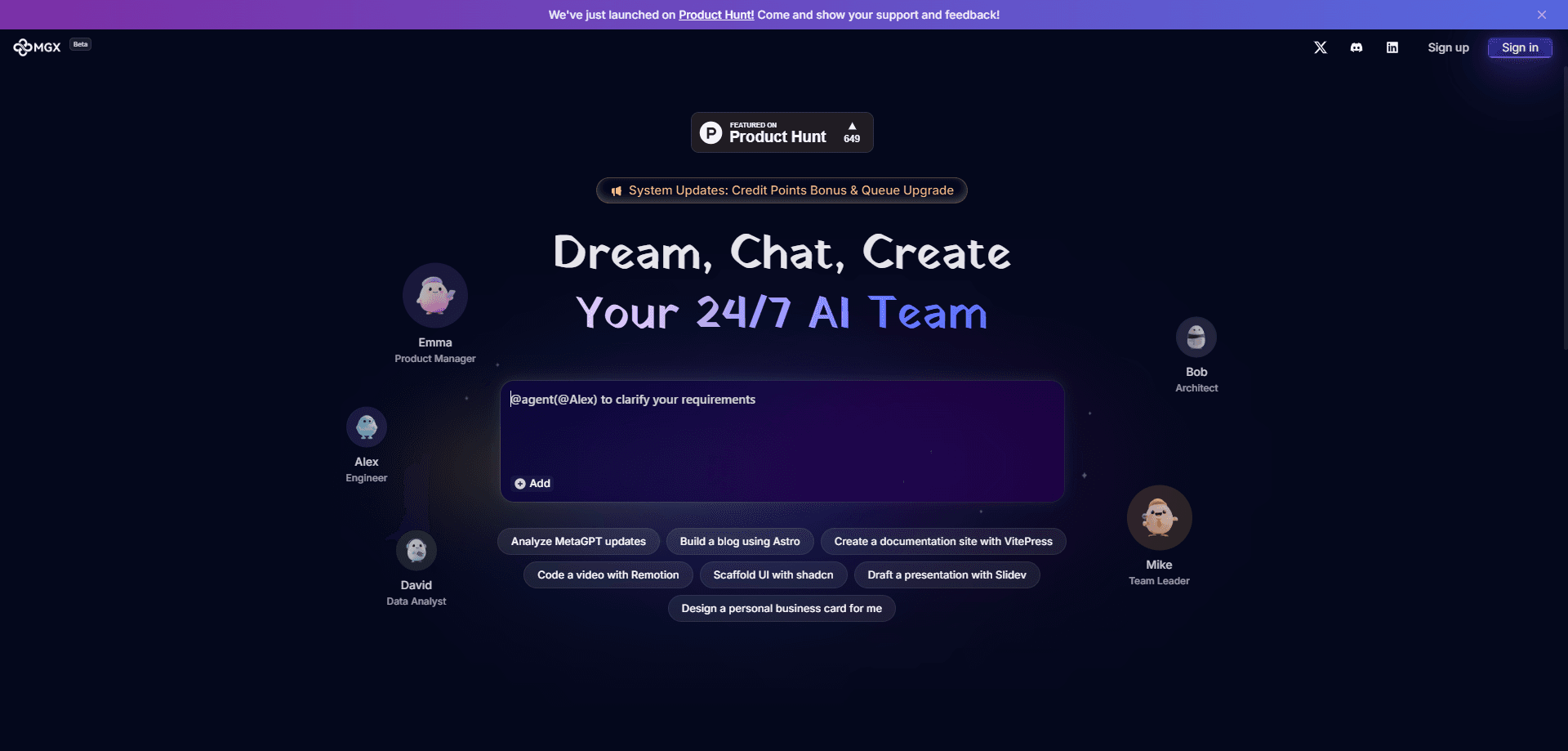
MGX runs several AI agents at once, each with a fixed role. A team lead named Mike splits the work, Emma writes the product requirements, Bob designs the architecture, Alex codes, and David handles data. You can watch them collaborate in real time instead of getting a single block of text.
Natural Language Programming
You describe the app in everyday words and MGX turns that into a plan and code. There is no setup, no local environment and no syntax to learn. The agents ask the model to follow a software company's standard steps, so the result is structured rather than improvised.
Live Project Preview
The interface shows agent progress on the left and a preview of the project on the right. You see the app take shape as it is built, then test the result in the same window. That loop makes it easy to catch a wrong turn early and request a fix.
Requirements and Design Docs
Before any code, the product and architect agents write a requirements doc and a system design. You get a clear record of what the app should do and how it will be built, which helps when you hand the project to a real developer later.
Iterative Refinement
You can send follow-up requests after each build. Tell MGX what to change, and the agents revise the code and the docs together. This keeps the plan and the app in step as your idea evolves.
Credit-Based Access
MGX runs on a credit system, so you pay for the agent work you use. New accounts start with free credits, and paid plans add more. That model fits short experiments, but heavy use adds up quickly.
Pros and cons
Pros
- Builds a working app from a plain-language description, no coding required.
- Splits work across specialist agents, so output stays structured and documented.
- Live preview lets you test and adjust the app inside the same window.
- Free starting credits make it easy to try before paying.
- Strong for prototypes, dashboards and internal tools.
Cons
- Credit-based pricing means long or repeated builds cost more.
- Large production systems still need human review and hardening.
- Quality depends on how clearly you describe the idea.
Frequently asked questions
MGX is a web platform from DeepWisdom that builds software from a natural language description using a team of AI agents. It covers planning, coding, data work and deployment instead of just autocompleting code.
Related content
Explore related tools, skills, and articles for MGX (MetaGPT X).
MGX (MetaGPT X) Alternatives

Udon
Udon · Coding · ProductivityUdon turns an Apple Silicon Mac into a home server you run from a browser, with container controls, file shares, and an optional AI sysadmin.

offstage
offstage cloud · Coding · Productivityoffstage gives AI coding agents and CI jobs a real Mac: a fresh macOS account on Apple silicon, driven over an API and billed by the second.

BotBus
Chengdu Tuyang Tusen Technology Co., Ltd. · Coding · ProductivityBotBus lets you control AI coding agents from your phone and watch: approve commands, start tasks and read results while the code stays on your desktop.