

Apiframe
Katario LLC (Apiframe) · Image
Apiframe is a REST API for Midjourney that runs V8.2 without Discord, returns four images per request, and bills 2 to 10 credits per generation.
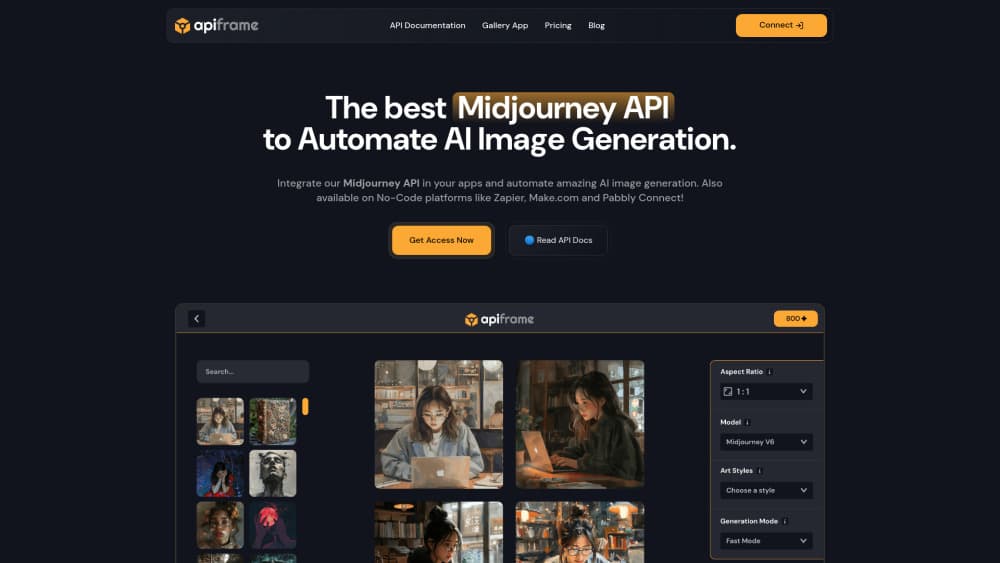
About Apiframe
What Is Apiframe
Apiframe is a managed AI image generation API from Katario LLC that puts Midjourney behind a single REST endpoint. You send a prompt, you get four images back. No Discord server, no bot tokens, no account juggling on your side.
The problem it solves is operational. Midjourney only ships inside Discord, and running it for an app means keeping accounts alive, respecting rate limits, and hoping nobody gets banned mid-launch. Apiframe keeps those accounts itself and exposes the workflow as HTTP calls. The same key also reaches 70+ other image, video, and music models, so swapping providers later is a one-line change.
The limit is control. You can't plug your own Midjourney subscription into it, you can't tune the Discord-side queue, and your output depends on Apiframe's account pool staying healthy. Credits are prepaid, concurrency is capped by plan, and everything above 100 concurrent jobs needs a sales conversation.
Getting Started
- Create an account at console.apiframe.ai. A quick phone check or a $1 card check unlocks 100 starter credits, which is enough for a few dozen test generations.
- Generate an API key in the console and keep it server side.
- Send a POST request to /v2/images/generate with your prompt and the model string set to midjourney.
- Poll the returned jobId, or pass a webhook_url and let the result arrive on its own. A finished job carries four image URLs plus a 2x2 grid.
- Pick a frame and run follow-up actions: upsample, variation, inpaint, outpaint, or pan. Each one is another call against the same job.
Product Information
A quick look at Apiframe's pricing, supported platforms, and performance.
Best for
The users, tasks, and scenarios where this tool fits best.
Users
- App developers
- Product and marketing teams
- Print-on-demand sellers
Tasks
- Prompt-to-image generation at volume
- Upscaling and variations on a chosen frame
- Ad creative testing
- Animating stills
Scenarios
- Adding an image feature to an existing app
- Per-order merch artwork
- Moving off a shared Midjourney subscription
Key features
Midjourney V8.2 Without Discord
The API runs V8.2, which became the default in July 2026, and Midjourney version upgrades land without config changes on your end. Apiframe holds and manages the underlying accounts, so the bans, login flows, and Discord quirks sit with them. You write a prompt, you get images back.
Four Images Per Request
Every job returns the classic four-image grid plus a combined 2x2 file. That matters for anything user facing: one request gives a person a choice instead of a single result they have to accept. For a storefront or a design tool, four options per call cuts the number of round trips your users make.
The Full Follow-Up Toolset
Imagine, vary, pan, zoom, and upscale are all exposed as calls. Upsampling a chosen frame costs 2 credits, variations, inpaint, outpaint, and pan cost 10. The workflow mirrors what people already do by hand in Discord, which keeps the mental model familiar for anyone on your team who has used Midjourney before.
Image to Video on the Same Key
V8.1 added native image-to-video, and V8.2 kept it. Any finished Midjourney image can be animated into a clip that extends to 21 seconds through the Midjourney Video model. Agencies testing motion concepts get a rough clip without opening a second vendor account or learning a new API.
One Key Across 70+ Models
The Midjourney API shares a request shape and a credit balance with every other model on the platform. Switching from Midjourney to another image model is a string change in the payload, not a refactor. Credits are team scoped, and each model spends at its own rate, so one balance covers image, video, and music work.
Webhooks, Polling, and Refunds
Jobs return an ID immediately, and you either poll it or hand over a webhook_url for a push when the render finishes. Credits are reserved when a job is accepted and refunded automatically if it fails. Average render time on Midjourney sits around 50 seconds, so async handling is the default rather than an option you have to build.
Pros and cons
Pros
- Removes Discord from the stack entirely, which also removes account bans and bot upkeep from your list of problems.
- Four images per generation at 2 credits per upsample gives real value per dollar compared with single-image APIs.
- One key and one request shape across image, video, and music models keeps switching costs near zero.
- Failed jobs are refunded automatically, so a bad prompt or a timeout doesn't quietly burn budget.
- Webhooks plus polling cover both event-driven and simple request-response architectures.
Cons
- You can't attach your own Midjourney account, so you're renting access rather than owning it.
- Credits are prepaid and expire within the plan cycle, which is awkward for teams with spiky seasonal usage.
- Concurrency caps start at 5 jobs on the entry plan, and high-volume pipelines need the Growth tier or above.
- Around 50 seconds per generation is slower than the 12 to 15 second averages of newer models, so latency-sensitive user flows need a queue and a placeholder.
Frequently asked questions
No. Midjourney doesn't sell a public developer API. Apiframe is a third-party layer that manages its own Midjourney accounts and exposes them over HTTP, which is why you don't need a Discord login to use it.
Related content
Explore related tools, skills, and articles for Apiframe.
Apiframe Alternatives

Google EmbeddingGemma 2
Google DeepMind · Writing · Image · CodingGoogle EmbeddingGemma 2 is a 740M-parameter open model that turns text, code, images, audio, and video frames into vectors in one 768-dimension space, running on phones and laptops.

Tractionwave
TractionWave · Image · MarketingTractionWave is an AI attention heatmap tool for static ads. Upload a PNG or JPG and it returns predicted attention, ranked hotspots, and fixes before you spend budget.

Imejis.io
Imejis.io · Image · MarketingImejis.io is an AI design studio for agents and marketing teams. Describe an image in plain words, and it writes the copy, builds the layout, reflows it to every size, then exports a finished file.