

Mind-Interveiw
MIND Interview · Leaning · Business
MIND Interview is an AI hiring platform that runs asynchronous video interviews, screens resumes, and turns each candidate's answers into a report before the next round.
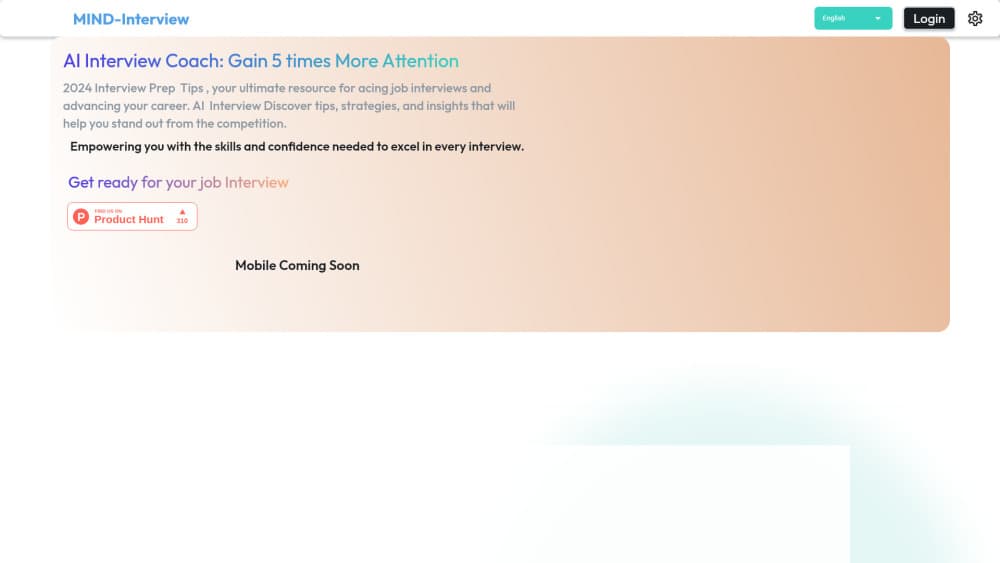
About Mind-Interveiw
What Is MIND Interview
MIND Interview is a hiring platform built around the first interview. Instead of booking a slot that works for both an HR recruiter and a candidate, the team sends an invitation with a deadline, and the candidate records answers when it suits them. The company positions the product for recruiters who lose hours to scheduling and for hiring managers who want more than a resume before they commit to a live conversation.
The platform folds three jobs into one workspace. Resume screening scores each applicant against the job description and writes a short rationale. The AI video interview records structured answers and produces an AI interview report with a transcript, a score, a five-dimension performance view, and Big Five traits inferred from expression. A translation toggle turns the whole report into the reviewer's language, so a hiring manager in another region can read the original and the translation side by side.
The limits matter as much as the features. The first interview is asynchronous, so it replaces scheduling, not conversation; a live follow-up still decides most hires. AI output is advisory, and the vendor states that HR and hiring managers make the call. Pricing sits behind a consultant conversation, which makes it hard to budget before you talk to sales. Published compliance work includes an internal ISO 42001 audit, AI Verify fairness validation, and GDPR-aligned consent and access controls.
Getting Started
- Register on the MIND Interview portal and talk to a consultant to pick a plan, either MIND Resume Lite for screening or MIND Hiring Pro for screening plus 10 AI interviews a month.
- Create a recruitment project for the role, then build the interview with an AI-generated question set or your own interview question bank.
- Send candidates an invitation link with a deadline. They choose a time, record their answers, and submit without joining a live call.
- Open the AI interview report, read the transcript against the recording, and move the candidate to the next stage or schedule a live follow-up from the same pipeline.
Product Information
A quick look at Mind-Interveiw's pricing, supported platforms, and performance.
Best for
The users, tasks, and scenarios where this tool fits best.
Users
- HR teams hiring across time zones
- Hiring managers who want evidence before a live interview
- Recruiting agencies and campus teams
Tasks
- Screening a large applicant pool
- Standardizing first-round questions
- Reviewing candidates who interview in another language
- Running a structured first round for distributed teams
Scenarios
- A first-round screen where calendars never line up
- An agency screen handed to a client
- Roles where communication matters more than keywords
Key features
Asynchronous AI video interviews
Candidates open an invitation link, pick a time before the deadline, and record answers to a fixed question set. Nobody has to coordinate calendars or take time off for the first round. The AI video interview then analyzes expression, confidence, and logic, and the recruiter reviews the original recording rather than a summary alone.
Resume screening with fit scores
Upload a job description and the platform scores each resume against it, with a brief written rationale for the match. MIND Resume Lite includes 80 resume analysis credits a month, and MIND Hiring Pro includes 150. Credits refill monthly and extra volume can be bought, so a heavy hiring month doesn't stall.
AI interview report with five-dimension analysis
Each interview produces a report that combines an overall score, an executive summary, key highlights, a five-dimension radar chart, and Big Five traits inferred from expression where the feature is enabled. Reports are encrypted and can be shared by link, which keeps hiring-manager review inside one document instead of a folder of notes.
One-click report translation
The report translates into the language your reviewers read, and a toggle switches between the original and the translated view without re-running the interview. Performance analysis, traits, and transcript translate together, and the translated view carries a machine-translation notice plus the source and target languages, so reviewers know what they are reading.
Question bank and structured interview design
Teams either let the platform generate questions from the role or draw on a custom interview question bank. Because everyone in a project answers the same prompts, candidate screening stays comparable, and reviewers spend their time judging answers instead of reconciling different interview styles.
Hiring workspace with pipeline stages
Recruitment projects hold candidate records, resume analysis, interviews, and review checkpoints in one place. Stage management shows who is waiting on a recording, who has been reviewed, and who moves to the next round. The Enterprise plan adds ATS and HRIS integration plus data retention settings matched to internal policy.
Governance and fairness controls
The vendor documents an ISO 42001-aligned AI management process with an internal audit completed, AI Verify fairness validation on its models, and GDPR-aligned consent, encrypted transfer, and access controls. For teams that have to answer procurement or legal questions, those records shorten the review.
Pros and cons
Pros
- Removes calendar matching from the first round, which is the part of hiring that eats the most recruiter time for the least information.
- Puts the recording, transcript, score, and traits in one AI interview report that reviewers can open without asking for context.
- Translation covers the full report, so a multilingual hiring team can review the same candidate without scheduling a second interview.
- A shared question bank makes candidate screening comparable across interviewers and regions.
- Compliance work is documented and specific: ISO 42001-aligned process, AI Verify validation, GDPR-aligned controls.
Cons
- No prices are published, so you have to talk to a consultant before you can compare cost against a self-serve tool.
- The credit model means a month with heavy resume volume needs top-ups or a plan upgrade, which adds an admin step.
- A human still reviews every recording, so a small team with low volume saves less time than the pitch suggests.
- Candidates who interview better in conversation may record weaker answers, and some roles still need a live first round.
Frequently asked questions
It handles the first interview and the resume screen for hiring teams. Candidates record answers to a fixed question set, and the platform returns an AI interview report that a recruiter or hiring manager reviews before deciding on a live conversation.
Related content
Explore related tools, skills, and articles for Mind-Interveiw.
Mind-Interveiw Alternatives

HireKey
HireKey · Voice & Language · Productivity · LeaningHireKey is an AI job search copilot built by a former tech recruiter. It checks role fit, tailors resumes, runs interview practice and tracks every application.

Lune
Retrograde Labs · Productivity · LeaningLune is a research search engine for scientific AI agents. It runs as an MCP server that lets Claude, ChatGPT and Cursor search peer-reviewed computer science papers and cite them.
Coddy
Coddy · Coding · LeaningCoddy is a gamified platform to learn to code through short interactive lessons in 20+ languages, with a browser editor, an AI tutor and free certificates.