

MindStudio
YouAI · Coding · Other
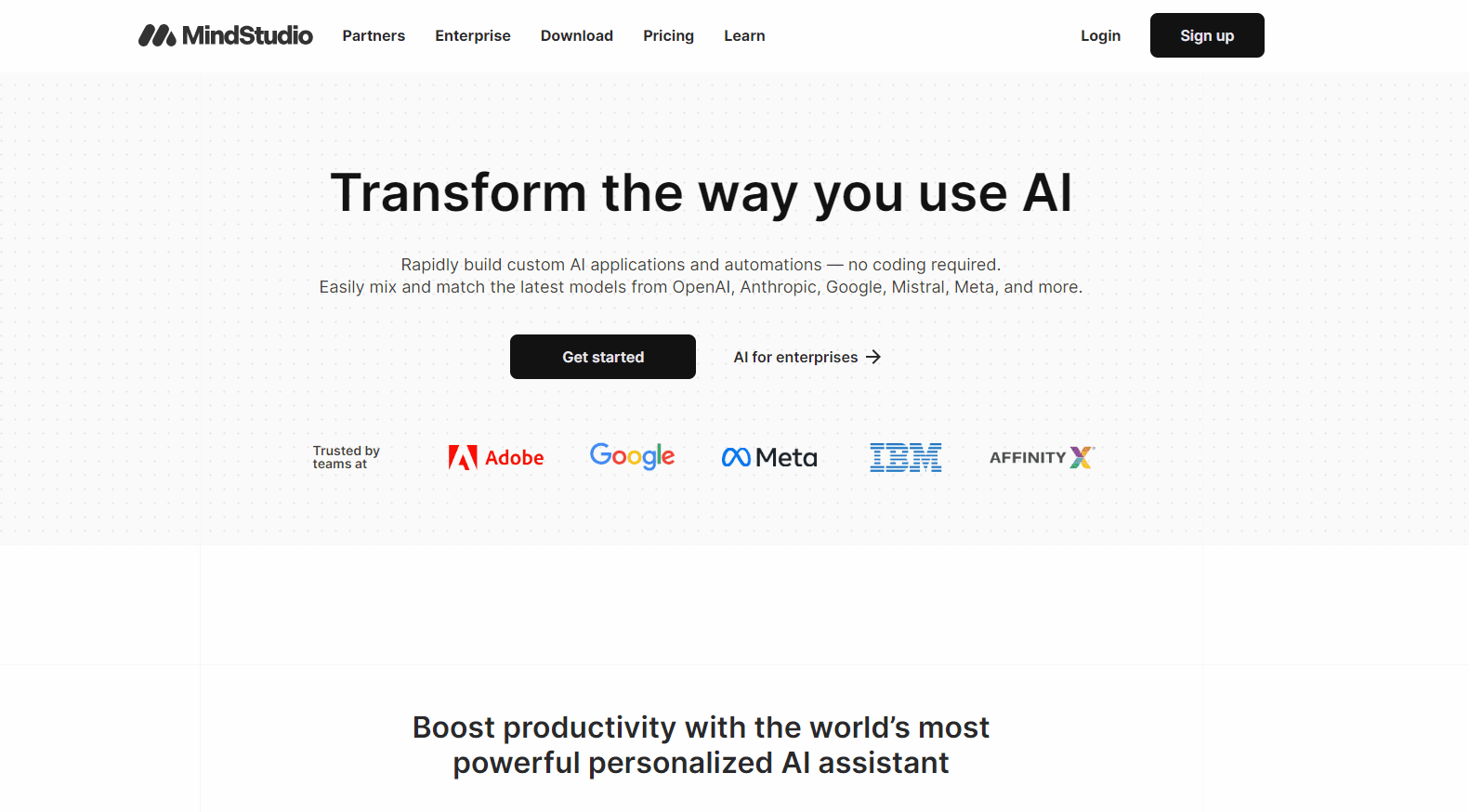
MindStudio is a no-code workspace for building and deploying AI agents, with 200+ models, 1,000+ integrations, and templates that get a working agent live in under an hour.
About MindStudio
What Is MindStudio
MindStudio is a web platform from YouAI for creating AI agents that do actual work: reading documents, calling outside apps, and running on a schedule or a trigger. It works as a no-code AI agent builder, so a support triage bot or a lead research assistant doesn't require a development team. The company says more than 400,000 agents have been deployed on the platform, and that most builds take 15 minutes to an hour.
The appeal is breadth without setup. One subscription connects you to more than 200 text, image, and video models through a service router that bills at cost, so you skip separate accounts with OpenAI, Anthropic, and Google. Around 1,000 pre-built integrations cover the usual business stack, and AI workflow automation is the point: the agent reads, decides, and writes back without a person moving files. You can drop in your own API calls or code when the blocks run out.
The limits show up at scale and at the edges. The free plan caps you at one agent and 1,000 runs a month, advanced workflows still need someone who thinks in logic branches, and the newest pieces, Remy for full app builds and the AI Media Workbench, are early and changing fast. For a small team that wants to deploy AI agents on one repeated task, the tradeoffs are easy to live with.
Getting Started
- Create a free account at mindstudio.ai with Google, Microsoft, or email, then open the dashboard.
- Start from one of the 100+ templates or describe the job you want done and let Agent Architect draft the first version.
- Add the pieces the agent needs: a prompt with instructions, a knowledge source such as uploaded files or a connected drive, and the apps it should read from or write to.
- Run a test with sample input, check the output and the run cost, then publish the agent to a share link, an embed, Slack, email, or an API endpoint.
Product Information
A quick look at MindStudio's pricing, supported platforms, and performance.
Best for
The users, tasks, and scenarios where this tool fits best.
Users
- Operations staff who repeat the same intake, sorting, or reporting task every week
- Small marketing and sales teams
- Solo builders and consultants shipping client work
Tasks
- Inbox and support triage
- Lead and company research
- Document processing
- Content production
Scenarios
- A weekly report that nobody wants to build by hand
- Testing an AI idea before committing budget
- Putting an assistant inside an existing tool
Key features
Visual Agent Builder
The core editor is a canvas of blocks: prompts, knowledge lookups, tool calls, conditionals, and loops. You drag them into a sequence, wire the branches, and watch each step run in a test panel. It's the reason people build AI agents without code here, and the same canvas accepts JavaScript or Python when a step needs custom logic.
Agent Architect
Describe the agent you want in plain language and Agent Architect writes the first draft of the workflow for you. Follow-up messages refine it, so the loop becomes conversation rather than configuration. The same idea now extends to Remy, an alpha product agent that turns a written spec into a working application with a database and tests.
Model Access Through One Router
More than 200 models from OpenAI, Anthropic, Google, and others sit behind a single connection, and MindStudio bills model usage at cost with no markup. You can also attach your own API keys if you already have contracts. For anyone comparing AI agent platform costs, this removes the surprise of separate provider invoices.
Integrations and Custom Code
Roughly 1,000 pre-built integrations cover Gmail, Google Sheets, Slack, Notion, HubSpot, Airtable, and similar services, and an HTTP block handles anything without a connector. Code blocks accept JavaScript and Python, which matters when an agent has to reshape data or call an internal endpoint that no integration knows about.
Deployment Beyond a Chat Window
A finished agent can go out as a public link, an embedded widget, a Slack bot, an email address, or an API endpoint that other systems call. Scheduled triggers run it on a timer, and the Chrome extension lets it read the page a user is already on. That range is what separates a demo from a tool people use daily.
Team Controls and Templates
The library holds over 100 templates for support, sales, research, and content work, which shortens the blank page problem. Business plans add a shared workspace, granular permissions, SSO, audit logs, spend limits, custom domains, and a self-hosted option. Per-agent budgets keep a runaway loop from turning into a surprise bill.
Pros and cons
Pros
- Building a first working agent takes minutes, and the visual blocks stay readable when the workflow grows.
- Model access runs at cost through one router, so you avoid five separate provider accounts and markup fees.
- Deployment options are unusually wide: link, embed, Slack, email, API, and a Chrome extension from the same build.
- Templates cover common business tasks, which helps when you don't know where to start.
- Run-level cost tracking and spend limits make it easy to see what each agent actually costs.
Cons
- The free plan allows only one agent and 1,000 runs per month, so real testing pushes you to the $20 Individual plan quickly.
- Complex branching logic still requires careful design, and debugging a long workflow is slower than reading code.
- Remy and the AI Media Workbench are marked alpha or new, so features and interfaces can shift under you.
- Custom domains, SSO, and self-hosting sit behind custom Business pricing, which means a sales conversation instead of a published rate.
Frequently asked questions
Support assistants, research agents, document parsers, content generators, and internal tools that move data between apps. Anything that follows repeatable steps and benefits from a model reading or writing text fits well.
Related content
Explore related tools, skills, and articles for MindStudio.
MindStudio Alternatives

Udon
Udon · Coding · ProductivityUdon turns an Apple Silicon Mac into a home server you run from a browser, with container controls, file shares, and an optional AI sysadmin.

offstage
offstage cloud · Coding · Productivityoffstage gives AI coding agents and CI jobs a real Mac: a fresh macOS account on Apple silicon, driven over an API and billed by the second.

BotBus
Chengdu Tuyang Tusen Technology Co., Ltd. · Coding · ProductivityBotBus lets you control AI coding agents from your phone and watch: approve commands, start tasks and read results while the code stays on your desktop.