MiniMax

MiniMax

MiniMax · Other · China AI

MiniMax is a multimodal AI platform whose open-weight models cover text, video, speech and music, with API pricing built for developers.

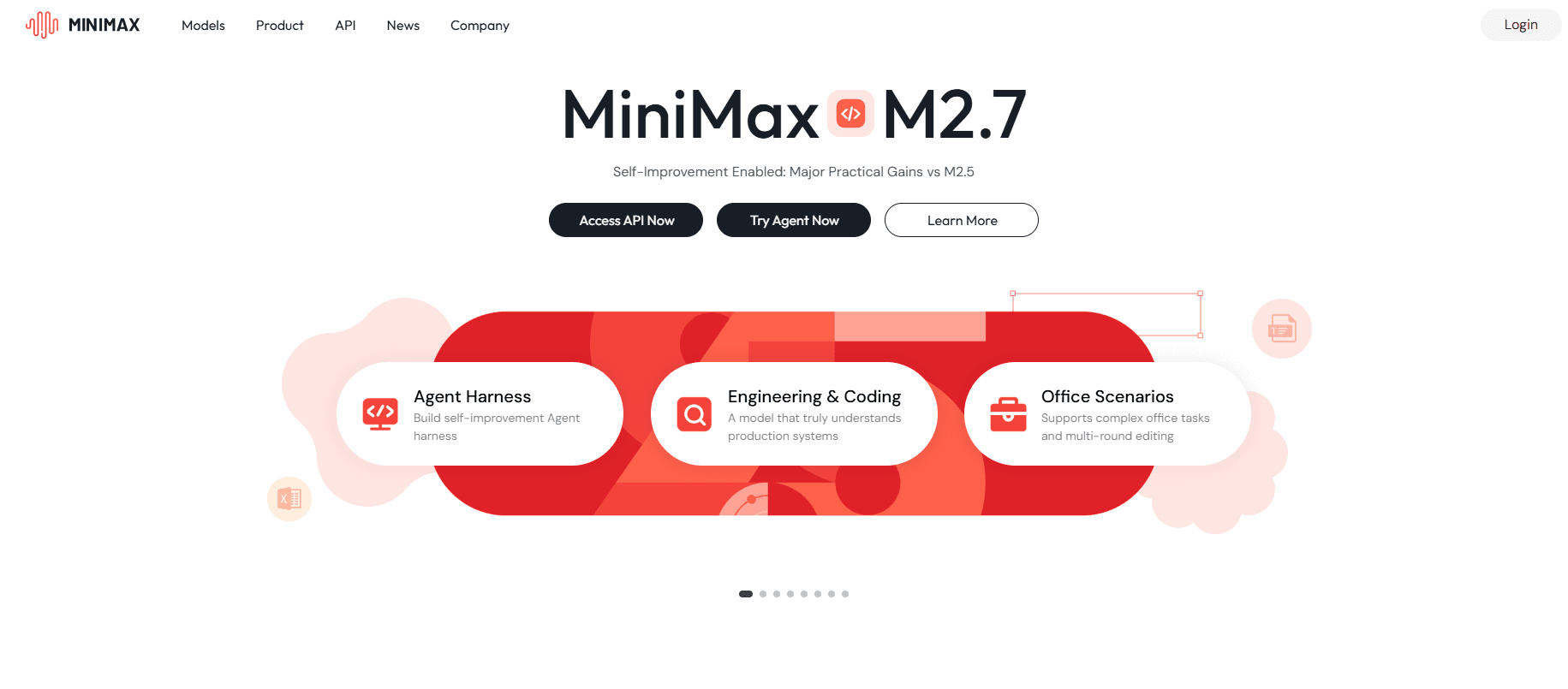
Interface preview of MiniMax

About MiniMax

What Is MiniMax

MiniMax is an AI company that builds its own foundation models, then sells access to them through a developer platform and a set of ready-made apps. The lineup spans text and coding models, a video generator, speech synthesis and music. You meet it either as an API you call from your own product or as one of the company's own apps, like MiniMax Code for coding agents or MiniMax Audio for voice work.

The thing that sets MiniMax apart is where it sits on the price-to-capability line. Its M3 text model handles a million tokens of context and ships under a permanent half-price cut, which lands input at $0.30 per million tokens. For teams burning through long documents or running agents all day, that math matters more than a leaderboard rank.

Two limits are worth knowing before you commit. MiniMax is a Chinese company, so teams with strict data-residency policies will want to read the terms closely. And the free tiers have shifted more than once, so check the current quota rather than trusting last month's thread.

Getting Started

  1. Sign up on the MiniMax open platform with a phone number or email, then complete your profile before you can create a key
  2. Create an API key in the console and copy it, since it is only shown once
  3. Pick a model for your job, M3 for long-context text and coding, H3 for video, or speech-2.8-hd for voice
  4. Send a first request through the OpenAI-compatible endpoint, or install the SDK for your language
  5. Watch usage in the console and top up balance or start a Token Plan when you outgrow the trial credit

Product Information

A quick look at MiniMax's pricing, supported platforms, and performance.

Free PlanYes
Paid Plans$22 - $132/mo
PlatformWeb, API, iOS, Android
DeveloperMiniMax
CategoryOther · China AI
Release DateFeb 2022
Latest UpdatedJun 2026
Website Visits6.6M
Website Global Rank9.1K
API AvailabilityYes

Best for

The users, tasks, and scenarios where this tool fits best.

Users

  • Indie developers and small teams
  • AI product teams shipping agents
  • Multimodal app creators
  • Voice and companion app builders

Tasks

  • Long-document analysis
  • Coding and refactoring
  • Video generation
  • Speech synthesis
  • Music generation

Scenarios

  • An agent runs for hours
  • A solo founder prototypes a voice assistant
  • A media team needs b-roll fast
  • A global app localizes audio
  • A researcher feeds a whole book into a model

Key features

MiniMax M3 and Long Context

M3 is the current flagship text and coding model, and it takes a one-million-token context window. That means you can pass an entire codebase or a stack of documents in one request instead of splitting and re-stitching them. It sits under a permanent half-price cut, so input runs $0.30 per million tokens and output $1.20 on the standard tier. For heavy users, that window and that price together are the main draw.

Open-Weight Models You Can Self-Host

MiniMax releases much of its lineup under open weights, including members of the M-series text models and MiniMax Music 3.0 on Hugging Face. Open weights mean you can download the model, run it on your own hardware and skip the per-token meter entirely. Teams with strict data rules often pick this route, since nothing leaves their servers. The trade-off is that you supply the GPUs and the operational work.

Hailuo and H3 Video Generation

The video line, sold under both the Hailuo and MiniMax H3 names, turns text prompts or reference images into short clips at up to 2K. You get text-to-video, image-to-video and first-to-last-frame control, which lets you direct how a shot moves rather than hoping. Output is billed by the second, so a 768P clip on H3 costs $0.08 per second of video. It is aimed at quick b-roll and social clips, not full production.

Speech 2.8 With Voice Cloning

The speech models, speech-2.8-hd and speech-2.8-turbo, cover more than 40 languages and seven emotions, and they support zero-shot voice cloning from a short reference clip. You can also design a voice from a text description. Expressive tags like laughs and sighs let a character sound human in a role-play or companion app. Pricing runs $100 per million characters for HD and $60 for turbo.

MiniMax Code and Coding Agents

MiniMax ships its own coding agent, MiniMax Code, and its models plug into outside tools too. MiniMax M2.7 and M2.7-highspeed are tuned for real-world engineering work, refactoring and multi-language code, and they work through Claude Code, Cursor and similar clients. The high-speed variants keep the same output while cutting latency, which matters when the agent is working in a tight loop.

Token Plan Subscriptions

Instead of pure pay-as-you-go, MiniMax offers a Token Plan with monthly tiers at $22, $55 and $132. Each tier bundles a usage quota across text, image and speech resources under one key, along with rolling five-hour and weekly windows. The top tier is built for heavy agent workflows running six to seven agents at once. For steady users, a plan is easier to budget than metered billing.

Pros and cons

Pros

  • Permanent half-price cut puts M3 input at $0.30 per million tokens, low for a million-token model
  • One platform covers text, video, speech and music, so you don't stitch together several vendors
  • Open-weight releases let teams self-host models and keep data on their own hardware
  • Speech handles 40+ languages with cloning and emotion tags, which suits companion and dubbing work
  • OpenAI-compatible endpoints mean you can swap MiniMax in without rewriting your client

Cons

  • MiniMax is a Chinese company, which can be a blocker for teams with strict data-residency rules
  • Free quotas and plan terms have changed more than once, so old tutorials may mislead you
  • Music generation is now app-only for new users, so it is no longer a clean API target
  • Some special models, like the H3 video and voice-cloning services, sit outside the Token Plan quota

Frequently asked questions

MiniMax is a Chinese AI company that builds its own multimodal foundation models and sells access through a developer API and its own apps. Its models cover text and coding, video generation, speech synthesis and music. You can call them from your own product or use the company's apps directly.

Related content

Explore related tools, skills, and articles for MiniMax.

MiniMax Alternatives

BinkBink

BinkBink

BinkBink · Other
Editor's pick

BinkBink is a free online game platform and AI game maker that lets anyone turn a short text description into a playable browser game. You can jump into hundreds of community-made games. Or describe your own idea and play it in seconds, then share it with friends. Want to create your own game? You don't need to code. No engine setup, no download, no hassle.

Free / $0View details
Audiogen

Audiogen

Audiogen Inc. · Other

Audiogen is an AI music generator built by Audiogen Inc., a small research team that spent about 2.5 years training its own generative music model and designing a web interface around it. Instead of a plain text box, this AI music tool turns the timeline into a beginner-friendly Generative Audio Workstation, or GAW, where inpainting, extending, remixing and stem editing work more like painting on a canvas. The product is still in beta, so access runs through a waitlist or an invite. Paid plans aren't published yet.

Free / Free (beta)View details
Aiml API

Aiml API

AIMLAPI OÜ · Other

Aiml API is a unified AI model API that puts more than 1000 models from OpenAI, Google, Anthropic, and others behind one endpoint and one bill. You write code against a single OpenAI-compatible schema, then switch between chat, image, video, and audio models by changing a model string. It suits developers and small teams who want multi-model access without juggling a dozen separate provider accounts, and it removes the usual billing headache that comes with testing several vendors. One key covers it all.

Free / $0 - $200/moView details

Related AI News

Space Bunny Was MiniMax M3.1 Flash, and Its Weights Are Now Public
Models

Space Bunny Was MiniMax M3.1 Flash, and Its Weights Are Now Public

A model that spent months answering queries under a cartoon codename now has a public download and a price list. MiniMax put the M3.1 Flash weights online this week, and the license has a revenue line in it.

Heat: 1,380