
Moescape AI
MOESCAPE TECHNOLOGY CORP. · Image · Chatbot
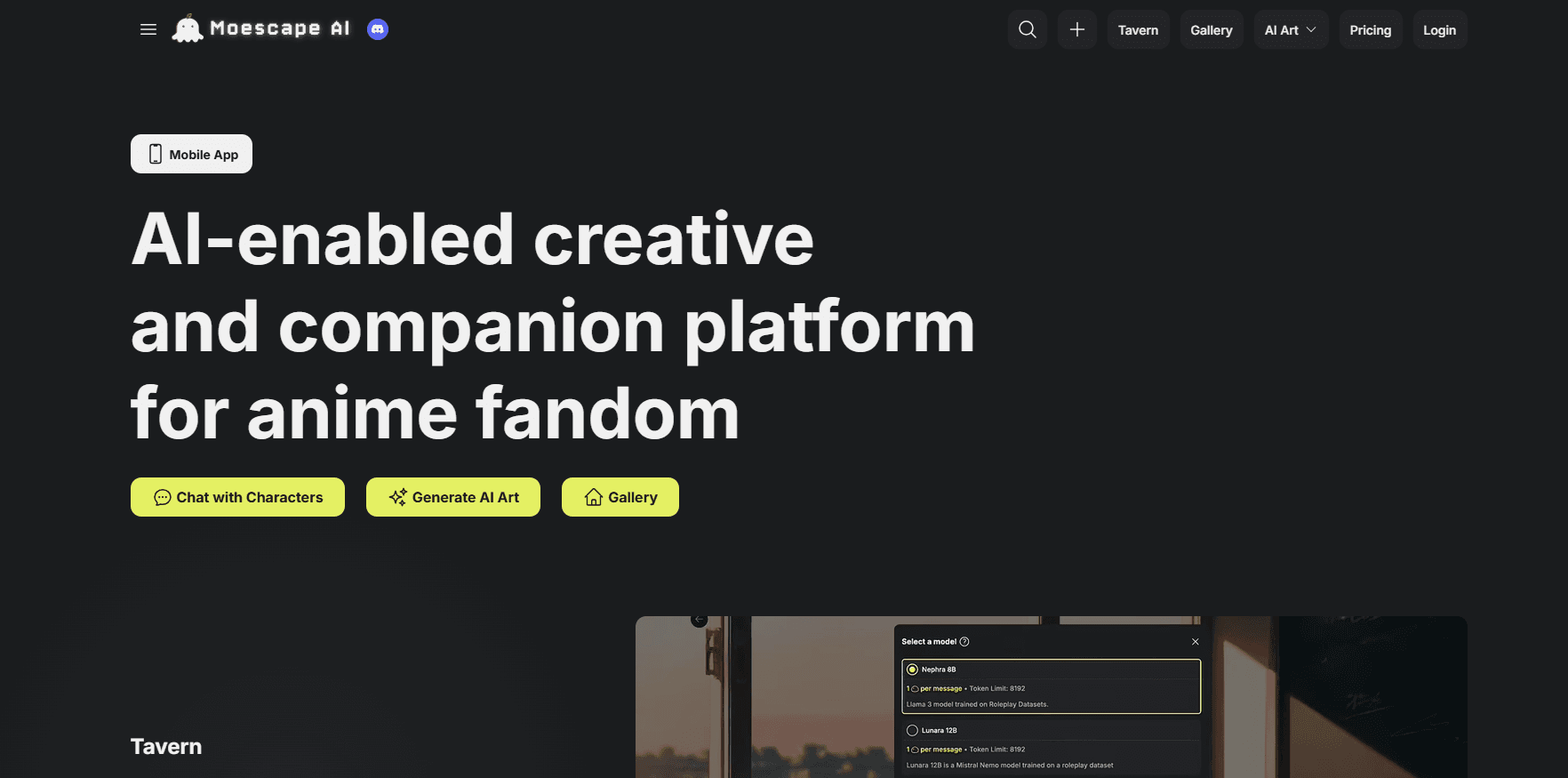
Moescape AI is an anime-focused creative platform that pairs character roleplay chat in Tavern with AI image, video, voice, and music tools, all fueled by the Mochi credit system.
About Moescape AI
What Is Moescape AI
Moescape AI is a web and mobile platform built for anime fans who want to chat with characters and make art around them without hopping between apps. The center of the product is Tavern, its roleplay chat space. Around Tavern sits a full creative toolkit: an anime image generator, video generation, voice, music, and a model hub.
The platform targets a specific audience. If you spend time in AI roleplay communities and you also want character portraits or short animated clips of the same characters, Moescape keeps that work in one place. Characters, lorebooks, and chat history sit next to the images those characters star in.
The biggest constraint is the credit economy. Most generations in Tavern and the image tools run on Mochi, the site's internal currency. You start with daily free Mochi and can earn more through milestones and community events, but heavy use pushes you toward buying packs or a subscription.
Getting Started
- Create an account at moescape.ai using Google, a phone number, or email.
- Open Tavern and either pick a community-made character or build your own with personality, backstory, and a greeting.
- Choose a chat model, then set your persona and system prompt to steer how the story unfolds.
- Switch to the image or video tools when you want art of the scene, and spend Mochi on each generation.
- Collect daily free Mochi and claim milestone bonuses to keep creating without paying.
Product Information
A quick look at Moescape AI's pricing, supported platforms, and performance.
Best for
The users, tasks, and scenarios where this tool fits best.
Users
- Anime and VTuber fans
- AI roleplay regulars
- Fan artists and writers
Tasks
- Character roleplay chat
- Anime image generation
- Short video and animation
- Worldbuilding and lore
Scenarios
- Building an original character before writing a story
- Running a serialized roleplay with friends or for an audience
- Dropping art into a roleplay session
Key features
Tavern Roleplay Chat
Tavern is the heart of Moescape. You chat with community characters or your own creations, and the platform supports fantasy, romance, and long-form stories instead of short Q&A. Multiple models let you pick between detailed narration and faster, snappier dialogue.
Multiple Roleplay Models
Moescape runs its own fine-tuned models such as Nephra 8B, Lunara 12B, Apollo 13B, and Nephra 70B, each with a different token limit and writing style. You switch models from Chat Settings inside any conversation, so a single story can change pace when you want it to.
Advanced Memory and Lorebooks
Long roleplay falls apart when a character forgets last week's events. Moescape counters that with a memory box, a memory dashboard, and Lorebooks that store world details, relationships, and recurring facts. The result is a story that builds instead of resetting.
Anime Image Generator and LoRA Training
As an anime AI art generator, Moescape handles character portraits, outfits, and anime-style scenes, with access to models like Stable Diffusion, Flux, and Illustrious-XL. You can also train a LoRA to keep one character looking the same across many images, which matters once a story grows a cast.
AI Video and Animation Tools
Moescape extends past still images with an AI video generator for cinematic moments, character animation, and video-to-video work. Ideas that start as a chat scene or a single portrait can turn into a moving clip without leaving the platform.
Voice and Music Generation
Voice tools let you experiment with how a character might sound, and AI music adds atmosphere to scenes and fictional worlds. Together they push a project past text and static art toward something closer to a full multimedia story.
Creator Economy and Mochi Rewards
Creators earn 20% commission on user messages once a public bot passes 4,000 interactions in 90 days, plus milestone bonuses for likes, model uses, and spell uses. Mochi can also come from weekly Discord contests, Reddit art challenges, and fan tips, giving active users a way to keep creating without paying.
Pros and cons
Pros
- Combines roleplay chat and anime creation tools in one platform, so characters and their artwork stay together.
- Runs several fine-tuned roleplay models, letting you trade detail for speed without switching apps.
- Memory and Lorebook features hold long stories together better than plain chat windows.
- Generous free Mochi plus creator commissions and contests lower the cost for active users.
- Covers image, video, voice, and music, so a single idea can grow into a full multimedia project.
Cons
- Most generations burn Mochi, so heavy image or video use can get expensive fast.
- No public API is documented, which blocks developers who want to build on top of it.
- The mobile app lists Japanese and English only, limiting other-language users on phones.
- The content-rating system allows mature themes, so the platform is not a fit for younger or sensitive audiences.
Frequently asked questions
Moescape AI is used for AI character roleplay and anime-style content creation. People chat with characters in Tavern, then generate matching images, video, voice, and music around the same stories.
Related content
Explore related tools, skills, and articles for Moescape AI.
Moescape AI Alternatives

Google EmbeddingGemma 2
Google DeepMind · Writing · Image · CodingGoogle EmbeddingGemma 2 is a 740M-parameter open model that turns text, code, images, audio, and video frames into vectors in one 768-dimension space, running on phones and laptops.

Tractionwave
TractionWave · Image · MarketingTractionWave is an AI attention heatmap tool for static ads. Upload a PNG or JPG and it returns predicted attention, ranked hotspots, and fixes before you spend budget.

Imejis.io
Imejis.io · Image · MarketingImejis.io is an AI design studio for agents and marketing teams. Describe an image in plain words, and it writes the copy, builds the layout, reflows it to every size, then exports a finished file.