

Monospace from Directus
Monospace Inc. (from Directus) · Coding · Business
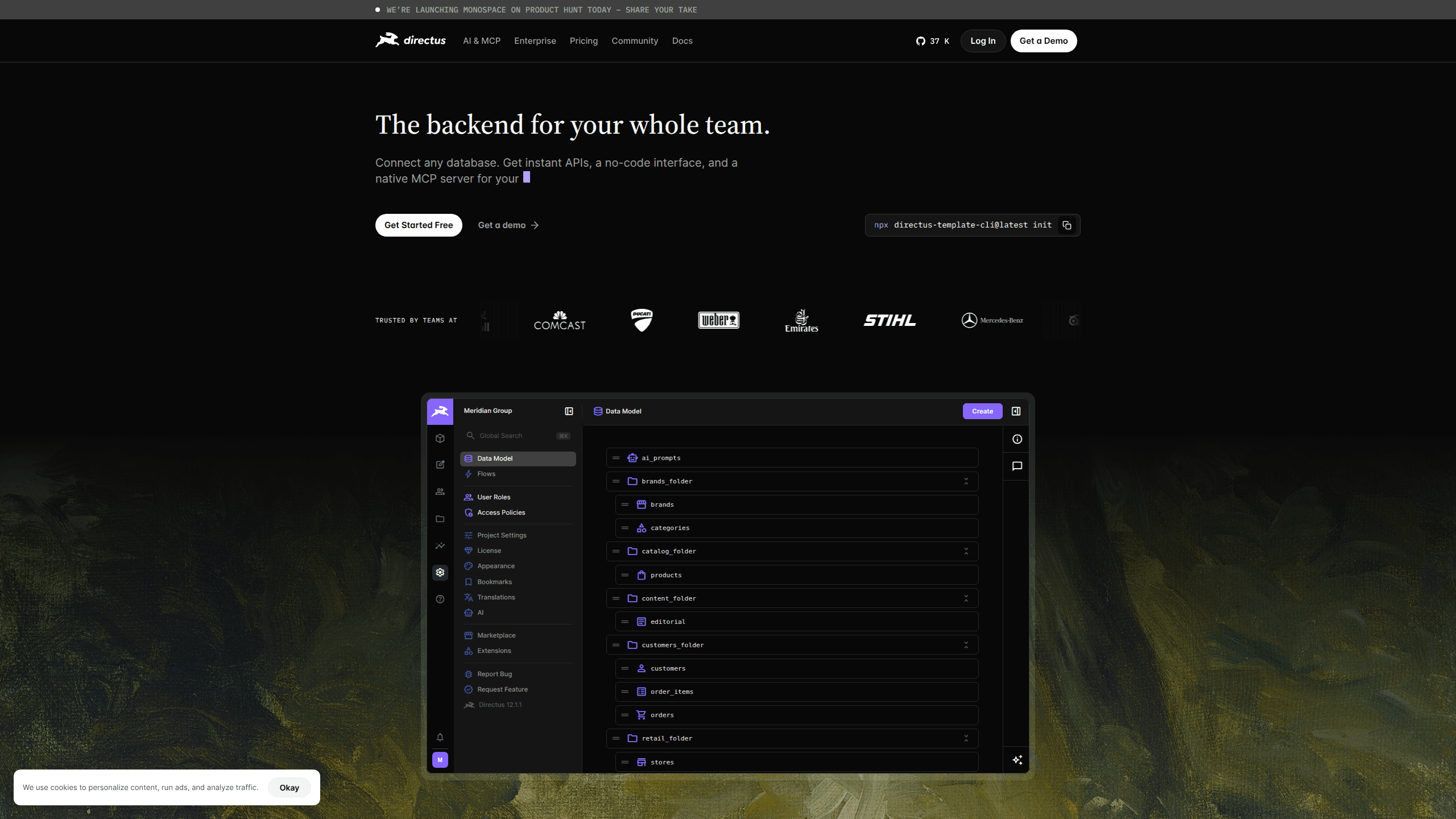
Monospace from Directus is a governed API layer that connects databases, REST APIs, and SaaS tools, then serves them as one REST API, typed SDK, and MCP server under a single permission model.
About Monospace from Directus
What Is Monospace
Monospace is a data platform built by the team behind Directus. You register a source, whether that's a PostgreSQL database, a MySQL instance, or an internal REST service, and Monospace reads its schema and maps tables to collections with fields and relations. From there the data is served four ways: a REST API, a TypeScript SDK, an MCP server for AI agents, and the Studio, a browser interface for people who don't write code.
Access happens without copies. Queries run against the live system, so nothing gets replicated into a warehouse and no ETL job sits in the middle. Permissions resolve at query time, down to rows and columns, for every caller: an application, a person at a desk, or an agent working on its own.
That last case is where the product earns its keep. Agents need write access to real records to be useful, and plenty of teams handle it by handing over a database credential and hoping. What does that credential actually allow? Everything the database does, which is usually far more than the agent needs. Monospace gives each service account or agent its own key, role, and audit trail instead.
Getting Started
- Launch an instance with the Docker Compose quick start, or book a demo for a hosted workspace.
- Create a workspace and add a data source using connection details or a connection string. Monospace introspects the schema on save.
- Check the generated collections, rename fields where the database names are cryptic, and link relations between them.
- Set roles and policies, then create a service account for each app or agent that will call the API.
- Edit records in Studio, or copy the workspace API URL and MCP endpoint into your own tooling.
Product Information
A quick look at Monospace from Directus's pricing, supported platforms, and performance.
Best for
The users, tasks, and scenarios where this tool fits best.
Users
- Backend and platform teams
- Agencies and software vendors
- Data and operations teams
- AI engineers
Tasks
- Building internal tools
- Governing agent writes
- Consolidating client backends
- Sharing curated data with partners
Scenarios
- A legacy order database that needs a modern API this quarter and can't be migrated.
- A multi-brand company that shares infrastructure but must keep customer data separated by brand.
- A support workflow where an AI agent looks up order status and refund eligibility in live systems.
Key features
Live data federation
Monospace queries each source where it lives. PostgreSQL, MySQL, MariaDB, and SQL Server connect natively, and managed services such as Supabase, Neon, and Amazon RDS work through the same connectors. Custom connectors reach internal APIs and SaaS tools. Nothing is copied, so the data you see in the API is the data in production at that second.
Four interfaces from one schema
Register a source once and Monospace builds a REST API, a typed TypeScript SDK, an MCP server, and the Studio on the same model. An app built on the REST API and an agent connected through MCP read the same collections and obey the same rules. For teams that already maintain a separate gateway for agents and an admin panel for staff, this collapses two systems into one.
Row and column level security
Roles, policies, and entitlements are set once and resolved on every request. You can hide a salary column from a contractor role or restrict a partner to the orders tied to its own account, and the filter applies inside the query rather than in the client. That differs from an MCP gateway, which can only allow or deny a tool call.
Agent identities and audit logs
Each workspace exposes its own MCP endpoint. An agent authenticates with an API key and acts with exactly that key's permissions, so you can revoke one agent without touching the others. Read, write, and schema tools each need the matching permission. Every action lands in the same audit log as human activity, which matters when someone asks which agent changed a record.
Workspaces for isolation
A workspace has its own members, roles, data sources, and API path under /api/{workspace}. Agencies can run a backend per client on one instance, and multi-brand companies can keep datasets apart while sharing the underlying servers. An instance without a license key runs on the Starter license with one workspace.
Studio and AI Assistant
Studio is the part non-developers touch. It handles record editing, the data model, and form layouts, with grid arrangement for ejected forms. The Assistant answers questions and changes records in natural language, using the signed-in user's permissions rather than a system account. Business teams get live data access without a ticket to engineering.
Pros and cons
Pros
- No migration project. Point Monospace at an existing database and it generates the API from the current schema.
- One permission model covers apps, staff, and agents, so you don't write separate authorization logic for each interface.
- Self-hosting on the free Starter license makes evaluation cheap, and the Docker Compose file is short enough to run on a laptop.
- Cross-source relations let a collection in one database reference a collection in another, resolving in a single request.
- Audit logs and per-agent keys answer the question most agent rollouts struggle with: who did this, and with what access.
Cons
- Business and Enterprise pricing is quote-only, so budgeting means talking to sales. The public numbers are add-ons: $4K/yr per extra workspace and $10K/yr for premium support.
- The connector list is still growing. SQL Server arrived in October 2026, while Snowflake, MongoDB, BigQuery, and several SaaS connectors are listed as coming soon or under consideration.
- Running it yourself means operating four containers, including PostgreSQL, RabbitMQ, and Redis, which is real work for a small team.
- The generated SDK is TypeScript only. Python and other language clients have to call the REST API directly.
Frequently asked questions
Monospace is a governed API layer for data. It connects databases and other systems, then exposes them through a REST API, a TypeScript SDK, an MCP server, and a browser Studio, with one set of permissions across all four. Directus built it, and the company now operates as Monospace Inc.
Related content
Explore related tools, skills, and articles for Monospace from Directus.
Monospace from Directus Alternatives

Udon
Udon · Coding · ProductivityUdon turns an Apple Silicon Mac into a home server you run from a browser, with container controls, file shares, and an optional AI sysadmin.

offstage
offstage cloud · Coding · Productivityoffstage gives AI coding agents and CI jobs a real Mac: a fresh macOS account on Apple silicon, driven over an API and billed by the second.

BotBus
Chengdu Tuyang Tusen Technology Co., Ltd. · Coding · ProductivityBotBus lets you control AI coding agents from your phone and watch: approve commands, start tasks and read results while the code stays on your desktop.