

N71
N71 · Leaning
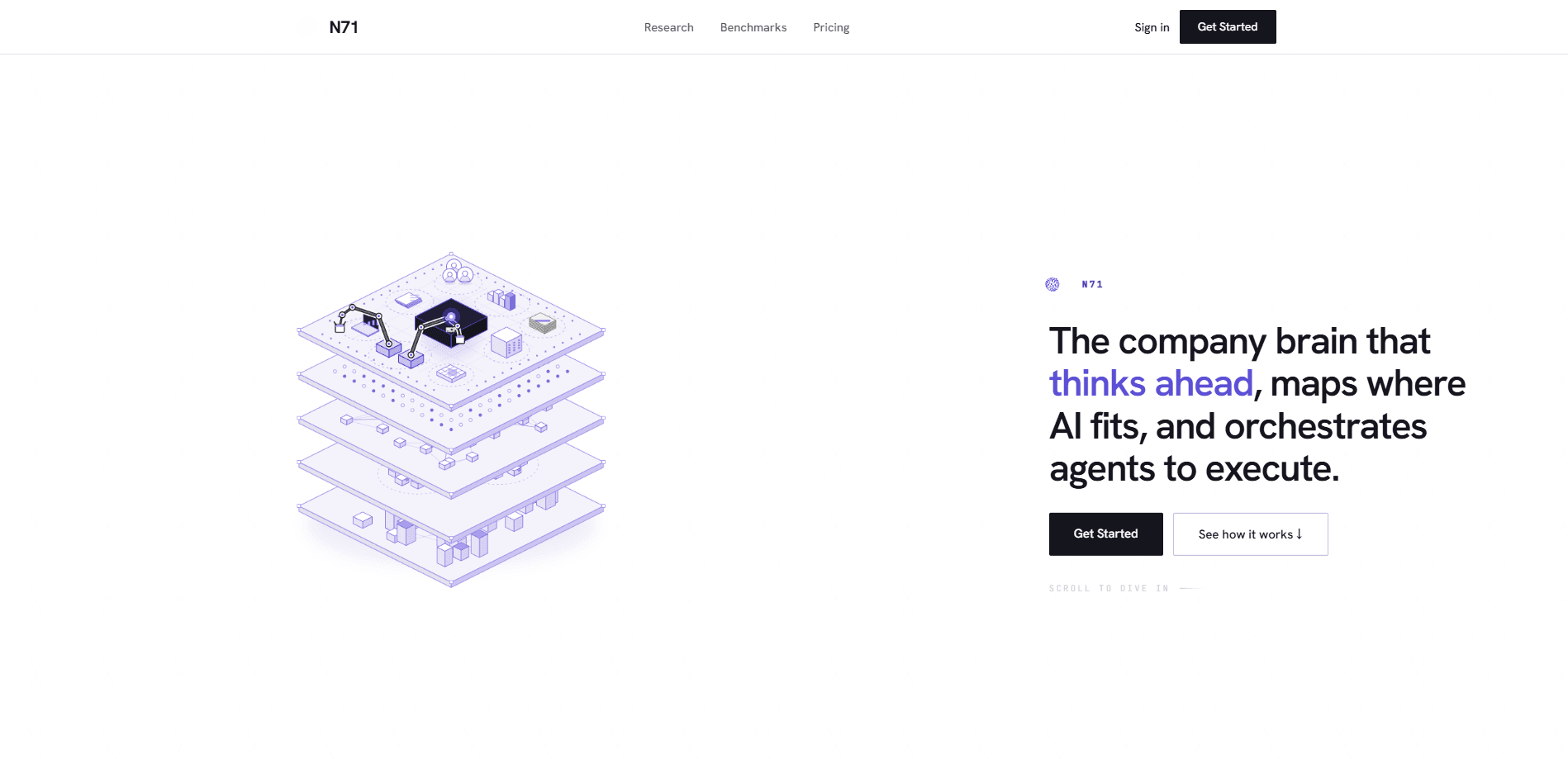
N71 is a company brain that gives AI agents shared memory and proactive context. Instead of stuffing a million tokens into one model, it connects your mail, calendar, documents, chat, and code through a single knowledge layer, then serves the right slice to whatever agent you're already using. Teams plug in over one governed MCP endpoint. Every answer comes back with its source attached. No repeated introductions.
About N71
What Is N71
N71 is a memory and retrieval layer that sits between your company's systems and the AI agents you use every day. It answers a problem plenty of teams run into: each agent starts from zero, so you end up repeating context that the whole organization already holds. N71 keeps that context in one place and hands it to whichever assistant you open next.
The pitch is a "company brain." You connect up to 17 source types, including mail, calendar, documents, chat, and repos. From there, agent memory carries across Claude, ChatGPT, Cursor, and custom agents, all through one governed MCP endpoint. You don't swap your tools. You give them something to remember with.
Why does that matter? Because every assistant you open starts from zero unless something feeds it context. N71 is that something.
The limits matter, so here goes. It's built for teams and organizations, not casual users, and the entry tier runs $49 a month for a single person. Cloud deployment is standard on the lower tiers, and data residency is only fully yours on the Sovereign plan, which is priced per deployment. The benchmark claims are N71's own runs, not independent lab results.
Getting Started
- Sign up at n71.ai and pick a tier, starting with Individual at $49 a month.
- Connect your sources one by one, opting in per source and per workspace.
- Point your MCP-compatible client, such as Claude, ChatGPT, or Cursor, at the governed endpoint.
- Ask a question and check the citations, since every answer is traced back to its origin.
- Turn on the proactive feed if you want changes surfaced before you ask for them.
Product Information
A quick look at N71's pricing, supported platforms, and performance.
Best for
The users, tasks, and scenarios where this tool fits best.
Users
- Small teams that share one brain
- Agent-heavy individuals
- Regulated organizations
Tasks
- Keeping agent answers consistent across tools
- Catching facts that change
- Recalling a detail buried in a long thread
Scenarios
- Onboarding a new teammate who needs the team's history fast
- A sales lead working a renewal
- A founder tracking what shifted overnight
Key features
Shared agent memory over MCP
N71 exposes your company's context through one governed MCP endpoint, so Claude, ChatGPT, Cursor, and custom agents all read from the same memory. The practical effect is that context isn't trapped inside a single assistant. Switch tools and the knowledge comes with you. Each call is authorized per request, which matters if you need to show who touched what.
Retrieval built for long context
The memory core doesn't try to stuff a million tokens into a model's window. Instead it retrieves the relevant occurrences by topic, collapses a huge haystack down to a few thousand tokens, and hands a 128k-window model a slice it can actually answer. According to N71's published MRCRv2 results, its tiers hold up past 512k without the collapse you'd expect beyond a model's native window.
Proactive feed
Beyond answering questions on demand, N71 surfaces what changed across your connected sources. Think of it as a morning digest that only includes things that moved. It's the difference between pulling context and being told about it, and it fits teams that would rather see a shift than go looking for one.
Full provenance on every answer
Every answer is cited back to its source. That single habit changes how you use an AI assistant at work, because you can verify a claim instead of trusting it. For anyone who's been burned by a confident wrong answer, the citations are the part that makes the rest usable.
Entity-level permissions
On the Team tier, a shared workspace comes with entity-level permissions, so you can grant granular slices of memory rather than all-or-nothing access. Agents act under your permissions through the endpoint, which means you keep the same boundaries you'd expect from a human teammate.
Deployment options that include air-gapped
Below the top tier you get cloud hosting with source-by-source and workspace-by-workspace opt-in. The Sovereign plan goes further, running in-boundary with connected sovereign or fully air-gapped tiers. N71 says this architecture is running today in a regulated government environment, which is the kind of deployment most memory tools don't offer.
Pros and cons
Pros
- Works with the agents you already use: Claude, ChatGPT, and Cursor connect through a single MCP endpoint, so there's no new assistant to learn.
- Citations on every answer: provenance is built in, which makes the output easier to trust and verify.
- Real governance for teams: entity-level permissions and per-call authorization suit organizations that can't hand over blanket access.
- Air-gapped option: the Sovereign tier covers institutions that need data to stay inside their perimeter.
- Published benchmarks: N71 names the models and graders behind its numbers instead of making vague claims.
Cons
- No free plan: there's no way to try it before paying, and the cheapest tier is $49 a month for a single user. That's a real barrier if you just want to test the idea.
- Team pricing adds up: $250 a month covers five seats, then $39 for each extra person, so a mid-size team pays a meaningful annual figure.
- Benchmark numbers come from N71 itself: the results look strong but are self-reported, so treat them as vendor claims until the method behind them is public.
Frequently asked questions
It's an AI agent memory layer. It connects your company's systems and feeds the relevant context to your agents, so shared memory for AI agents stops being a separate setup per tool. You connect sources, and the memory follows you into whichever MCP-compatible agent you open.
Related content
Explore related tools, skills, and articles for N71.
N71 Alternatives

HireKey
HireKey · Voice & Language · Productivity · LeaningHireKey is an AI job search copilot built by a former tech recruiter. It checks role fit, tailors resumes, runs interview practice and tracks every application.

Lune
Retrograde Labs · Productivity · LeaningLune is a research search engine for scientific AI agents. It runs as an MCP server that lets Claude, ChatGPT and Cursor search peer-reviewed computer science papers and cite them.
Coddy
Coddy · Coding · LeaningCoddy is a gamified platform to learn to code through short interactive lessons in 20+ languages, with a browser editor, an AI tutor and free certificates.