
NEX
NEX · Image
NEX is a media technology company behind IKON-1 and NEX Studio, a web app for controllable AI image generation and editing, plus custom models built for brands.
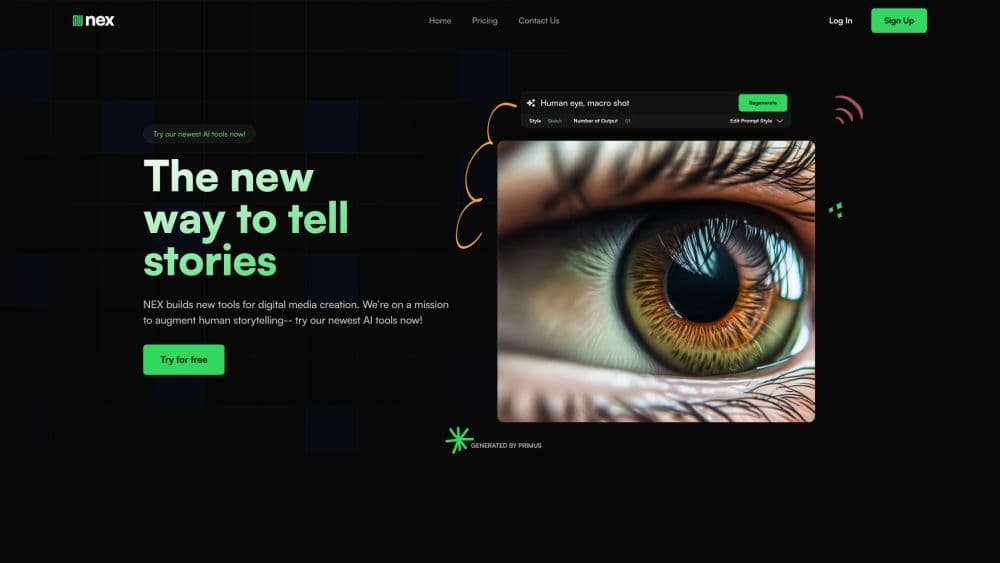
About NEX
What Is NEX
NEX is a media technology company that builds AI models for visual work. IKON-1 is a controllable AI image model, and its studio sits at nex.art, where you write a prompt, attach reference images, and steer the result instead of rerolling until something looks right. The company also trains private models for brands that need the same product, character, or packaging to survive a hundred variations.
The problem it targets is control. Most text-to-image tools treat your prompt as a suggestion, so a character drifts between shots and a product changes shape. NEX's answer is a layer of image controls it calls Control Blocks, paired with its own model, IKON-1, which reads text and pictures together. In August 2024 the studio added multimodal prompting, and later brought Flux 1.1 into the same workspace, so you can switch models without switching tabs.
Three limits frame the product. Everything runs in a browser, there's no desktop app. Access runs on monthly credits that don't carry over, so unused balance is gone at the end of the cycle. And the company has shifted its sales focus toward brand marketing work: nex.art now redirects to a site aimed at consumer goods teams, which makes the self-serve studio harder to find than it used to be.
Getting Started
- Open nex.art and create an account. A small credit balance comes with the free entry point, enough to test a handful of generations.
- Choose a model in NEX Studio. IKON-1 handles reference-driven work; Flux 1.1 is the pick when you want a familiar look and don't need image controls.
- Set your controls. Type the prompt, then add reference images for composition, subject, or style. Each added block narrows what the model is free to invent.
- Generate and judge. One image costs a credit. If the framing is right but details are off, edit the result rather than starting over.
- Export at the size you need and keep the prompt recipe with it, since the same control stack is what makes the next image match this one.
Product Information
A quick look at NEX's pricing, supported platforms, and performance.
Best for
The users, tasks, and scenarios where this tool fits best.
Users
- Brand and product marketers
- Concept artists and illustrators
- Small agency teams
Tasks
- Keeping a character recognizable across a campaign
- Turning a rough sketch into a finished render
- Producing product shots without a studio booking
- Testing a visual direction before committing budget
Scenarios
- Quarterly campaign production
- Pitching a look to a client
- Building a small on-brand image library without a retoucher
Key features
Control Blocks for Image Prompting
Control Blocks is NEX's name for the layer that takes image inputs alongside text. You attach a reference for composition, one for the subject, or one for style, and the model works within those bounds. The point is repeatability. Stack the same blocks and you get variation in the details you left open, not in the parts you pinned down.
IKON-1 and Multimodal Prompting
IKON-1 is NEX's own image model, launched in August 2024 with prompting that reads pictures as well as words. In practice that means you can point at a photograph and ask for the same arrangement with a different subject. The model was built for controlled output rather than wild range, so prompts that lean on references tend to land closer than long descriptive paragraphs.
NEX Studio as a Multi-Model Workspace
The studio hosts more than one model. IKON-1 sits next to Flux 1.1, and you pick per job. Flux covers the familiar text-to-image look and the broader style range that comes with it. Switching models keeps your project in one place, which matters when a campaign mixes controlled product shots with looser editorial frames.
Style Presets With Named Recipes
NEX ships presets with names you can actually search for, such as Labeled Cutaway Diagram, Window Shot, and Watercolor. Each one is a starting stack rather than a filter. You get a recognizable format in one click, then adjust the controls underneath to fit your subject.
Custom Model Development for Brands
Beyond the studio, NEX builds models around a single company's products. The goal is brand-consistent visuals: same packaging, same character, same visual grammar across every asset, which is the part stock models struggle to hold. This is the part of the business the company now leads with, and it's sold as a project rather than a subscription you buy off a page.
Credit-Based Generation and Editing
Usage runs on platform credits, handed out monthly and not carried over. An image generation costs one credit, a retouch of an existing result costs four, and a video generation costs ten. The gaps tell you where the real compute goes: fixing a frame is priced as heavier work than making one, so iterating on details costs more than exploring ideas.
Pros and cons
Pros
- The control layer is the product. Reference images do more work than prompt wording, so a character or package stays recognizable across a set.
- Two models in one workspace, IKON-1 for controlled work and Flux 1.1 for range, saves a second subscription for most small teams.
- Named style presets shorten the path to a usable first frame, which matters when you're showing options rather than polishing one image.
- Custom model development covers the case where nothing off the shelf will hold a brand's visual identity.
- Editing an existing result costs credits but keeps the composition, so a near-miss doesn't mean starting from zero.
Cons
- Pricing has gone opaque. The studio runs on credits, but the site now pushes custom quotes, so you can't price a plan from a public page.
- Credits expire monthly. If your work comes in bursts, you pay for capacity in the quiet weeks and still run short in the busy ones.
- There's no public API or developer documentation, so teams that want generation inside their own tools have to wait for a partnership conversation.
- The self-serve studio is no longer the company's main pitch, and nex.art redirects to a brand-marketing site, which leaves individual creators guessing how long the product stays as it is.
Frequently asked questions
NEX is a media technology company that builds AI image models for controlled visual output. Its main products are IKON-1, an image model with multimodal prompting, and NEX Studio, a web workspace where you generate and edit images using text plus reference images.
Related content
Explore related tools, skills, and articles for NEX.
NEX Alternatives

Google EmbeddingGemma 2
Google DeepMind · Writing · Image · CodingGoogle EmbeddingGemma 2 is a 740M-parameter open model that turns text, code, images, audio, and video frames into vectors in one 768-dimension space, running on phones and laptops.

Tractionwave
TractionWave · Image · MarketingTractionWave is an AI attention heatmap tool for static ads. Upload a PNG or JPG and it returns predicted attention, ranked hotspots, and fixes before you spend budget.

Imejis.io
Imejis.io · Image · MarketingImejis.io is an AI design studio for agents and marketing teams. Describe an image in plain words, and it writes the copy, builds the layout, reflows it to every size, then exports a finished file.