

NextGenAI by OpenAI
OpenAI · Leaning · Business
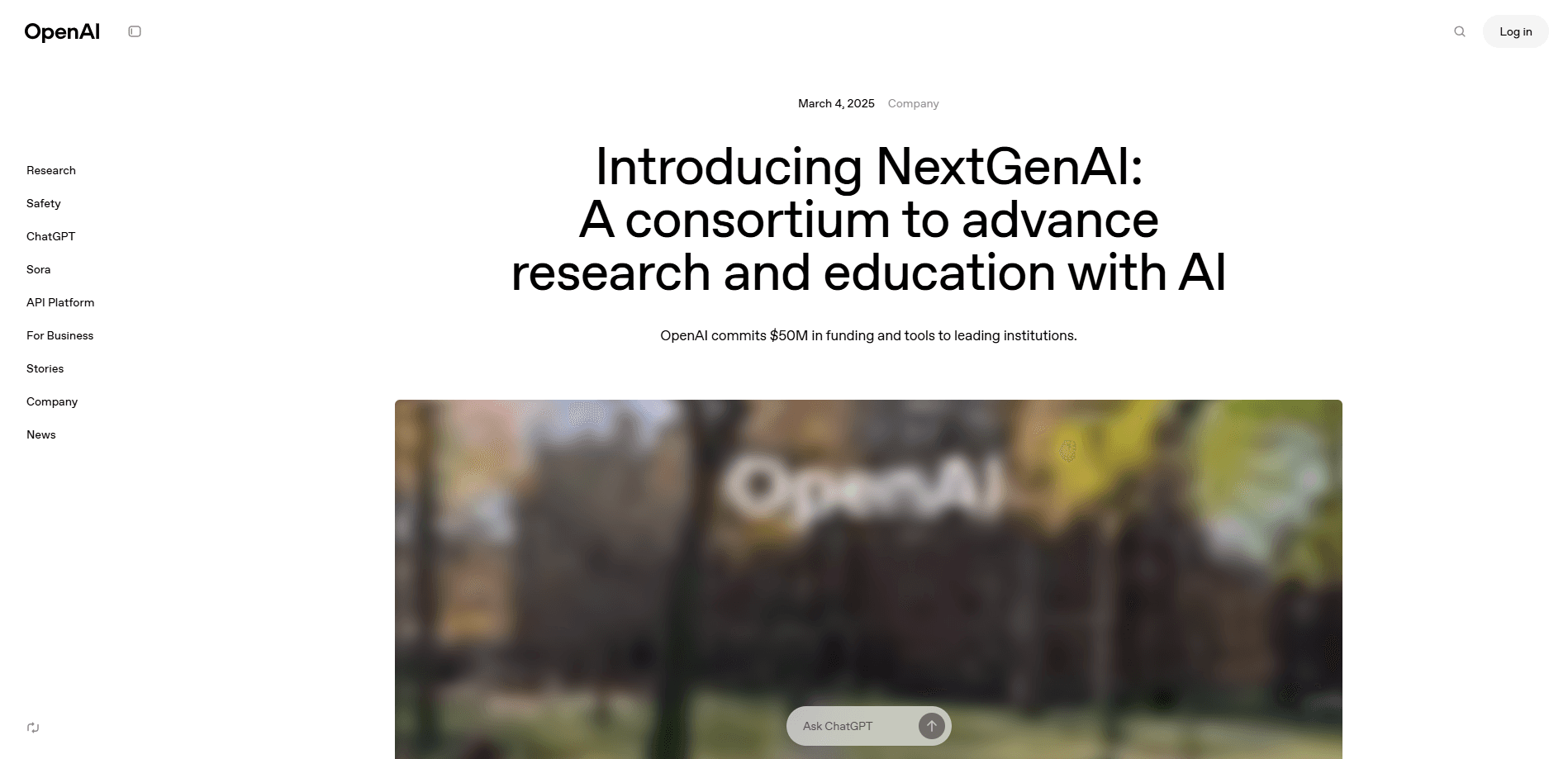
NextGenAI is an OpenAI-backed consortium with 15 leading research institutions, funded by a $50 million commitment of grants, compute, and API access to speed up research and reshape education.
About NextGenAI by OpenAI
What Is NextGenAI by OpenAI
NextGenAI is a research and education consortium that OpenAI launched in March 2025 alongside 15 founding partners. The group pools OpenAI funding, compute, and API access so universities, hospitals, and libraries can push their own AI work further than any one of them could alone. It's the clearest example of AI research funding aimed squarely at academia.
The point isn't a product you sign into. It's an academic AI partnership built on funding and collaboration. Members get research grants plus direct access to OpenAI's models through the API, and they use that to attack problems in medicine, science, and teaching. Texas A&M, for example, runs a Generative AI Literacy Initiative, while Oxford is digitizing rare texts from its Bodleian Library.
The obvious limit is who can take part. Founding membership is fixed to the named institutions, and there's no open application for a solo researcher or a smaller school. Individual users who want the same tools are better served by ChatGPT Edu or a standard OpenAI API account.
Getting Started
- Check whether your institution is one of the 15 named founding partners, since participation runs through the partner list rather than a public signup.
- If you're at a partner school, reach out through your university's research or IT office to learn how NextGenAI grants and API credits are allocated internally.
- Work with your institution's team to scope a project, such as a research study, a teaching pilot, or a digitization effort.
- Apply the OpenAI API and compute funding to train models, transcribe archives, or build classroom tools.
- Share results with the consortium, then look for follow-on funding as OpenAI expands the program's reach.
Product Information
A quick look at NextGenAI by OpenAI's pricing, supported platforms, and performance.
Best for
The users, tasks, and scenarios where this tool fits best.
Users
- University researchers
- Educators and curriculum teams
- Students at partner institutions
Tasks
- Accelerating medical research
- Digitizing archives and rare texts
- Building AI literacy curricula
Scenarios
- A lab that needs compute but can't fund a cluster
- A library sitting on unscanned collections
- A university planning an AI curriculum
Key features
$50M in research grants and compute
The headline commitment is $50 million spread across research grants, compute funding, and API access. For a lab, this means the cost of running experiments shifts off the department budget, which is often the difference between a stalled idea and a funded one.
Direct API access to OpenAI models
Members get API access so they can train and fine-tune their own models and build applications on top of OpenAI's stack. MIT, for instance, uses this to develop new tools, which matters for teams that need raw model access rather than a chat interface.
A 15-institution research network
The founding group spans Caltech, MIT, Harvard, Oxford, Duke, Howard, and others, plus Boston Children's Hospital and the Boston Public Library. That mix of universities, a hospital, and a public library means projects cross disciplines instead of staying inside one department.
Education and AI literacy programs
Several partners are building teaching around the funding. Texas A&M's Generative AI Literacy Initiative gives hands-on training, and Howard is developing curricula and new teaching methods. For educators, this is the part of the consortium closest to their day-to-day work.
Real-world research applications
The consortium frames its work around concrete problems rather than demos. Ohio State applies AI in education, digital health, energy, and agriculture, while Duke researchers use it to map which scientific fields gain the most from AI.
Pros and cons
Pros
- Puts $50 million of OpenAI grants, compute, and API access behind academic research instead of leaving labs to fund it alone.
- Direct API access lets institutions train and fine-tune their own models rather than only using hosted chat tools.
- The partner list covers universities, a children's hospital, and a public library, so projects cross institutions and disciplines.
- Funds both research and classroom work, which gives education teams the same resources as research labs.
- Openly tied to OpenAI's education efforts, so follow-on programs like ChatGPT Edu pick up where NextGenAI leaves gaps.
Cons
- Membership is limited to the 15 named founding partners, so individuals and other schools can't simply apply.
- OpenAI hasn't published a public pricing sheet because there's no direct subscription, which makes budgeting hard for outsiders.
- Program details and next steps come mainly through partner institutions, so outside observers get limited visibility into how funds are used.
Frequently asked questions
It's a consortium OpenAI launched in March 2025 with 15 founding research institutions, backed by $50 million in research grants, compute funding, and API access. Its goal is to speed up research breakthroughs and help reform education with AI.
Related content
Explore related tools, skills, and articles for NextGenAI by OpenAI.
NextGenAI by OpenAI Alternatives

HireKey
HireKey · Voice & Language · Productivity · LeaningHireKey is an AI job search copilot built by a former tech recruiter. It checks role fit, tailors resumes, runs interview practice and tracks every application.

Lune
Retrograde Labs · Productivity · LeaningLune is a research search engine for scientific AI agents. It runs as an MCP server that lets Claude, ChatGPT and Cursor search peer-reviewed computer science papers and cite them.
Coddy
Coddy · Coding · LeaningCoddy is a gamified platform to learn to code through short interactive lessons in 20+ languages, with a browser editor, an AI tutor and free certificates.