
Nova3D
RareSense · Image · Coding
Nova3D is an AI 3D generator and part-aware 3D asset generator that writes Blender Python construction code instead of spitting out a single fused mesh. It's code, not a blob. Type a sentence or drop a photo and you get a structured GLB with named parts, a real assembly hierarchy, joint pivots, and unwrapped UVs. That matters because the asset stays editable by name after generation, which most diffusion-based text to 3D tools won't do.
About Nova3D
What Is Nova3D
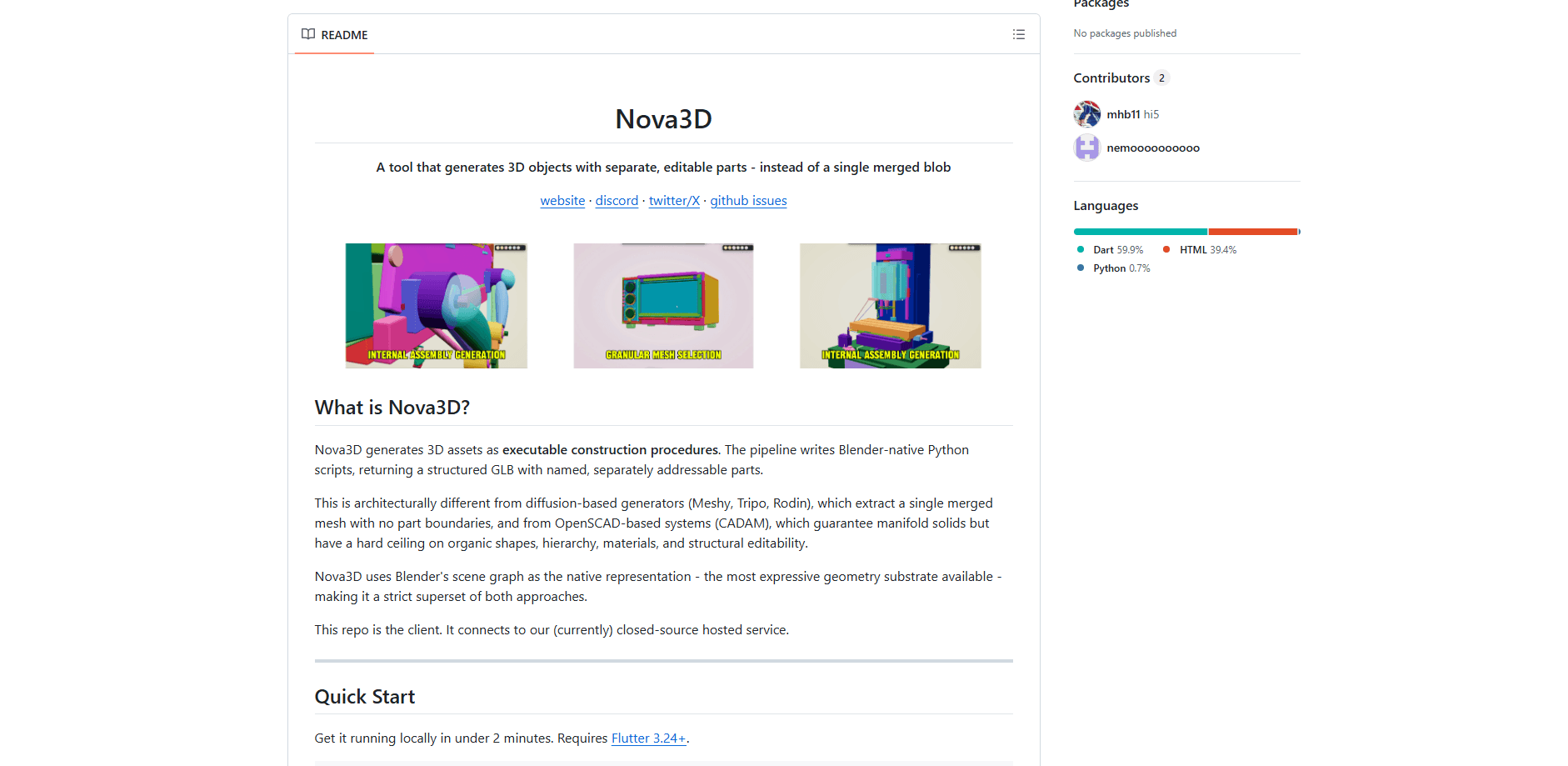
Nova3D approaches AI 3D generation from a different angle than the usual diffusion pipeline, and it's a standout example of part-aware 3D generation. Most image to 3D and text to 3D generators extract one merged mesh that looks fine in a render but falls apart the moment you try to edit, rig, or pipeline it. Nova3D has an LLM write Blender Python that a headless Blender instance then executes, validates, and repairs. The mesh is just the compiled output of that program.
Parts have names. Hierarchy is intact. Joints are real. You can inspect, restyle, articulate, and re-export without regenerating the whole thing.
It's worth knowing the limits. The hosted generation backend is closed-source, so you can't run the model locally. The open repository ships the clients: a Flutter web app, an MCP server, and a Blender add-on. Bring your own LLM API key (OpenRouter, OpenAI, Anthropic, or Gemini) if you self-host the client.
Getting Started
- Sign in to the Nova3D web client with a Google or email account.
- Add a provider API key under Settings if you're running the open client yourself.
- Type a text prompt, or attach a reference photo to guide the spatial logic.
- Generate, then edit any part by name in the built-in Three.js viewport.
- Export the structured GLB with its named hierarchy and PBR textures.
Product Information
A quick look at Nova3D's pricing, supported platforms, and performance.
Best for
The users, tasks, and scenarios where this tool fits best.
Users
- Game developers
- Technical artists
- AI agent builders
Tasks
- Turning a photo into an editable 3D asset
- Restyling a single component
- Building articulated objects
Scenarios
- Prototyping game props
- Product configurators
- Robotics and AR scenes
Key features
Code-Native Generation Pipeline
Nova3D runs prompt or image through an LLM that writes Blender Python, then a headless Blender executes, validates, and repairs the script. The mesh is the compiled output, not the source of truth. So what does that buy you? Because the asset is a program, it's inspectable and programmable by default.
Part-Aware Structure
Every asset comes back with named, separately addressable parts. A 232-part kart can be exploded, labeled, and picked apart in the viewer. That's the point. This is the core difference from diffusion generators like Meshy or Tripo, which extract a single merged mesh with no part boundaries.
4K PBR Texturing
Assets ship with full PBR material sets up to 4K: albedo, normal, roughness, metallic, ambient occlusion, and height. You can restyle from a prompt too, repainting a raygun or a petrified snail without rebuilding the geometry.
Automatic UV Unwrapping
Parts get packed into clean, non-overlapping atlases with even texel density, so they're ready to paint the moment they arrive, which means you skip one of the most tedious and error-prone manual steps in a typical 3D production workflow entirely.
Free Rigging from Declared Joints
The construction code declares every joint's axis and how far it may turn, so movable parts animate without anyone rigging them. The wheels on the kart turn because the asset already knows where its own axles are. No rig needed.
MCP Server for AI Agents
nova3d-mcp exposes the pipeline as a callable tool inside Codex, Cursor, VS Code, Visual Studio, and Claude Code. One tool call returns a structured model, which lets agents generate 3D assets as part of a larger task.
Self-Hostable Open Client
The Flutter web client is open source and connects to the hosted service with no local backend. BYOK keys stay in that browser profile and are cleared on sign-out, and analytics stays off unless you supply a PostHog token at build time.
Pros and cons
Pros
- Parts keep their names, hierarchy, and pivots, so editing one component doesn't force a full regeneration.
- Cleaner silhouette control and sharper feature delineation than merged-mesh diffusion generators, according to the project's own comparisons.
- UV unwrapping and PBR texturing are handled automatically, skipping a slow manual stage.
- Open clients with an MCP server mean it slots into existing agent and editor workflows.
Cons
- The hosted generation backend is closed-source, so you can't run the model on your own hardware.
- You need an LLM provider key to use the open client, which adds a separate cost and setup step.
- Output quality still depends on the underlying LLM's grasp of Blender scripting, so odd prompts can produce messy geometry.
Frequently asked questions
It generates structured 3D assets as GLB files built from Blender Python construction code. You get named parts, an intact hierarchy, real joints, and PBR textures instead of one fused mesh.
Related content
Explore related tools, skills, and articles for Nova3D.
Nova3D Alternatives

X Ray Interpreter
X-ray Interpreter · ImageX Ray Interpreter is a web-based AI radiology tool that turns X-rays, CT scans, MRI, ultrasound, and PET images into plain-language reports. You upload a scan, get a preliminary X-ray interpretation in moments, then ask follow-up questions if something needs explaining. It works as a second opinion and a learning aid, not as a medical diagnosis.

Aieasypic
AIEasyPic · ImageAIEasyPic is an AI image generator that turns plain text prompts into finished artwork in seconds. You can also train custom models on your own photos, swap faces in existing images, and create short video clips from text, all from a browser. It suits casual creators who want quick visuals and hobbyists who want to build a personal model without touching any code.

Chargen
Chargen · ImageChargen is an AI character generator and worldbuilding toolkit built for Dungeons & Dragons and other tabletop RPGs. It turns a one-line idea into a painted character portrait, spins up NPCs, monsters, maps and encounters from the same session, and keeps every creature's details close at hand. The tabletop RPG art side runs on a credit system called Gold, while the text generators stay free for everyone.