

Numa | AI for Dealerships
NumberAI, Inc. · Productivity · Marketing
Numa is an AI operating system for car dealerships, combining voice agents, a shared inbox, and real-time CSI alerts so service teams stop losing customers to missed calls.
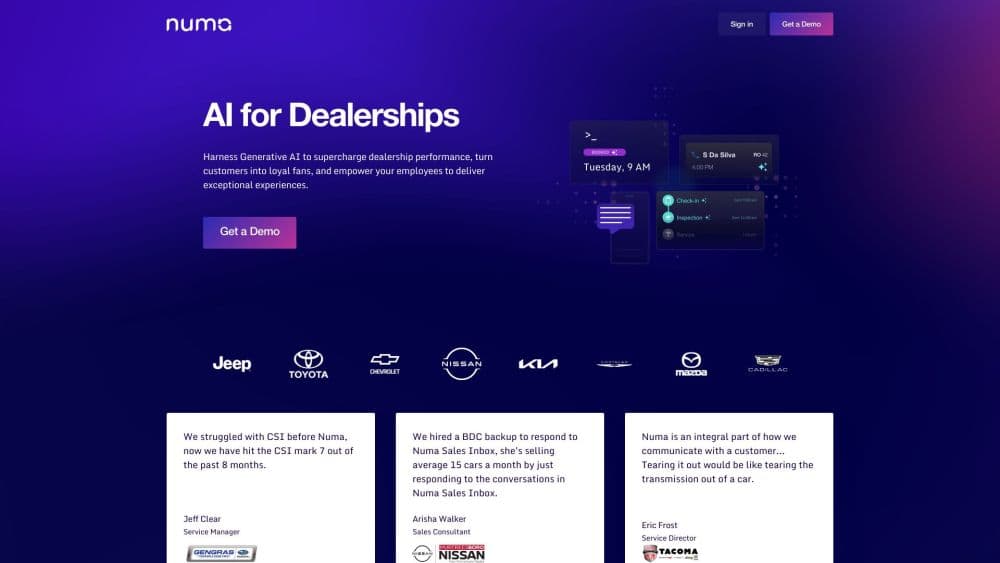
About Numa | AI for Dealerships
What Is Numa
Numa is an AI platform built for car dealerships, sold by NumberAI, Inc. out of Oakland, California. It bundles three things dealers usually buy separately: a voice agent that answers the phone, a shared inbox for calls and texts, and a monitoring layer that watches customer satisfaction in real time. The company markets Numa AI as an operating system rather than a single tool, and the pitch is that all three parts read the same customer record.
It's an automotive AI platform with a narrow target, and the problem it attacks is familiar to anyone who has run a service drive. Calls arrive faster than advisors can pick up, texts sit unanswered, and a customer who wanted a status update ends up leaving a one-star survey. Numa says its dealers cut average response time from 23 hours to under 10 minutes, and that repair order dollars per advisor rise by more than 35%. Those figures come from the vendor, so treat them as claims, not audit results.
There are real limits, and the dealership AI market is crowded with tools that stop at answering the phone. Numa leans on your DMS for context, so a store with thin integration coverage gets a thinner version of the product. Pricing isn't published, and setup takes a few weeks rather than an afternoon. The fit is strongest for franchise stores and multi-rooftop groups in North America that run heavy fixed ops call volume.
Getting Started
- Book a demo through numa.com. A rep maps your stores, departments, and phone numbers, then scopes the DMS and CRM connections.
- Connect your dealer management system and scheduler. Numa pulls vehicle records, open repair orders, and bay availability so the agent can answer with context instead of a script.
- Port or forward your service and sales lines. Calls route to the AI when advisors are busy or the store is closed, and every thread lands in the shared inbox.
- Train the team on the inbox and the agent handoff rules, then review the first weeks of transcripts. Most stores go live in two to three weeks and reach full comfort around 90 days.
Product Information
A quick look at Numa | AI for Dealerships's pricing, supported platforms, and performance.
Best for
The users, tasks, and scenarios where this tool fits best.
Users
- Fixed operations directors at franchise stores
- Service advisors handling 60 or more conversations a day
- Dealer group operators with several rooftops
Tasks
- Catching overflow and after-hours calls
- Chasing declined service and unsold work
- Sending repair order status updates
Scenarios
- Monday morning voicemail backlog
- A customer waiting on a backordered part
- A deal or repair going sideways while the customer is still in the store
Key features
Voice AI With DMS Context
The voice agent connects to your dealer management system in real time, so it knows the caller's vehicle and open repair order before it says hello. That context lets it answer specific questions, such as whether a part has arrived or when the car will be ready. It can also handle AI appointment booking against a bay that is actually open and write the result back to the DMS, which is the step most phone bots skip. Think of it as an AI phone agent with the dealership's records in front of it.
Dealership Smart Inbox
Every call, text, and web message lands in one thread per customer. Staff see who replied last, how long the customer has waited, and which department owns the conversation. Numa calls this a dealership smart inbox, and the practical effect is that a service question and a sales question about the same household stop living in two different phones.
LiveCSI
LiveCSI tracks survey risk while the customer is still on site. It scores conversations and flags the ones heading toward a bad review, then routes them to a manager with the transcript attached. Catching a problem before the survey arrives is the whole point, since a recovered customer usually scores higher than one who never complained.
Service Advisor Agent
The service advisor AI sits beside the human advisor rather than replacing them. It drafts a reply, pulls the vehicle history, and suggests the next step, such as a follow-up call or an approval request. Advisors can send the draft as written or edit it, and the agent keeps chasing the thread until someone closes it.
Heat Case and Opportunity Agents
Two agents work the revenue that usually leaks. The heat case agent watches deals and repairs that are going wrong and pushes them back to a manager, which Numa says retains about 70% of the cases it touches. The opportunity agent reads declined work and unsold inventory in your data, then books the follow-up.
Integrations and Mobile Access
Numa connects to DMS, CRM, and scheduling systems, and the company says it covers about 90% of the DMS market. Managers and advisors can answer calls and messages from the mobile app, which matters on a lot where nobody sits at a desk. Setup is handled by a Numa team rather than a self-serve wizard.
Pros and cons
Pros
- One place for every conversation: calls, texts, and messages share a customer record, so nothing depends on which advisor owns the phone.
- Answers carry real context: DMS and repair order data turn a generic greeting into a specific answer about the car.
- Early warning on CSI: LiveCSI flags unhappy customers while they're still in the building, when a manager can still act.
- Built for fixed ops: the agents handle appointment booking, status updates, and declined service follow-up, which are the three jobs that eat an advisor's day.
- Group-level visibility: multi-rooftop operators get the same rules and reporting across stores, not nine separate setups.
Cons
- No published pricing: you need a sales conversation before you can budget, and small stores may find the quote hard to justify.
- Dependent on DMS data: if the integration is partial or the records are messy, the agent's answers get vaguer.
- Two to three weeks to launch: this isn't a plug-in you turn on yourself, and the training window runs longer.
- No public API: custom workflows and homegrown tools can't call Numa directly, so you work inside the product's own inbox and reporting.
Frequently asked questions
Numa is an AI operating system for car dealerships. It answers calls with vehicle and repair order context, puts every customer conversation in one shared inbox, and flags satisfaction risk before a survey goes out.
Related content
Explore related tools, skills, and articles for Numa | AI for Dealerships.
Numa | AI for Dealerships Alternatives

Base Code
Base44 (Wix) · Coding · ProductivityBase Code is a shared cloud development environment from Base44. Teammates describe changes to an existing GitHub codebase in chat, preview them live and send them back as pull requests.

Knocket
Knocket (Tencent RTC team) · Productivity · Business · ChatbotKnocket is a free live chat and contact page tool that lets visitors message you from your website, app, or a shareable link, with every reply handled from Telegram or one inbox.

FloorGen
Vinit Kumar (FloorGen) · Productivity · China AIFloorGen is a browser-based floor plan maker that turns a sentence or a sketch into an editable 2D plan and a 3D walkthrough. Export to PDF, DXF or video, and draw without an account.