

Omnara
Omnara (Y Combinator S25) · Productivity
Omnara is an open-source managed agent platform for running durable AI agents on any model and any machine through one API, with a free self-hosted option.
About Omnara
What Is Omnara
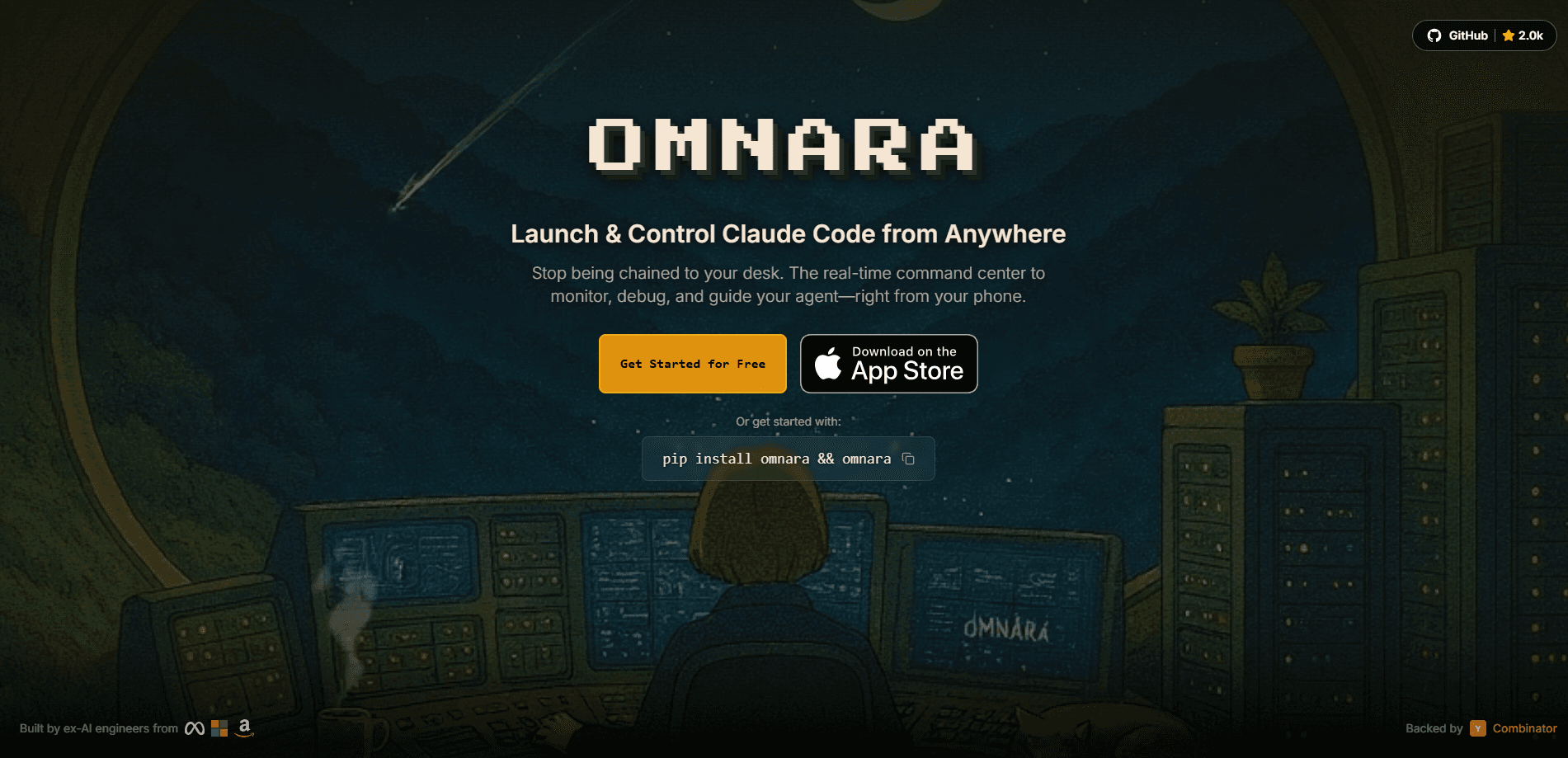
Omnara is a managed agent platform you can self-host, built as an open-source alternative to Claude Managed Agents and OpenAI's Agents API. The idea is simple: an agent is a durable API object, and the platform that runs it handles state, machines, permissions, and history for you.
The problem it targets is real. A prototype agent takes an afternoon, but a production agent needs retries, an audit trail, cost tracking, and somewhere to run. Teams usually build that plumbing themselves, which is why several engineering blogs describe rewriting roughly the same stack. Omnara ships that layer on day one instead.
The main limit is scope. Omnara is infrastructure for developers who write code. If you want a ready-made chatbot or a consumer app, this isn't it. You also need to supply model keys or pay for managed ones, so the free part covers the platform, not the tokens.
Getting Started
- Sign in at app.omnara.com or clone the repository from GitHub for a self-hosted install.
- Add a model provider. Point it at OpenAI, Anthropic, OpenRouter, or any compatible endpoint, including models you host yourself.
- Connect a machine. Start one with nothing to set up and pay through Omnara, link your own Blaxel, Daytona, or Unikraft Cloud account, or install the Omnara daemon on a laptop, VM, or container.
- Write an agent config. A short YAML block names the instruction, the model, the tools, and the machine pool.
- Launch the agent from the dashboard, the REST API, the TypeScript SDK, or the CLI, then stream its events and resolve any approval requests.
Product Information
A quick look at Omnara's pricing, supported platforms, and performance.
Best for
The users, tasks, and scenarios where this tool fits best.
Users
- Backend and platform engineers
- Startup teams shipping agent features
- Operations and GTM teams
Tasks
- Deploying internal agents
- Embedding agents in a product
- Long-running or overnight work
Scenarios
- Replacing a managed platform to avoid lock-in
- Keeping data inside your own infrastructure
- Prototyping several agents quickly
Key features
Durable agents
Omnara stores agent state in a durable event log, so an agent keeps its work when a call fails or a machine dies and picks up where it left off. Idle agents burn no compute, which keeps a fleet cheap between bursts of activity. This is the difference between a demo and something you can leave running unattended.
Any model
The platform is model-agnostic. You can route through OpenAI, Anthropic, OpenRouter, or LiteLLM, or point it at a model you host yourself, and switch when price or quality changes. That includes open-source models like GLM, Qwen, and DeepSeek, whether through a gateway or on your own hardware.
Any machine
Agents run wherever you grant access. Start a machine with nothing to set up and pay through Omnara, bring your own Blaxel, Daytona, or Unikraft Cloud account, or install the Omnara daemon on a macOS or Linux laptop, VM, or container. The daemon connects outbound, so there are no ports to open.
Access controls
Risky tool calls can pause for human approval instead of running straight through. Credentials are stored as encrypted, scoped secrets, people and API keys get role-based access, and every action lands in an append-only history. That combination lets an agent act without handing over the keys.
Agent-ready APIs
Launch, steer, and observe agents from the REST API, the TypeScript SDK, or the CLI. You can change an agent's behavior mid-conversation by posting a new config, with nothing to redeploy. This is what makes agents a product feature rather than a script on someone's laptop.
Integrations
Connect MCP servers and reusable skills so agents reach your real data, then talk to them through first-party Slack, Discord, and GitHub integrations. Model configs, secrets, and machines are shared at the organization level, so a new project inherits what the team already set up.
Pros and cons
Pros
- Open source under Apache 2.0, so you can self-host the whole platform in your own cloud for full control.
- No vendor lock-in on models or machines, which means you can swap providers on price or quality without a migration.
- The platform itself carries no fee, and bringing your own model keys and machines is free.
- Agents are durable and idle at zero compute, so long-running or overnight work stays affordable.
- Built-in permissions, scoped secrets, and an append-only audit trail fit teams that need governance from the start.
Cons
- It's developer infrastructure, so there's no ready-made consumer app and you write your own agent logic and interface.
- Managed models and machines run on credits, and heavy always-on usage raises the bill, so teams should watch the metering.
- Connecting your own machine means installing and maintaining the Omnara daemon on each host, which adds operational work.
Frequently asked questions
Omnara runs AI agents in production. It handles execution and state while you choose the models, tools, machines, and how users reach each agent, so you can ship internal bots or agent features inside your own product.
Related content
Explore related tools, skills, and articles for Omnara.
Omnara Alternatives

Base Code
Base44 (Wix) · Coding · ProductivityBase Code is a shared cloud development environment from Base44. Teammates describe changes to an existing GitHub codebase in chat, preview them live and send them back as pull requests.

Knocket
Knocket (Tencent RTC team) · Productivity · Business · ChatbotKnocket is a free live chat and contact page tool that lets visitors message you from your website, app, or a shareable link, with every reply handled from Telegram or one inbox.

FloorGen
Vinit Kumar (FloorGen) · Productivity · China AIFloorGen is a browser-based floor plan maker that turns a sentence or a sketch into an editable 2D plan and a 3D walkthrough. Export to PDF, DXF or video, and draw without an account.