

Finvi
Finvi (formerly Ontario Systems) · Productivity
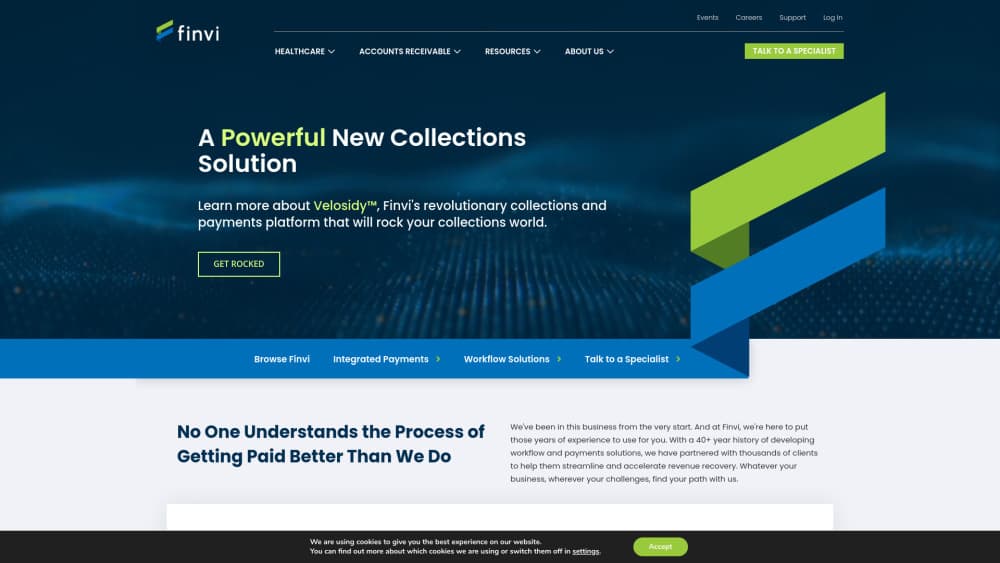
Finvi is revenue recovery software for collections agencies, healthcare systems, and lenders, pairing AI-guided work queues with built-in compliance across four platforms.
About Finvi
What Is Finvi
Finvi sells software that helps organizations get paid. Its customers chase overdue accounts all day: collection agencies, hospital revenue cycle teams, healthcare outsourcers, banks, and fintech lenders. The company started in Muncie, Indiana in 1980 as Ontario Systems and took the Finvi name in October 2021.
The product line covers the whole recovery chain. Velosidy runs third-party collections in the cloud. Artiva HCx handles healthcare revenue cycle management, including claim follow-up and denial prevention. Katabat serves first-party lenders with omnichannel outreach. Simplicity is the entry point for small agencies.
What ties them together is workflow control. Each platform puts accounts in priority order, tells an agent or an automated job what to do next, and records whether the step happened. Compliance rules sit inside those workflows rather than in a separate checklist. That's the pitch, and it matches how the company has sold accounts receivable management software for four decades.
The limits show up before you sign. Finvi doesn't publish prices, doesn't offer a self-serve trial, and doesn't hand you a public API. Implementation runs through a sales and onboarding team, so a small shop should expect a real project rather than an afternoon of setup. The compliance tooling is built around US rules such as the FDCPA and Regulation F, which matters if you operate elsewhere.
Getting Started
- Book a demo with a Finvi specialist and describe your account volume, client mix, and current system.
- Pick the platform that matches your business: Velosidy for third-party agencies, Artiva HCx for providers and RCM partners, Katabat for first-party lending, Simplicity for small agencies.
- Work through implementation: data migration, workflow templates, dialer and channel setup, and your compliance rules.
- Train agents on the work queues and reports, then run a parallel period against your old system.
- Go live, review the first month of results, and adjust queue priorities and outreach rules from there.
Product Information
A quick look at Finvi's pricing, supported platforms, and performance.
Best for
The users, tasks, and scenarios where this tool fits best.
Users
- Collection agency operations managers
- Hospital and health system revenue cycle teams
- Banks and fintech lenders
- Healthcare outsourcers and EBOs
Tasks
- Deciding which accounts to work first
- Running outreach across voice, text, email, and letters
- Preventing avoidable denials
- Monitoring agent performance and compliance
Scenarios
- Cost to collect is climbing while headcount stays flat
- You're retiring an on-premise legacy system
- You run collections for several clients under one roof
Key features
AI-Driven Work Queues and Next-Best Actions
Velosidy puts every account through a scoring layer, then hands agents a ranked queue with a suggested action. The system weighs payment history, contact patterns, and account traits to decide what to work now. Agents stop triaging spreadsheets and start working the top of a list. Managers can see whether the guidance actually moved recovery.
Best Channel and Best Time to Call
The AI collections software picks a channel and a contact window for each consumer. Finvi reports a 125 percent lift in connection rates from Best Time to Call in its own client data. Treat vendor figures as vendor figures, but the feature addresses a real problem: reaching people at hours they answer.
Omnichannel Outreach and Payments
Voice, text, email, and print letters come from one workflow, and payment links close the loop. A consumer who ignores a call can get a text with a payoff amount the same day. For agencies, that cuts the number of touches per dollar collected. For lenders, it keeps the experience consistent across channels.
Compliance Guardrails Inside Workflows
Regulatory rules are attached to the task, not filed in a policy binder. Agents see required disclosures, contact limits, and documentation rules at the moment of the interaction. Audit trails record what happened and when. This is the part that makes ARM software defensible in an exam, and it's also the part that slows down any move to a new vendor.
Healthcare Revenue Cycle Automation
Artiva HCx groups the healthcare side into one workflow: eligibility, claim status, denial handling, and patient payments. Payer rules and deadlines appear before a claim ages out. Finvi says roughly 90 percent of clients report positive results within six months, a company claim worth checking against references in your own specialty.
Reporting and Agent Coaching
Dashboards show queue throughput, contact rates, promise-to-pay rates, and per-agent results. Supervisors can compare a new hire against the team median within days instead of months. The reporting is operational rather than strategic: it tells you where work is stuck, not what the market is doing.
Pros and cons
Pros
- Four platforms cover third-party agencies, healthcare providers, first-party lenders, and small shops, so you can stay with one vendor as you grow.
- Compliance rules live inside workflows, which reduces the chance an agent skips a required disclosure.
- AI prioritization and channel selection go after the two biggest levers in collections: who to call and when.
- Cloud delivery removes server maintenance and version upgrade work from your IT team.
- Client reporting is granular enough for outsourcers that answer to several creditors at once.
Cons
- Pricing is quote-only, so you can't estimate cost without a sales conversation.
- No free tier or self-serve trial means evaluating the product takes weeks, not minutes.
- Public API documentation isn't available, which complicates custom integrations with your own stack.
- The compliance focus is US-centric, so teams outside that regulatory frame will need extra work.
Frequently asked questions
Finvi sells revenue recovery and debt collection software. Its platforms handle account prioritization, consumer outreach, payments, and compliance for collection agencies, healthcare providers, healthcare outsourcers, and lenders.
Related content
Explore related tools, skills, and articles for Finvi.
Finvi Alternatives

Base Code
Base44 (Wix) · Coding · ProductivityBase Code is a shared cloud development environment from Base44. Teammates describe changes to an existing GitHub codebase in chat, preview them live and send them back as pull requests.

Knocket
Knocket (Tencent RTC team) · Productivity · Business · ChatbotKnocket is a free live chat and contact page tool that lets visitors message you from your website, app, or a shareable link, with every reply handled from Telegram or one inbox.

FloorGen
Vinit Kumar (FloorGen) · Productivity · China AIFloorGen is a browser-based floor plan maker that turns a sentence or a sketch into an editable 2D plan and a 3D walkthrough. Export to PDF, DXF or video, and draw without an account.