

Onto
Onto · Coding · Business
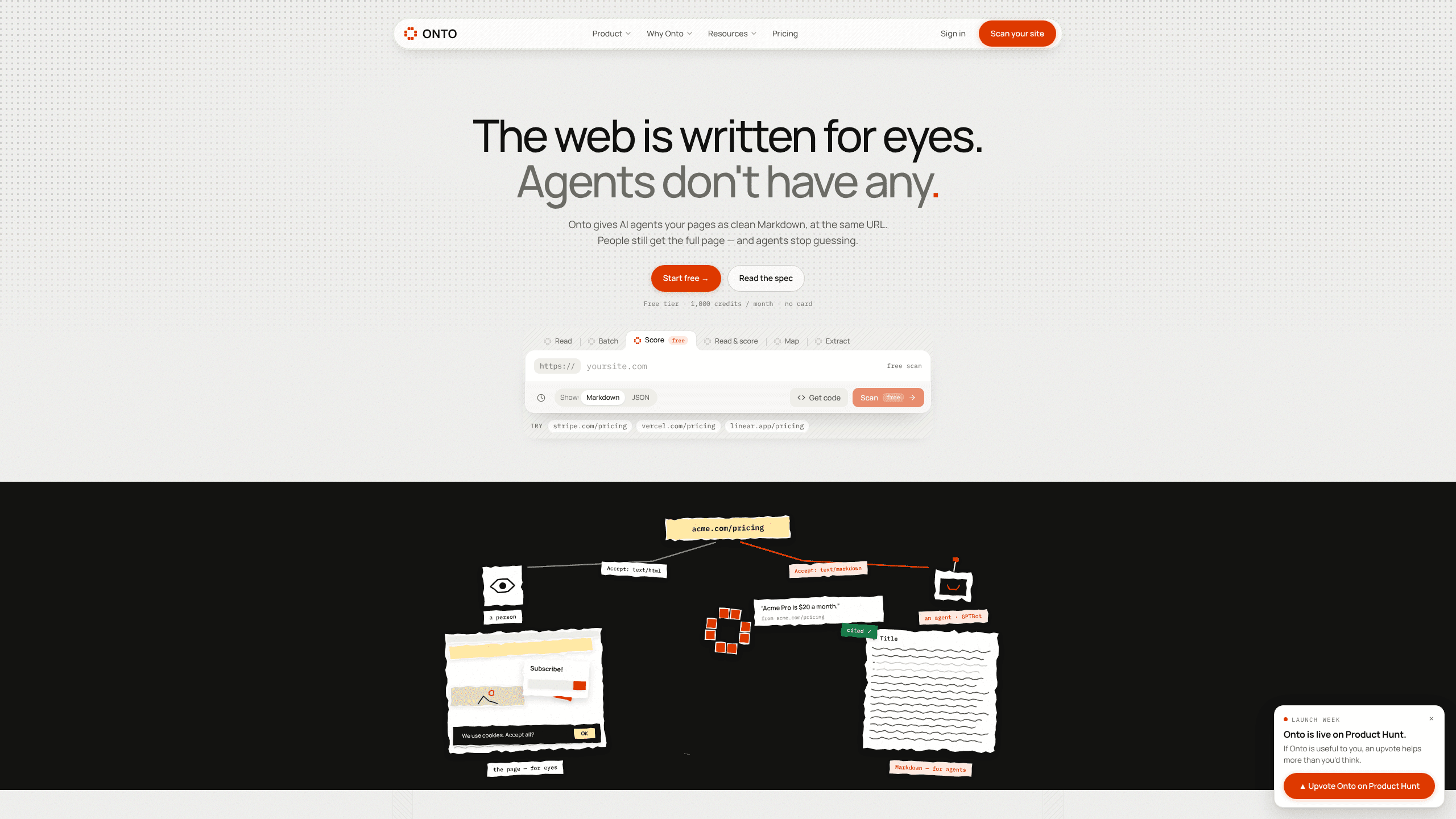
Onto serves AI agents a clean Markdown copy of your pages at the same URL, then shows which bots read what and how readable each page is.
About Onto
What Is Onto
Onto is a tool for sites that want AI agents to read them correctly. When a crawler requests a page, Onto hands back Markdown built from your content instead of the full HTML payload. People who open the same URL in a browser get the normal page. Nothing is rewritten for humans.
The problem it targets is simple to describe and expensive to ignore. A pricing page weighs hundreds of kilobytes of HTML, scripts and layout code. An agent that fetches it has to work out which part matters, and when it can't, it fills the gaps with a guess. Onto measured five public pricing pages in September 2026 and found Markdown versions between 95% and 99.6% smaller than the HTML they came from.
Two parts do the work. The Serve SDK sits on your own site, detects known AI user agents, and serves prebuilt Markdown at the edge, so there's no per-request extraction. The Read API and MCP server let your own agents pull clean page text from anywhere. A dashboard records every visit: which agent, which page, where it came from, and how many bytes you didn't send.
Limits matter before you install. The Serve SDK ships as @ontosdk/next, so a Next.js codebase gets it in one command and other stacks need their own wiring. The Read API doesn't run JavaScript, so pages rendered only in the browser come back thin.
Getting Started
- Run a free scan of any URL on buildonto.dev. It returns the Markdown an agent would see, plus an AIO score with each fault listed.
- Sign up at app.buildonto.dev. The free plan starts with 1,000 credits a month and needs no card.
- Install the Serve SDK with
npm install @ontosdk/nextand add it to your Next.js config. Markdown files are generated at deploy time. - Open the dashboard after the first crawler hits. Agent visits appear with page, country and payload size.
- If you're building an agent, create an API key and call
/v1/reador connect the MCP server atapi.buildonto.dev/mcp.
Product Information
A quick look at Onto's pricing, supported platforms, and performance.
Best for
The users, tasks, and scenarios where this tool fits best.
Users
- Next.js developers with docs or marketing sites
- Developer marketing teams
- AI agent builders
- SEO and GEO consultants
Tasks
- Serving Markdown to AI crawlers
- Tracking which bots quote you
- Auditing a page for AI readability
- Feeding pages into an agent workflow
Scenarios
- A documentation site where AI assistants answer setup questions
- A pricing page that chatbots summarize
- Checking AI visibility before a launch
Key features
Markdown at the same URL
The Serve SDK checks the User-Agent, an Accept: text/markdown header, or an ?onto parameter on the URL. Matches get Markdown generated at build time and served from your own domain. Everyone else gets the page you already ship, so there's no separate docs subdomain and no llms.txt file to maintain.
Agent visit analytics
Each request that gets Markdown is logged as it happens. The dashboard separates named agents from unknown ones, lists page, country and response size, and shows how many megabytes were never sent. Serve Pro adds CSV export and a longer history.
AIO score
The score starts at 100 and subtracts for specific faults: a robots.txt that blocks crawlers, a page with no Markdown version, missing JSON-LD, images without alt text, HTML over 200 KB. Every lost point maps to a named check, so you know what to fix rather than guessing at a grade.
Read API
Six endpoints cover the common jobs: read returns Markdown plus metadata, read-and-score adds the AIO number, score rates any URL for free, batch handles up to 50 URLs, map pulls a URL list from a sitemap, and extract returns JSON-LD, Open Graph and meta tags. Reads run with a 15 second timeout, follow at most five redirects, cap at 10 MB and respect robots.txt.
MCP server
Claude, ChatGPT and Cursor can call Onto through a hosted connector at api.buildonto.dev/mcp or a local npx server. Six tools sit behind it, including read_url. Calls bill to the same credit balance as the API, so an agent session doesn't need a second subscription.
Per-route context
On Serve Pro and above, you can attach notes to a route. Those notes ride along with the Markdown for that page, which is useful when a product name, a policy or a unit needs an explanation that the page itself doesn't spell out.
Pros and cons
Pros
- The Markdown is served from your own domain at the same URL, so agent citations point at the page you already rank with.
- The SDK is MIT licensed and free without a cap, which makes the install decision cheap to test.
- Score deductions name the fault and the point cost, so a fix list comes out of one scan.
- The SDK and the Read API share one cleaner, so what you test in the dashboard matches what an agent receives.
- Credits are metered per URL rather than per seat, and failed reads are refunded.
Cons
- The Serve SDK is built for Next.js. A WordPress, Rails or SvelteKit site needs custom work to serve the same Markdown.
- The Read API doesn't execute JavaScript, so client-rendered pages come back with headings but little substance.
- Unknown agent names, CSV export and history past 30 days sit behind the $19/mo Serve Pro plan.
- There's no SSO, SLA or signed DPA yet. Teams that need any of those have to talk to sales and wait.
Frequently asked questions
No. The SDK only intercepts requests that come from a known AI agent, carry a text/markdown accept header, or include the ?onto parameter. A normal browser request passes straight through to your existing page.
Related content
Explore related tools, skills, and articles for Onto.
Onto Alternatives

Udon
Udon · Coding · ProductivityUdon turns an Apple Silicon Mac into a home server you run from a browser, with container controls, file shares, and an optional AI sysadmin.

offstage
offstage cloud · Coding · Productivityoffstage gives AI coding agents and CI jobs a real Mac: a fresh macOS account on Apple silicon, driven over an API and billed by the second.

BotBus
Chengdu Tuyang Tusen Technology Co., Ltd. · Coding · ProductivityBotBus lets you control AI coding agents from your phone and watch: approve commands, start tasks and read results while the code stays on your desktop.