

Orshot – API for Image Generation
Orshot · Image
Orshot is an API that renders images, PDFs and videos from reusable templates, with social media automation on your data. Design once, then generate in bulk via REST API, integrations or AI agents.
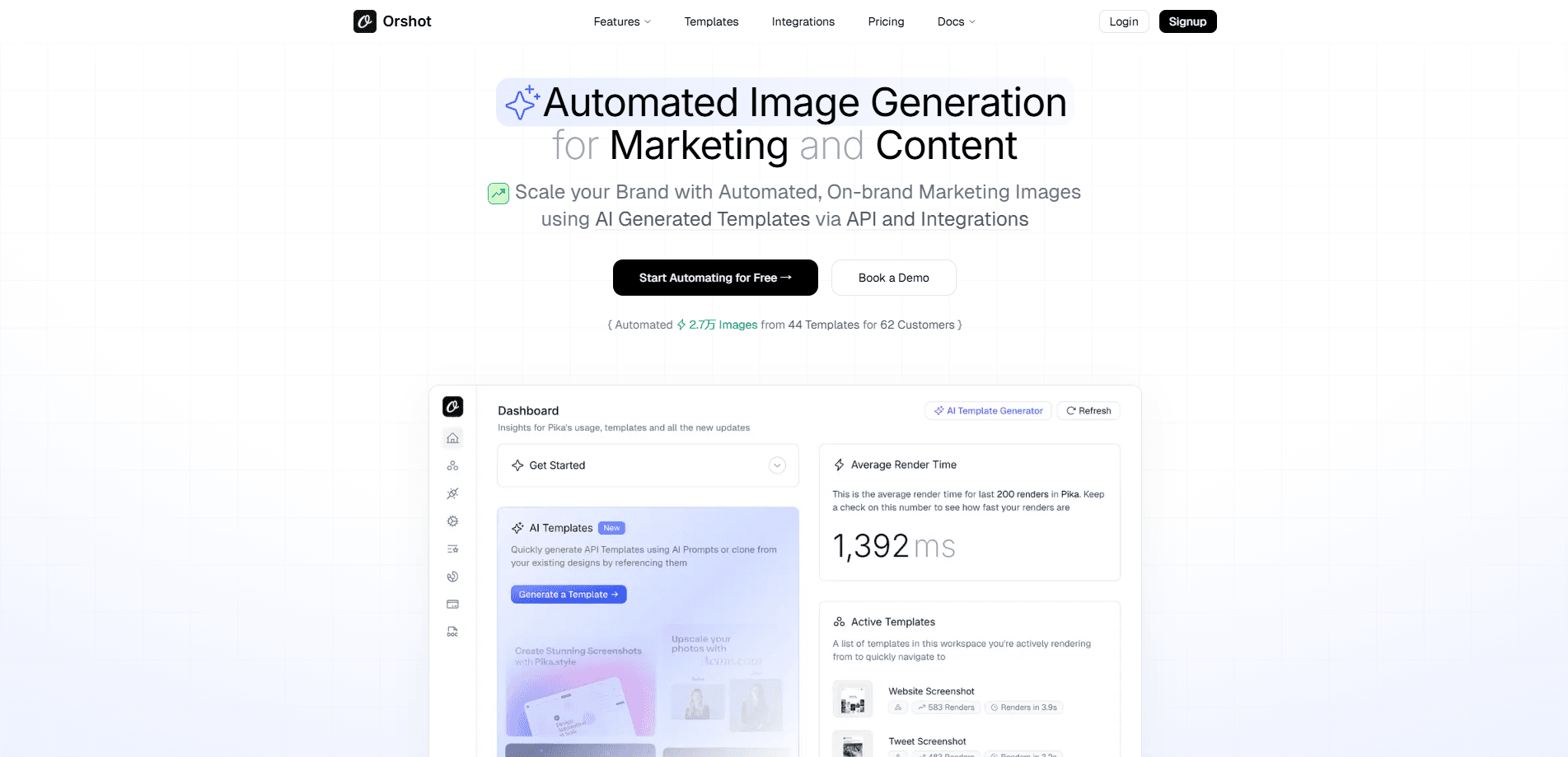
About Orshot – API for Image Generation
What Is Orshot
Orshot is an API for automated image, PDF and video generation. You build a template once in its visual editor, mark the text, photos and colors that change as parameters, then send those values to a single endpoint and get back a finished file. It targets teams that make the same kind of graphic over and over: social posts, OG images, invoices, certificates or product banners.
The company was founded in March 2025 by Rishi Mohan in Berlin and is bootstrapped. It reports 15.5k+ signups, 150+ paying customers and about 1.2 million renders to date, with 20% of recent customer renders coming from AI agents over MCP.
The main catch is scope. Orshot is built for recurring, high-volume work where a template already exists. If you need a single one-off design, a traditional design tool does the job with less setup. AI video of something nobody filmed is a different problem too, since Orshot renders templates rather than inventing new footage.
Getting Started
- Sign up for a free account; there's no credit card and the plan refills to 100 credits every month.
- Design a template in Orshot Studio, import one from Canva or Figma, or start from the 2,400+ template library, then mark the changing layers as parameters.
- Send a request to
POST https://api.orshot.com/v1/studio/renderwith the template ID and your values, or connect a no-code tool such as n8n, Make, Zapier, Google Sheets or Airtable. - Get the result back as a URL in PNG, JPG, WebP, PDF or MP4, push it to your own storage, or publish it to a connected social account.
Product Information
A quick look at Orshot – API for Image Generation's pricing, supported platforms, and performance.
Best for
The users, tasks, and scenarios where this tool fits best.
Users
- Small marketing teams
- Developers who need a rendering endpoint
- Agencies managing several clients
Tasks
- Bulk social media posts
- OG images for a blog or docs site
- Invoices and certificates
Scenarios
- A weekly content schedule that never changes shape
- Launching a campaign across many sizes
- Putting a design editor inside your own product
Key features
Template-based rendering
The core of Orshot is a template you reuse. You mark the layers that change, then each render swaps in new text, images or colors while the layout stays fixed. That means a hundred personalized images cost about as much effort as one, which is the whole point of an image generation API for recurring work.
One API for images, PDFs and video
A single endpoint returns PNG, JPG, WebP, PDF or MP4 depending on the request. Images and PDFs run on every plan, and video joins on paid plans. One credit equals one image, one PDF page or one second of video, so the billing unit stays easy to reason about.
No-code and workflow integrations
Orshot lists 46 integrations, covering n8n, Make, Zapier, Pipedream, Google Sheets, Airtable, Shopify and Slack. Non-developers build automation in a tool they already know, and developers fall back to the API or CLI when a workflow needs more control.
MCP server for AI agents
The Orshot MCP server exposes 97 tools at https://mcp.orshot.com/mcp, and it plugs into Claude, ChatGPT and Cursor. Agents generate images, PDFs and videos from your templates, which keeps AI-made content on brand instead of drifting off-spec.
Canva and Figma import
You import a Canva or Figma design as a template and render every variation from your data through the REST API. Existing Canva automation, including bulk create, then runs from your own code with no Canva API integration to build.
Smart Resize and multi-page output
Smart Resize re-lays out one design at every target size, so a single template covers square, story and wide formats. Multi-page templates extend the same idea to carousels and PDF documents.
Orshot Embed white-label editor
Paid workspaces embed the Orshot editor inside their own product through an iframe or React and Vue components. Each end user gets a private template library behind JWT sessions locked to your domains, which lets you ship a design editor without cloning Canva.
Social publishing and analytics
From the same API call or workflow, Orshot publishes or schedules to 15 platforms, including Instagram, LinkedIn, X and TikTok, as an add-on at $12 per connected account. Social analytics then tracks impressions, engagement and the best time to post.
Pros and cons
Pros
- Free plan renews to 100 credits every month, unlike the one-time trial credits most rivals offer, so a small recurring job can run free.
- One credit covers an image, a PDF page or a second of video, which makes cost easy to estimate before you commit.
- Official figures show a median render time of 1.4s and 99.98% uptime over 91 days, numbers you can check on its public dashboard.
- Imports from Canva, Figma, Bannerbear and Placid reduce the switching cost if you already have designs.
- The MCP server works with Claude, ChatGPT and Cursor, so agent-driven rendering needs no custom glue code.
Cons
- Credits reset monthly and don't roll over, so unused capacity is lost rather than banked.
- No video on the free plan, and the Launch plan tops out at three-minute clips, which rules out longer content without an upgrade.
- API rate limits sit at 100 requests per minute on Free and Launch and 200 on higher plans, a ceiling bulk jobs can hit.
- A one-off design you'll never regenerate doesn't justify the setup, since a plain design tool covers that case.
Frequently asked questions
Orshot generates images, PDFs and videos automatically from templates you design once. Teams use it for social media posts, OG images, invoices, certificates and ad creatives, especially when the same format repeats from spreadsheet or API data.
Related content
Explore related tools, skills, and articles for Orshot – API for Image Generation.
Orshot – API for Image Generation Alternatives

Google EmbeddingGemma 2
Google DeepMind · Writing · Image · CodingGoogle EmbeddingGemma 2 is a 740M-parameter open model that turns text, code, images, audio, and video frames into vectors in one 768-dimension space, running on phones and laptops.

Tractionwave
TractionWave · Image · MarketingTractionWave is an AI attention heatmap tool for static ads. Upload a PNG or JPG and it returns predicted attention, ranked hotspots, and fixes before you spend budget.

Imejis.io
Imejis.io · Image · MarketingImejis.io is an AI design studio for agents and marketing teams. Describe an image in plain words, and it writes the copy, builds the layout, reflows it to every size, then exports a finished file.