

PageAI
PageAI · Coding
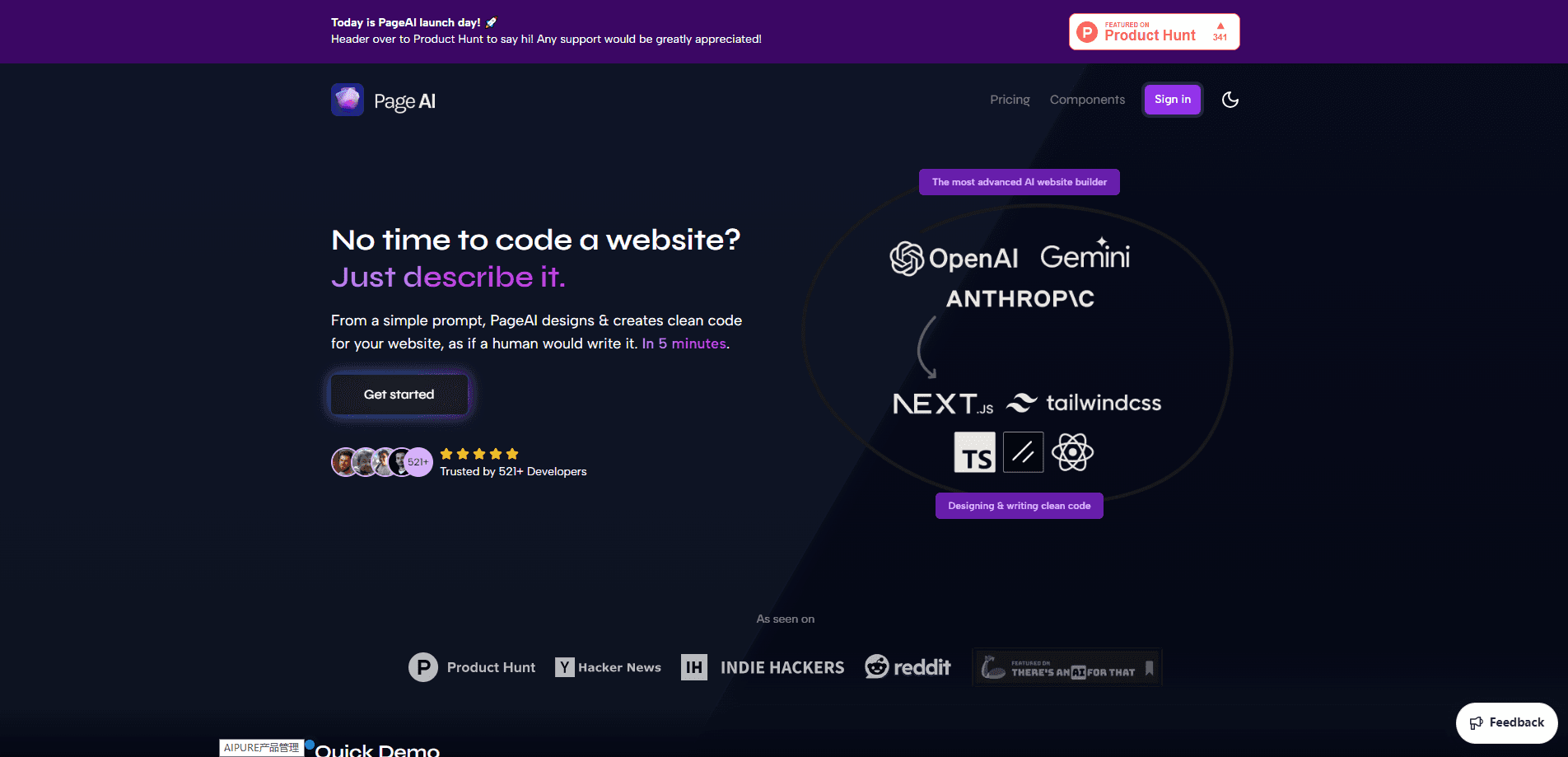
PageAI is an AI landing page builder that turns one prompt into a production-ready Next.js website with SEO, blog, and a codebase you own. It works as a full AI website generator for developers.
About PageAI
What Is PageAI
PageAI is an AI agent-powered website builder that plans, designs, and codes a landing page from a single written prompt. Instead of handing you a locked template, it produces a full codebase built with Next.js, Tailwind CSS, TypeScript, and Shadcn UI, then sets up a git repository you can deploy to any host that supports Next.js. The pitch is simple: a professional, production-ready page in minutes rather than days.
The tool targets busy developers and founders who need a real, fast, search-friendly site without hand-writing every section. According to PageAI, generation takes 2 to 3 minutes, and the output includes SEO meta tags, JSON-LD, a sitemap, an RSS feed, open graph images, and terms and privacy pages. As a website builder for developers, it leans on code you can read and keep.
The biggest limit is that it builds one thing well. It focuses on landing pages and marketing sites built on Next.js, so people who need a WordPress-style CMS, a large ecommerce catalog, or a no-code drag-and-drop builder won't find them here. You also need some coding comfort after deployment if you plan to keep editing the generated code by hand.
Getting Started
- Sign up on the PageAI site and describe your website in a prompt.
- Let the AI agents plan, research, design, and write the page; generation usually takes 2 to 3 minutes.
- Adjust the result in the live preview or the drag-and-drop editor, changing text, images, icons, theme, and section order.
- Download the codebase, or deploy it with one click to Vercel.
- Keep the code and edit it wherever you like, since you own it outright.
Product Information
A quick look at PageAI's pricing, supported platforms, and performance.
Best for
The users, tasks, and scenarios where this tool fits best.
Users
- Developers
- Indie founders and solo builders
- Product marketers
Tasks
- Launching a startup or product landing page
- A cultural festival promo page
- Building a personal portfolio or resume page
- Creating a campaign microsite
- Refreshing an existing marketing site
Scenarios
- Shipping a landing page before a weekend launch
- Working from the command line with Claude Code or Cursor
- Keeping hosting costs and lock-in low
Key features
One-Prompt Landing Page Generation
You describe your site in plain language, and PageAI's agents handle research, plan, design, copywriting, and code. It generates a complete landing page in roughly 2 to 3 minutes. The result is a working starting point, not a static mockup.
Agent-Based Build Pipeline
PageAI splits the work across specialized agents. A planning agent researches and structures the page, a design agent sets theme, fonts, and wireframes, and a code agent writes clean, maintainable code. Splitting the jobs keeps each stage focused instead of asking one model to do everything.
SEO and Technical Basics Included
The output ships with meta tags, JSON-LD, canonical URLs, a sitemap.xml, an RSS feed, and open graph images. The point is to rank from day one without wiring these up yourself. Smaller pieces like favicons and terms and privacy pages are generated too.
Next.js, TypeScript, and Tailwind Codebase
The generated code uses Next.js, TypeScript, Tailwind CSS, and Shadcn UI components. It's built for performance with SSR, static generation, and image optimization, and it stays responsive and SEO-friendly by default. You end up with a modern stack rather than a proprietary editor format.
Live Drag-and-Drop Editor
A live preview lets you change text, images, icons, and section order without a code push. You can restyle the whole site at once by swapping the theme. It bridges the gap between AI output and the tweaks you'd normally make by hand.
Blog, Search, and Content Tools
PageAI includes a Markdown and MDX blog, multiple blog layouts, custom components, multiple authors, tags, and built-in search that runs without a database or third-party service. Custom layouts cover anything from a gallery to a documentation hub.
You Own the Code and the Git Repo
You get a full codebase and a git repository you control. One-click deployment to Vercel is supported today, and the code can move to any host that runs Next.js. No subscription and no lock-in keeps long-term costs predictable.
Pros and cons
Pros
- Produces a real, deployable Next.js codebase you own, not a locked template.
- Ships with SEO, sitemap, RSS, and open graph images out of the box.
- Generation takes only 2 to 3 minutes, so you can test ideas quickly.
- One-time pricing avoids recurring subscription costs.
- The stack (Next.js, TypeScript, Tailwind) is familiar to most modern web developers.
Cons
- One-time cost starts at $149, so it isn't a free tool for casual testing.
- Editing the code later assumes some coding comfort, and the documentation only goes so far.
- It focuses on landing and marketing pages, so large ecommerce or CMS-heavy sites need other tools.
- Free-tool coverage is limited to single-purpose generators rather than the full builder.
Frequently asked questions
PageAI is an AI landing page builder that turns a written prompt into a production-ready website. Its agents handle research, design, copy, and code, then hand you a codebase you can deploy and own.
Related content
Explore related tools, skills, and articles for PageAI.
PageAI Alternatives

Udon
Udon · Coding · ProductivityUdon turns an Apple Silicon Mac into a home server you run from a browser, with container controls, file shares, and an optional AI sysadmin.

offstage
offstage cloud · Coding · Productivityoffstage gives AI coding agents and CI jobs a real Mac: a fresh macOS account on Apple silicon, driven over an API and billed by the second.

BotBus
Chengdu Tuyang Tusen Technology Co., Ltd. · Coding · ProductivityBotBus lets you control AI coding agents from your phone and watch: approve commands, start tasks and read results while the code stays on your desktop.