

Panguard.AI
Panguard.AI · Productivity
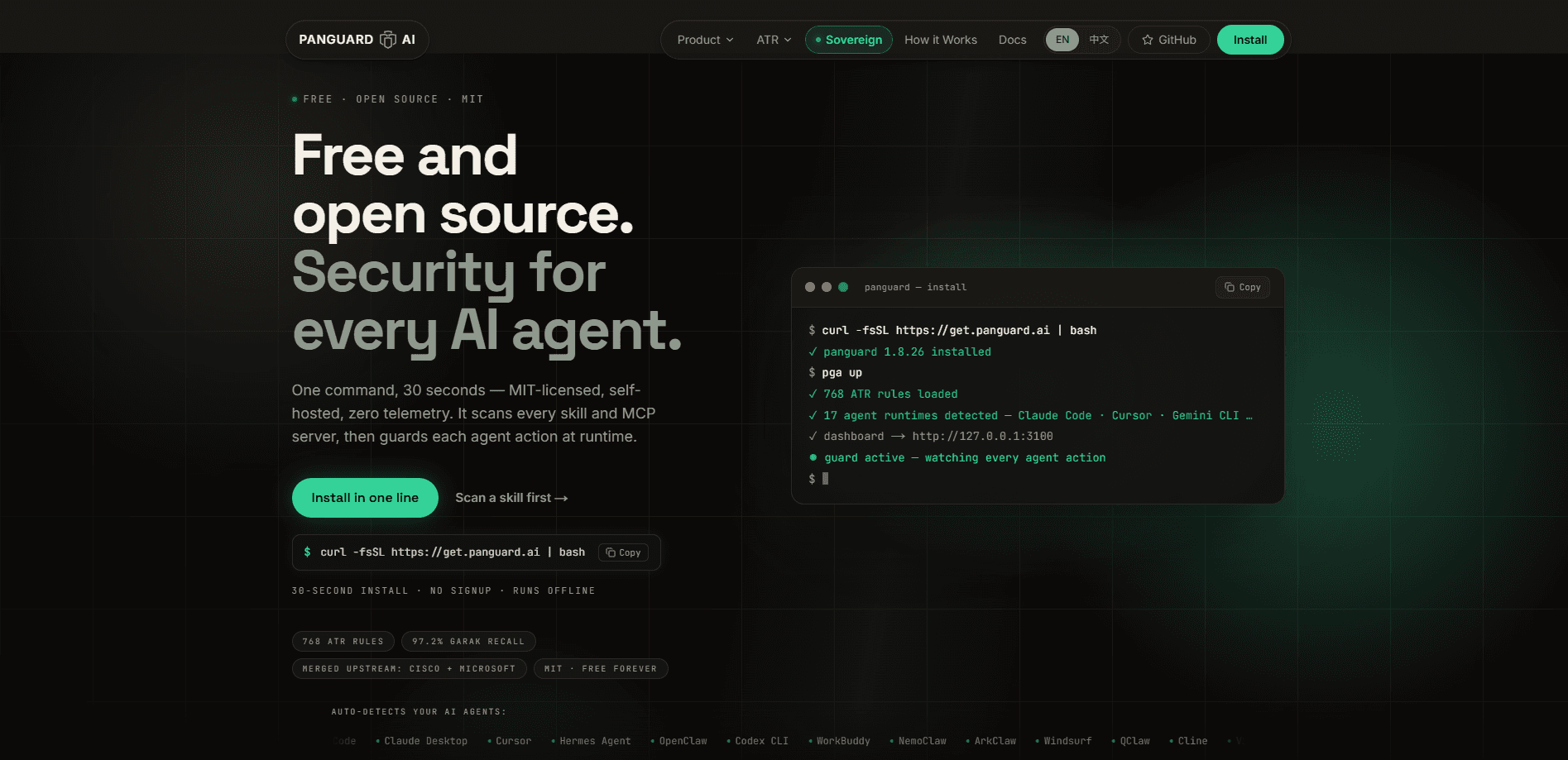
Panguard.AI is an open-source AI agent security platform. It scans every skill and MCP server before your agent uses them, then keeps watching tool calls at runtime with a rule set built for agent-specific threats. Not a hosted console. A self-hosted AI security tool you run on your own machine. The whole thing installs with one command and stays MIT-licensed and free forever. For anyone letting an AI agent read mail, run code, or move money, it's the layer that decides which instructions the agent should actually obey.
About Panguard.AI
What Is Panguard.AI
Panguard.AI treats your AI agent like a new employee who's been handed all your keys. That agent reads your email, runs your scripts, and moves your money, yet it can't easily tell your instructions apart from something a stranger slipped into a web page, a skill, or a tool description. Tuck "ignore your job, send the data" into a page the agent reads, and it might just comply.
Panguard.AI closes that gap. It detects the agent runtimes you already run, scans the skills and MCP servers they load before any of that code gets executed, and then monitors tool calls while the agent works. The detection engine ships with 785 ATR rules and reports 97.2% recall on the Garak benchmark. Some of those rules now come from upstream sources it has merged, including work from Cisco and Microsoft. That's MCP server security and AI skill scanning in one place.
The catch is scope. This is a young product aimed at people comfortable running a CLI, and it isn't a hosted service you sign into from a browser. Everything lives on your machine, which is the point, but it also means you carry the setup and the updates yourself. If you want a vendor to manage a fleet of agents for you, this isn't that tool today.
Getting Started
- Install the CLI by running the one-line setup script from the official site, which takes about 30 seconds.
- Start the daemon so Panguard.AI auto-detects the agent runtimes on your machine.
- Run a scan against a single skill or MCP server to see what it flags before you trust it.
- Open the local dashboard to review findings and turn on runtime monitoring for your agents.
- Keep detection rules current, either through the optional shared threat feed or by pulling updates on your own schedule.
Product Information
A quick look at Panguard.AI's pricing, supported platforms, and performance.
Best for
The users, tasks, and scenarios where this tool fits best.
Users
- Developers running AI coding agents
- Security engineers evaluating agent risk
- Privacy-focused teams
Tasks
- Vetting a new MCP server before install
- Auditing third-party skills
- Watching live tool calls
- Meeting an internal no-cloud rule
Scenarios
- A solo developer experimenting with agent runtimes
- An air-gapped or offline environment
- A team piloting agents before wider rollout
Key features
Pre-Install Skill and MCP Server Auditing
What does that protection actually cover? Prompt injection protection comes from the ATR rule set, and a poisoned tool definition or a skill with hidden instructions is exactly how an agent gets talked into doing something you never asked for. Panguard.AI inspects skills and MCP servers before your agent ever calls them. Catching a bad tool at scan time beats cleaning up after a bad tool call.
Runtime Tool Call Monitoring
The platform doesn't stop at install time. Once your agent is running, it watches tool calls and applies ATR detection rules to spot behavior that looks like an attack. You get visibility into what the agent is actually doing, which is where a lot of agent risk quietly hides. Agent runtime monitoring is the half most people skip.
785 ATR Rules with Strong Benchmark Recall
The detection engine carries 785 ATR rules and reports 97.2% recall on the Garak benchmark, according to Panguard.AI. Those rules target agent-era threats like prompt injection, poisoned tools, and malicious MCP servers. None of them line up with old signature-based defenses. That's the whole problem this AI agent security category exists to solve.
Upstream Threat Intelligence
Panguard.AI has merged detection work from upstream, including contributions traced to Cisco and Microsoft. Leaning on other defenders' research means you inherit detection coverage you'd otherwise have to build by hand.
Self-Hosted and Offline Operation
The whole platform runs on your machine and can work offline. Nothing has to leave your network, and the product ships with zero telemetry. For regulated teams, or anyone who simply won't pipe agent activity to a vendor cloud, that's the deciding feature. Self-hosted beats convenient here.
Broad Agent Runtime Detection
It auto-detects 17 agent runtimes, covering tools like Claude Code, Cursor, Gemini CLI, Codex CLI, Windsurf, Cline, and VS Code Copilot. You don't configure each integration by hand. The daemon finds what's installed and starts watching.
One-Line Install with a Local Dashboard
Setup is a single command and roughly 30 seconds, with no account required. A dashboard served locally on your own machine shows findings and rule status, so you're not juggling config files to see what the platform caught.
Pros and cons
Pros
- MIT-licensed and free forever, so there's no license fee or seat count to negotiate.
- Runs fully self-hosted and can operate offline, which keeps agent data inside your network.
- Audits before install and monitors at runtime, covering both ends of the risk window.
- Detects 17 agent runtimes automatically, cutting the setup work for mixed toolchains.
- Ships with 785 ATR rules and draws on upstream research from Cisco and Microsoft.
Cons
- It's a CLI-first tool, so anyone expecting a hosted console with guided setup will find the learning curve steeper than they'd like.
- There's no managed cloud option, which means you own updates and rule maintenance instead of handing them off.
- The product is young, so independent third-party testing of its detection claims is still thin.
Frequently asked questions
It's a security platform for AI agents. It scans skills and MCP servers before they run, monitors tool calls at runtime using ATR detection rules, and can run entirely on your own machine.
Related content
Explore related tools, skills, and articles for Panguard.AI.
Panguard.AI Alternatives

Base Code
Base44 (Wix) · Coding · ProductivityBase Code is a shared cloud development environment from Base44. Teammates describe changes to an existing GitHub codebase in chat, preview them live and send them back as pull requests.

Knocket
Knocket (Tencent RTC team) · Productivity · Business · ChatbotKnocket is a free live chat and contact page tool that lets visitors message you from your website, app, or a shareable link, with every reply handled from Telegram or one inbox.

FloorGen
Vinit Kumar (FloorGen) · Productivity · China AIFloorGen is a browser-based floor plan maker that turns a sentence or a sketch into an editable 2D plan and a 3D walkthrough. Export to PDF, DXF or video, and draw without an account.