
Particl Retail Intelligence
Particl, Inc. · Coding · Marketing
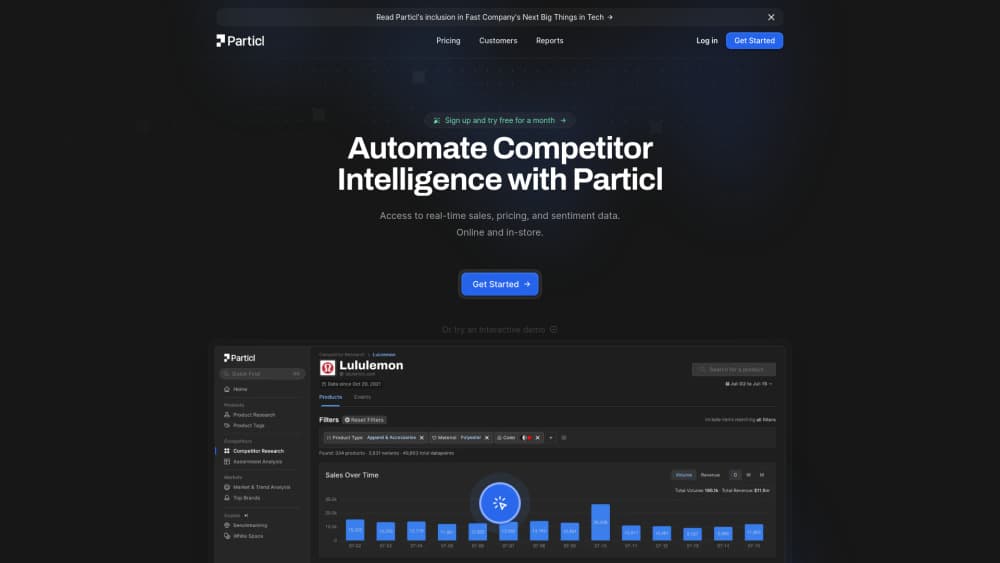
Particl is a retail intelligence platform that estimates competitor sales, pricing, inventory, and assortment across 20,000+ retailers, then turns that data into launch, pricing, and promotion decisions.
About Particl Retail Intelligence
What Is Particl Retail Intelligence
Particl is an ecommerce competitor tracking platform built for brand and retail teams. It collects storefront and checkout signals from thousands of retailers, models what each product likely sells, and packages the result as dashboards, reports, and alerts. Brand teams use it to answer three questions that internal analytics can't touch: what is selling in my category, at what price, and how much stock sits behind it.
The scale claim is the headline. Particl says it monitors more than 20,000 retailers, over 600 million unique SKUs, and roughly $500 billion in revenue. Those sales figures are estimates built from public signals, not numbers retailers report. Read them as directional, and expect wider error bars on small brands with little catalog visibility. For big categories and well-documented brands, the estimates hold up well enough to plan around.
What it doesn't do matters too. There's no ad buying, no storefront management, and no first-party view of your own customers. Particl is an outside-in market view that sits beside your BI stack, not a replacement for it. Pricing starts at $250/mo, so solo sellers are priced out. This is a brand, agency, or category team tool.
Getting Started
- Book a demo or start the 14-day trial from particl.com. Pick a plan based on how many competitors and how many months of history you need.
- Build a competitor list in Company Explorer. The Starter tier tracks five brands, Essential and Growth track ten, and Custom goes up to 1,000.
- Open Product Explorer to see SKU level sales data, pricing history, and inventory signals for those brands. Filters narrow the view to a category, price band, or product type.
- Save the views you'll check weekly and turn on alerts for new launches, restocks, and price moves.
- Export a CSV or schedule an email report for the people who don't log in. Custom plans add bulk exports and API access.
Product Information
A quick look at Particl Retail Intelligence's pricing, supported platforms, and performance.
Best for
The users, tasks, and scenarios where this tool fits best.
Users
- DTC brand founders
- Ecommerce analysts and category managers
- Agencies and retail consultants
Tasks
- Choosing what to launch next
- Setting and defending price
- Planning assortment
- Auditing competitor marketing
Scenarios
- A line plan review before next season
- A price change you're unsure about
- Monthly reporting for a client or a leadership team
Key features
SKU Level Sales Estimates
Particl estimates revenue per product rather than per brand, which is the level most launch decisions actually happen at. You can sort a category by estimated sales, filter to a price band, and see which items carry a competitor's revenue. The estimates are modeled, so the useful move is comparing products against each other inside the same category, not treating a single figure as audited truth.
Competitor Pricing and Discount Tracking
Pricing history shows list price, discount depth, and how long a promotion ran. That answers a question gut feel handles badly: did the markdown bring in volume, or did it just cut margin on units that would have sold anyway. Daily data refreshes keep the picture current enough for weekly pricing calls.
Assortment and White Space Analysis
Assortment analysis maps overlap between your catalog and a competitor's, so you can see where you're both crowded and where they've left a gap. White space analysis then ranks those gaps by demand. Teams use it to kill underperforming SKUs and to justify a new subcategory with evidence rather than a hunch.
Marketing Asset Library
Ads, emails, and social posts from tracked brands land in one library. You can read the creative, note the offer, and then check sales data for the same window. It's the difference between copying a competitor's campaign and knowing whether it worked. Agencies tend to live in this view during pitch season.
Historical Data, Trends, and Alerts
History runs three months on Starter, six on Essential, twelve on Growth, and up to 48 on Custom. That's enough to separate seasonality from a real trend. Alerts fire on new launches, restocks, and price moves, so you hear about a competitor's drop the same week instead of in a quarterly recap.
MCP Access for Claude and ChatGPT
Particl runs an MCP server, so you can connect your account to Claude, ChatGPT, or another MCP client and query competitor data in plain language. Ask for the top sellers at a retailer and get an answer with sources, without opening the dashboard. It suits analysts who already work in a chat window and want the data to come to them, and it's the quickest route to MCP retail data without building a pipeline.
Pros and cons
Pros
- Revenue estimates at the product level, which is more useful for launch decisions than brand level totals.
- Pricing, assortment, and marketing data sit in the same account, so a single question doesn't need three tools.
- MCP access means the data reaches Claude or ChatGPT without a custom integration project.
- Daily refreshes and alerts keep a fast-moving category visible between weekly reviews.
- The 14-day trial covers a real evaluation, including competitor setup and a first report.
Cons
- $250/mo entry pricing with one seat and three months of history is steep for small brands, and the useful history tier costs $1,000/mo.
- Sales numbers are modeled estimates. Treating them as reported revenue will lead to bad calls, especially on long-tail brands.
- Competitor limits bite early. Five brands on Starter covers a narrow category, not a real market map.
- No mobile app. Field teams checking a price in a store have to use the browser.
Frequently asked questions
Particl is used to see what competitors sell, at what price, and how much of it. Brand and agency teams use it for product launch research, pricing decisions, assortment planning, and campaign audits. It's an outside-in market view, so it complements your own sales data rather than replacing it.
Related content
Explore related tools, skills, and articles for Particl Retail Intelligence.
Particl Retail Intelligence Alternatives

Udon
Udon · Coding · ProductivityUdon turns an Apple Silicon Mac into a home server you run from a browser, with container controls, file shares, and an optional AI sysadmin.

offstage
offstage cloud · Coding · Productivityoffstage gives AI coding agents and CI jobs a real Mac: a fresh macOS account on Apple silicon, driven over an API and billed by the second.

BotBus
Chengdu Tuyang Tusen Technology Co., Ltd. · Coding · ProductivityBotBus lets you control AI coding agents from your phone and watch: approve commands, start tasks and read results while the code stays on your desktop.