

Peopling
Peopling · Leaning · Business
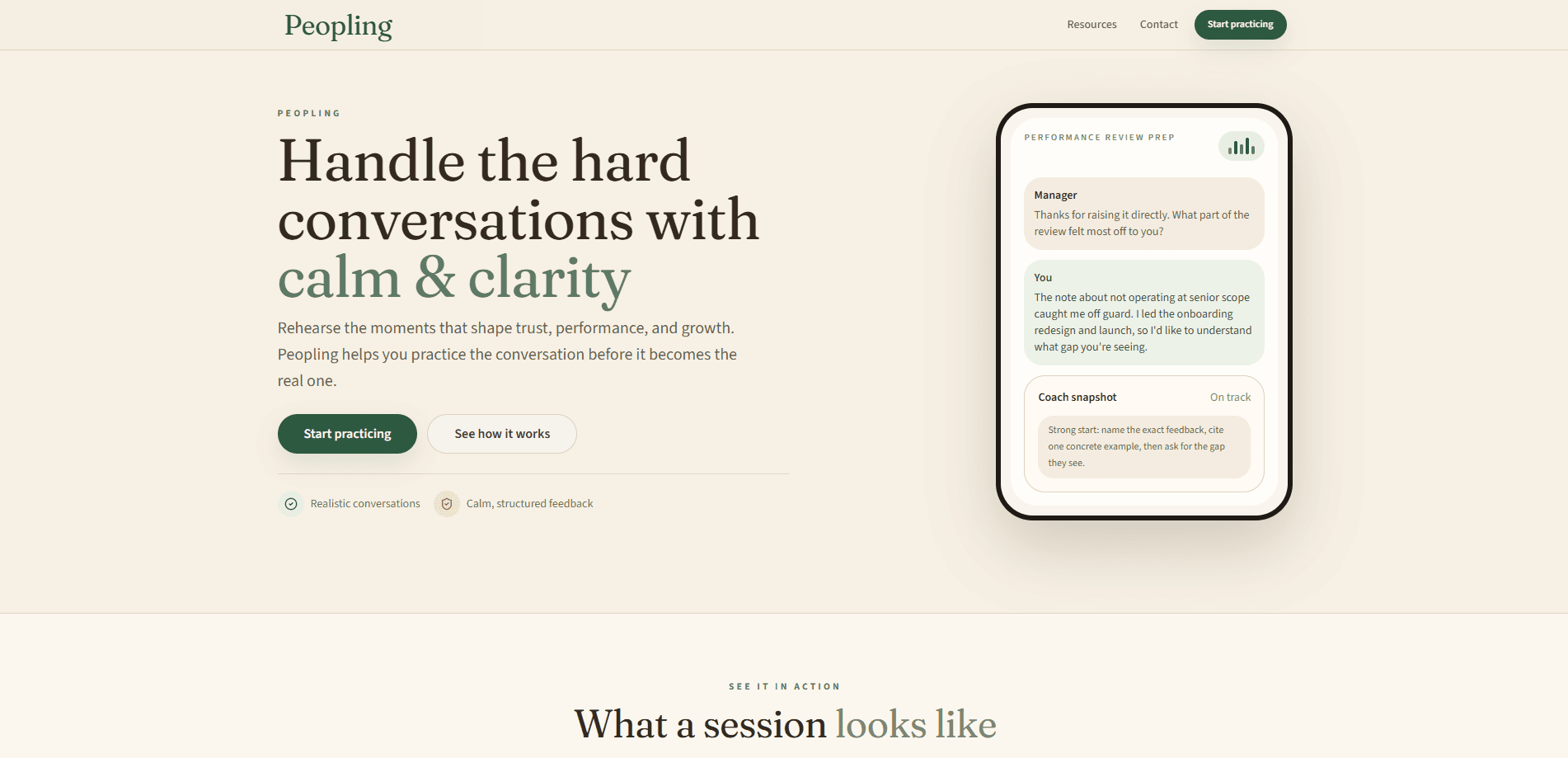
Peopling is an AI conversation practice tool built for anyone who dreads a hard talk. It lets you rehearse difficult conversations against a chatbot that plays a specific person, then hands you structured feedback on what you said and how you said it. Instead of scripting a one-off message, you practice the whole exchange: a salary negotiation, a breakup, a performance review, a boundary-setting chat with a friend. The goal isn't to memorize lines. It's to walk into the real thing having already heard how it goes wrong, and to have picked a version of yourself that holds up when the other person doesn't cooperate the way you hoped.
About Peopling
What Is Peopling
Most people can prepare for a presentation. Almost nobody knows how to prepare for asking their boss for a raise or telling a friend they crossed a line. Peopling treats those moments as a skill you can drill, not a personality trait you either have or don't.
The core idea is roleplay. You describe the situation and the person you're facing, and this AI roleplay tool generates a counterpart that responds like a plausible human, pushback and all. You can retry the same conversation as many times as you like, which is the part real life never gives you.
So why treat it as a conversation practice app rather than a script generator? Because the hard part isn't the words. It's staying calm when the other person pushes back.
The main limit is that a simulated partner is still a simulation. An AI can rehearse realistic resistance, but it can't fully replicate a specific person's history or mood, and its feedback reflects patterns in your wording rather than the emotional truth of the room. Treat it as a training gym, not a stand-in for the person. That distinction matters.
Getting Started
- Create an account on the Peopling website and sign in.
- Describe the situation you want to practice, plus the person you're talking to and what you each want.
- Run the roleplay and respond as you would in real life, including the parts you're unsure about.
- Read the structured feedback, then rerun the same scenario to test a different approach.
- Save the phrasing that worked and take it into the actual conversation.
Product Information
A quick look at Peopling's pricing, supported platforms, and performance.
Best for
The users, tasks, and scenarios where this tool fits best.
Users
- Managers who have to deliver critical feedback and keep the relationship intact
- People with social anxiety who freeze in tense moments
- Non-native speakers handling high-stakes talks in a second language
Tasks
- Rehearsing a salary or promotion negotiation before you walk into the office.
- Practicing how you'll set a boundary with a friend or family member without escalating.
- Preparing for a performance review, a client pushback call, or a hard apology.
Scenarios
- The night before a conversation you've postponed twice, when you want to hear the worst version out loud.
- A commute or lunch break where you replay a tense exchange and try a calmer opening.
- Post-mortem practice
Key features
Realistic Roleplay Scenarios
You set the stage and Peopling plays the other person, generating responses that push back rather than agree with everything. That resistance is the point. A counterpart that folds immediately teaches you nothing, so the tool is built to keep the exchange honest and a little uncomfortable.
Structured Feedback After Each Run
Once a roleplay ends, you get a breakdown of what you said and how it likely landed. It's less a grade than a mirror. You'll see which lines invited a fight and which ones kept the conversation moving, which is hard to judge in the moment. Worth reading twice.
Retry and Compare
The same scenario can be run again and again, so you can swap one opener for another and see how the response changes. Real conversations give you one shot. This gives you ten, and the comparison is where most of the learning happens. That's the whole trick.
Communication Skills Drilling
Peopling is framed around communication skills training rather than emotional support. It pushes you to practice specific behaviors like stating a need plainly or pausing instead of escalating, and then measures whether those moves actually changed the outcome.
Pre-Conversation Preparation
You can use it as a rehearsal tool before a talk you're dreading, writing out the situation and letting the roleplay surface objections you hadn't considered. That dry run often exposes the question your counterpart will actually ask.
Access From Any Browser
Because it runs on the web, there's nothing to install. You can practice from a laptop the night before or from a phone in the minutes before you walk in, which fits how these conversations actually come up and how little warning they usually give you.
Pros and cons
Pros
- Low-pressure place to hear pushback before it's real, which turns a dreaded talk into a practiced one.
- Structured feedback names specific lines and their likely effect instead of a vague "good job".
- Unlimited retries make it easy to A/B two openings and keep the one that works.
- Fits awkward gaps in the day, since it runs in a browser with no setup.
Cons
- The simulated partner can't know the real person's history or current mood, so its reactions may mislead you about a specific individual.
- Feedback judges your wording and patterns, not the emotional truth of your relationship, so don't treat it as a verdict on the outcome.
- Advanced practice and heavier use may sit behind a paid tier, so the free plan limits how much you can drill.
Frequently asked questions
It's for rehearsing conversations you expect to be hard, from negotiations to personal boundaries. You roleplay the exchange with an AI partner, get feedback, and rerun it until your approach holds up.
Related content
Explore related tools, skills, and articles for Peopling.
Peopling Alternatives

HireKey
HireKey · Voice & Language · Productivity · LeaningHireKey is an AI job search copilot built by a former tech recruiter. It checks role fit, tailors resumes, runs interview practice and tracks every application.

Lune
Retrograde Labs · Productivity · LeaningLune is a research search engine for scientific AI agents. It runs as an MCP server that lets Claude, ChatGPT and Cursor search peer-reviewed computer science papers and cite them.
Coddy
Coddy · Coding · LeaningCoddy is a gamified platform to learn to code through short interactive lessons in 20+ languages, with a browser editor, an AI tutor and free certificates.