

Plexe
Plexe · Coding
Plexe is an open-source AutoML platform that lets you build ML models from natural language. Say what you want in plain words, and the agent does the rest. Instead of writing training code by hand, you give the agent a dataset and a goal, and it handles data preparation, code generation, training, and deployment. Teams use it as their AI model builder to ship predictive results in weeks rather than quarters, without a dedicated ML engineer on staff.
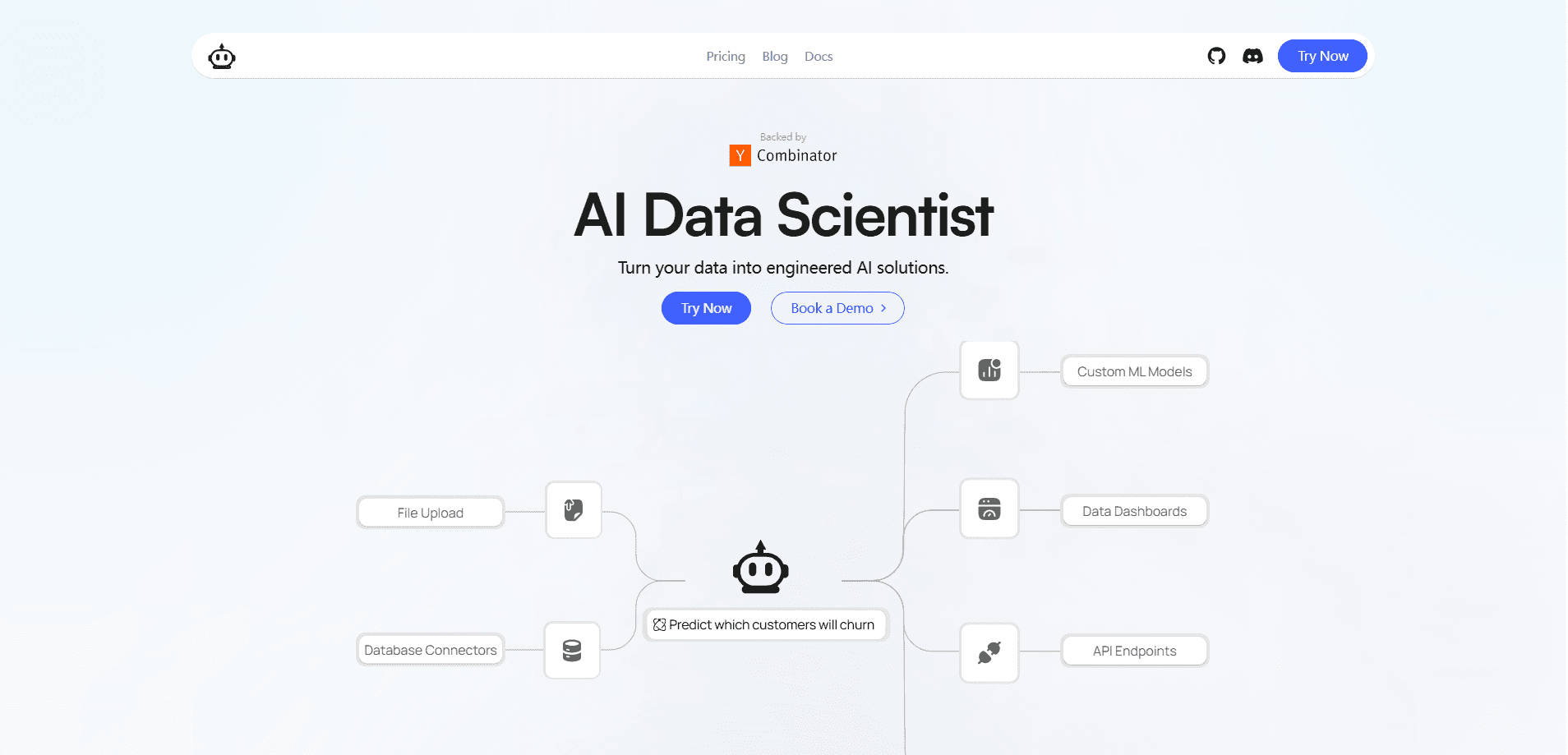
About Plexe
What Is Plexe
Plexe is an agent-driven tool for people who need working machine learning models but don't want to spend months learning the toolchain. It's also a friendly entry point for beginners. You connect a dataset, describe the prediction you want, and a multi-agent system plans the approach, generates the training code, runs it, and refines the result until it performs. It's built on common libraries like scikit-learn, PyTorch, and TensorFlow, so the output stays readable and easy to hand off to an engineer who wants to take it further.
The main problem it solves is the gap between having data and having a deployed model. Traditional workflows stall on feature engineering, framework choices, and infrastructure, and each of those steps can eat days before anyone sees a single prediction. Plexe collapses those steps into one loop and keeps every line of generated code visible, so you can inspect it, change it, or hand it to your own engineers later.
The biggest limitation is that you still need decent data and a clear target. A vague prompt over a messy dataset won't produce a useful predictive model, no matter how good the agent is. It's also an early-stage product. Expect rough edges around very large or unusual problem types.
For teams without an in-house ML specialist, Plexe works as a predictive model tool that handles the heavy lifting, but it won't rescue a project where the data itself is the real problem.
Getting Started
- Install the open-source library with
pip install plexe, or sign up for the hosted platform at console.plexe.ai if you'd rather skip infrastructure setup. - Connect a dataset as a Pandas DataFrame (library) or upload it through the platform UI and API.
- Describe your goal in natural language and, optionally, define input and output schemas so the model knows exactly what to expect.
- Point Plexe at your preferred LLM provider so the agent system can plan and generate code.
- Let the agent build and evaluate the model, then export it for inference or deploy it into your own product.
Product Information
A quick look at Plexe's pricing, supported platforms, and performance.
Best for
The users, tasks, and scenarios where this tool fits best.
Users
- Developers and data scientists who want to skip boilerplate training code and get to a working model faster.
- Product teams and analysts who need predictions inside an app but don't have a dedicated ML engineer.
- Founders running early experiments who want to test a modeling idea before committing real resources.
Tasks
- Building tabular predictive models like churn scores, pricing forecasts, or lead scoring from an existing dataset.
- Fast prototyping of a classification or regression idea to see if the data supports it at all.
- Generating clean, documented training code you can review and hand off to your own engineering team. No more mystery scripts.
Scenarios
- A small startup with a spreadsheet of customer history that wants a churn model without hiring an ML specialist.
- An internal tools team that needs a lightweight prediction endpoint wired into a product by next sprint.
- Early-stage research where you want to compare several approaches in an afternoon rather than a week. Fast turnaround. Low risk.
Key features
Natural Language Model Building
You describe the outcome you want in plain words, and Plexe's agent system works out the modeling strategy. No algorithms to pick. No training loops to write. The agent reads your intent and your data, then builds toward it.
Multi-Agent Pipeline
Under the hood, a sequence of agents handles planning, code generation, execution, and refinement. Each stage feeds the next, and the system iterates on results until performance stops improving. You get a working model without touching most of the internals. That loop is where the time savings come from.
Open-Source Python Library
The plexe library installs with a single pip command and drops straight into existing Python code. You control your own compute and data, and you bring your own LLM provider credentials. It's the path for teams that want maximum control. Simple as that.
Managed Hosted Platform
If you'd rather not manage infrastructure, the hosted platform at console.plexe.ai offers a web UI and a REST API with built-in scaling and simplified billing. It suits product teams that want enterprise-grade ML without the ops overhead, and it means you can get from an idea to a live endpoint without provisioning a single server yourself.
Schema and Dataset Control
You can define expected inputs and outputs with Pydantic models or plain dictionaries, and feed training data through Pandas DataFrames or a dataset generator. Tight schemas keep the generated model aligned with what your application actually needs. That alignment matters more than people expect.
Full Code Transparency
Every model Plexe produces is clean, documented, and readable. You can open the generated code, understand it, and customize it. Nothing hides behind a black box, which matters when a model has to pass an internal review.
Deployment and Inference
Plexe packages the trained model for inference or deploys it to your production infrastructure. Models can be saved to disk and loaded back later, so you're not locked into rebuilding each time. That turns a prototype into something you can actually ship.
Pros and cons
Pros
- Natural language input removes the steepest part of the ML learning curve, so non-specialists can produce real models.
- Open-source core means you own the code and can inspect or change anything the agent generates.
- Two deployment paths (Python library and managed platform) let you trade control for convenience.
- Supports common frameworks, so output fits tools your team already uses.
Cons
- The hosted platform's pricing isn't published, so you have to contact the team for enterprise quotes. Annoying if you want a number now.
- Results depend heavily on data quality; messy inputs still produce weak models, and it won't fix that for you.
- It's an early-stage product, so niche or unusually complex problems may hit rough edges.
Frequently asked questions
It builds machine learning models from natural language descriptions. You supply data and a goal, and its agent system plans, writes, trains, and deploys the model for you. That's the whole product in one sentence.
Related content
Explore related tools, skills, and articles for Plexe.
Plexe Alternatives
Forefront
Forefront · CodingForefront is a web platform for building with open-source AI. It lets you fine-tune leading open-source language models on your own data, evaluate how they perform, and run them through an API or export them to host yourself. Developers who want the convenience of a closed-source platform but insist on owning their models and data are the target audience here.

Startkit
StartKit.AI · CodingStartkit is a boilerplate for building AI SaaS and AI wrapper products. Think of it as an AI startup boilerplate with the boring parts already wired up: authentication, Stripe and Lemon Squeezy payments, usage limits, transactional email, and an AI API starter that talks to OpenAI, Anthropic, Groq, or Llama. You clone the repo, set your price, and start on the part of your product that people actually pay for. It's Next.js under React and Tailwind, so most of the boilerplate code already feels familiar.
Testim
Tricentis · CodingTestim is an AI-powered test automation platform for building and running end-to-end tests across web, mobile, and Salesforce applications. It leans on machine learning to keep tests stable when an interface changes, so teams spend less time fixing broken selectors. Not bad for an automated testing tool you can start using today. You create tests by recording actions in a browser, then optionally add JavaScript when you need more control. It's a solid pick for busy QA teams.