

Plural
Plural · Coding
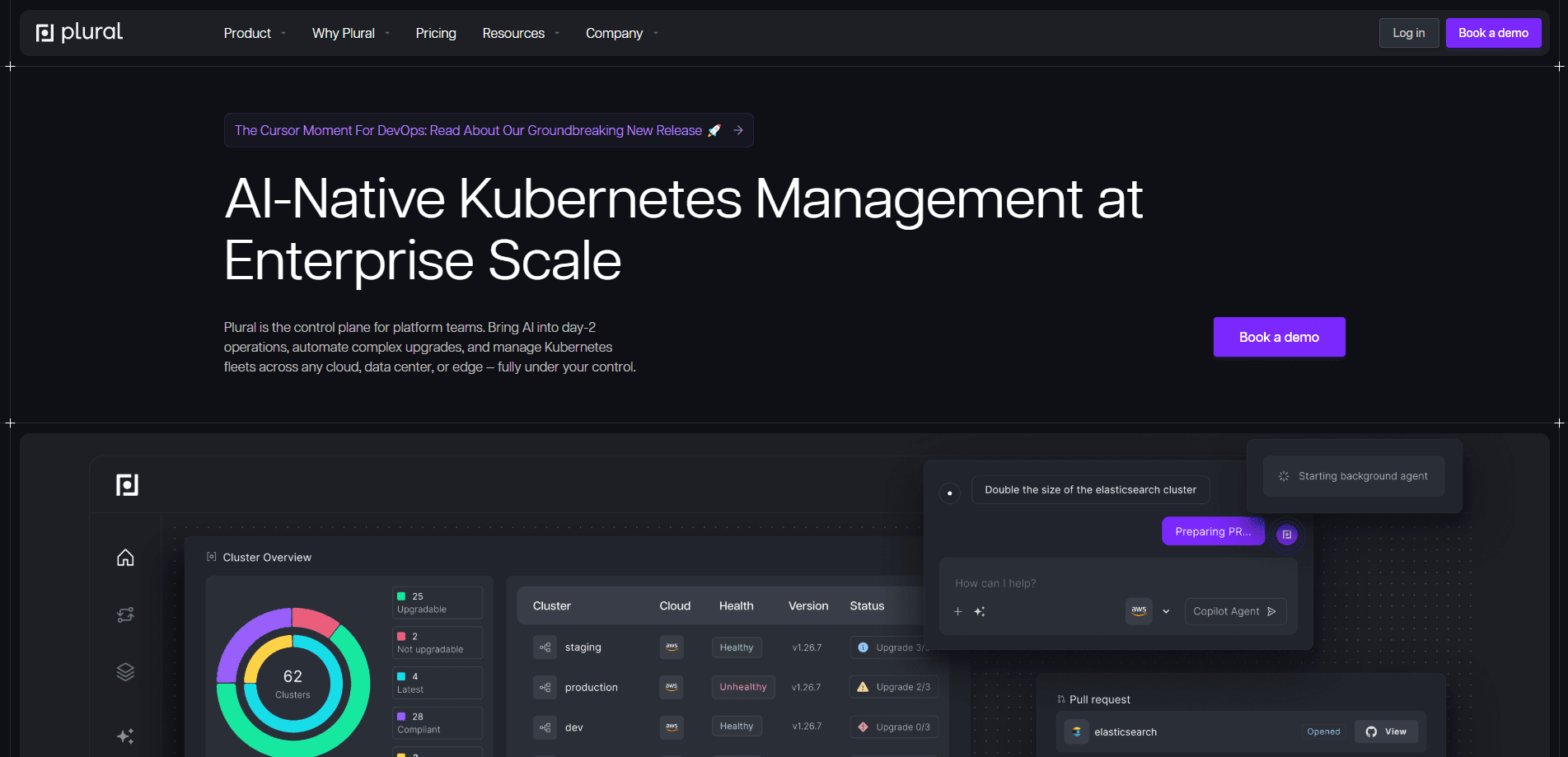
Plural is an AI-native Kubernetes management platform built for teams that run many clusters and want less manual work. It combines a single control plane with agents that read your live infrastructure, open pull requests, and handle routine jobs like cluster upgrades, CVE patching, incident response, and cloud cost right-sizing. The product targets enterprise platform and DevOps teams, and it runs agents inside your own environment rather than on a shared third-party service.
About Plural
What Is Plural
Plural is a self-hosted Kubernetes fleet management platform. Instead of clicking through each cluster one at a time, platform teams connect their environments once and then operate the whole estate from one console. The core pitch is that its AI infrastructure agents are grounded in your live infrastructure, so recommendations come from real cluster state, Terraform run state, and telemetry rather than generic advice.
The problem it solves is operational sprawl. A Kubernetes upgrade that touches dozens of clusters can eat months of engineering time. Security backlogs pile up while everyone waits for a free afternoon. Plural turns those chores into review tasks: an agent maps dependencies, plans the rollout, and opens the pull requests.
The biggest limitation is fit. Plural is built for organizations with a real multi-cluster estate and the budget to match. There's no free tier, and pricing isn't published. The value depends on how many clusters and cloud accounts you're already running. A team with one small cluster won't get much out of it.
Getting Started
- Book a demo through the Plural site and walk through your environment with the team.
- Connect your clusters, cloud accounts, and Git repositories to the control plane.
- Register the tools your team already uses, such as observability providers, source control, and ticketing systems like Jira or Linear.
- Encode your runbooks, review practices, and remediation patterns as skills the agents can follow.
- Run your first workflow, such as a fleet-wide cluster upgrade or a CVE scan, and review the pull requests it produces.
Product Information
A quick look at Plural's pricing, supported platforms, and performance.
Best for
The users, tasks, and scenarios where this tool fits best.
Users
- Platform engineering teams
- DevOps leads
- Security and compliance owners
Tasks
- Fleet-wide cluster upgrades
- Incident response
- CVE remediation
- Cloud cost right-sizing
- Drift detection
Scenarios
- A three-month upgrade project that needs to shrink into an afternoon of review.
- A security backlog that keeps growing because no one has calendar time to drain it.
- A ticketing queue where a request like enlarging a production database should become a linked pull request, not a manual scramble.
Key features
AI Agents Grounded in Live Infrastructure
Plural's agents read your actual cluster state, Terraform run state, and telemetry instead of guessing from documentation. They bundle the tools your team already uses, your encoded runbooks, and purpose-built subagents that specialize in observability, infrastructure analysis, and code changes. That grounding matters. It's the difference between a useful suggestion and a generic one.
Incident Response
When an Alertmanager webhook fires, sub-agents investigate observability and infrastructure at the same time, identify the root cause against the live graph, and open a pull request with a minimal fix. What used to be a multi-hour escalation becomes a short review. The agent digs. Your team approves.
Fleet-Wide Cluster Upgrades
Upgrade agents inventory the cluster estate, map component dependencies, and plan a rollout order across dev, staging, and production. They then produce the pull requests covering the whole fleet. One customer reported cutting Kubernetes upgrade cycles from three months to one day. That's the outcome this feature is aimed at.
CVE Remediation
A scheduled job scans the estate for known CVEs, prioritizes them by exposure, and opens pull requests for the affected service or stack. Security work keeps moving without consuming any engineer's calendar. Most teams struggle with exactly that.
Ticket-to-Pull-Request Automation
Pick up a ticket from Jira, Linear, or another system, and the agent finds the right Terraform module, checks downstream dependencies, and opens a pull request linked back to the ticket. Requests stop sitting in a queue. Someone finally translates them into code.
FinOps and Cost Right-Sizing
FinOps agents inventory cloud spend by cluster, run SQL against your cloud's billing tables, and open a Terraform pull request with right-sizing changes. A generated dashboard breaks down the numbers so you can review before anything ships. Nothing changes without approval.
GitOps and IaC Management
Plural automates deployments for Terraform, Pulumi, and Ansible stacks from any Git repository on commit. Terraform plans appear in pull requests, so engineers don't need local elevated permissions to apply changes. The engine runs Kubernetes-specific workflows on clusters close to the resources they manage and supports egress-only networking.
Operations Console and Policy Management
A unified console shows resources, logs, and cluster health in one view, with centralized RBAC and SSO. Standardized software bills of materials, tagging, and templating make it easier to target clusters and keep configurations consistent across environments.
Pros and cons
Pros
- Agents run inside your environment and read live infrastructure, so their suggestions reflect real state rather than stale docs.
- Turns multi-month chores like fleet upgrades and CVE backlog cleanup into pull request reviews.
- GitOps-first design means every change is tracked and reviewable in Git.
- Integrates with the tools teams already use, including observability providers, Jira, Linear, and MCP servers.
- Enterprise guardrails and policy management are built in, which matters for regulated environments.
Cons
- No free plan and no published pricing, so cost is a sales conversation that smaller teams can't easily evaluate.
- The value scales with your estate, meaning a team running one or two clusters won't see much benefit.
- Setup asks you to connect clusters, cloud accounts, repos, and ticketing, which is real work before you see results.
- It's Kubernetes-focused, so teams on other orchestrators are out of scope.
Frequently asked questions
Plural manages a fleet of Kubernetes clusters from a single control plane, with AI agents that handle upgrades, incident response, CVE remediation, and cost right-sizing by opening pull requests for review.
Related content
Explore related tools, skills, and articles for Plural.
Plural Alternatives
Forefront
Forefront · CodingForefront is a web platform for building with open-source AI. It lets you fine-tune leading open-source language models on your own data, evaluate how they perform, and run them through an API or export them to host yourself. Developers who want the convenience of a closed-source platform but insist on owning their models and data are the target audience here.

Startkit
StartKit.AI · CodingStartkit is a boilerplate for building AI SaaS and AI wrapper products. Think of it as an AI startup boilerplate with the boring parts already wired up: authentication, Stripe and Lemon Squeezy payments, usage limits, transactional email, and an AI API starter that talks to OpenAI, Anthropic, Groq, or Llama. You clone the repo, set your price, and start on the part of your product that people actually pay for. It's Next.js under React and Tailwind, so most of the boilerplate code already feels familiar.
Testim
Tricentis · CodingTestim is an AI-powered test automation platform for building and running end-to-end tests across web, mobile, and Salesforce applications. It leans on machine learning to keep tests stable when an interface changes, so teams spend less time fixing broken selectors. Not bad for an automated testing tool you can start using today. You create tests by recording actions in a browser, then optionally add JavaScript when you need more control. It's a solid pick for busy QA teams.