

Polygraph
Nx (Narwhal Technologies) · Coding
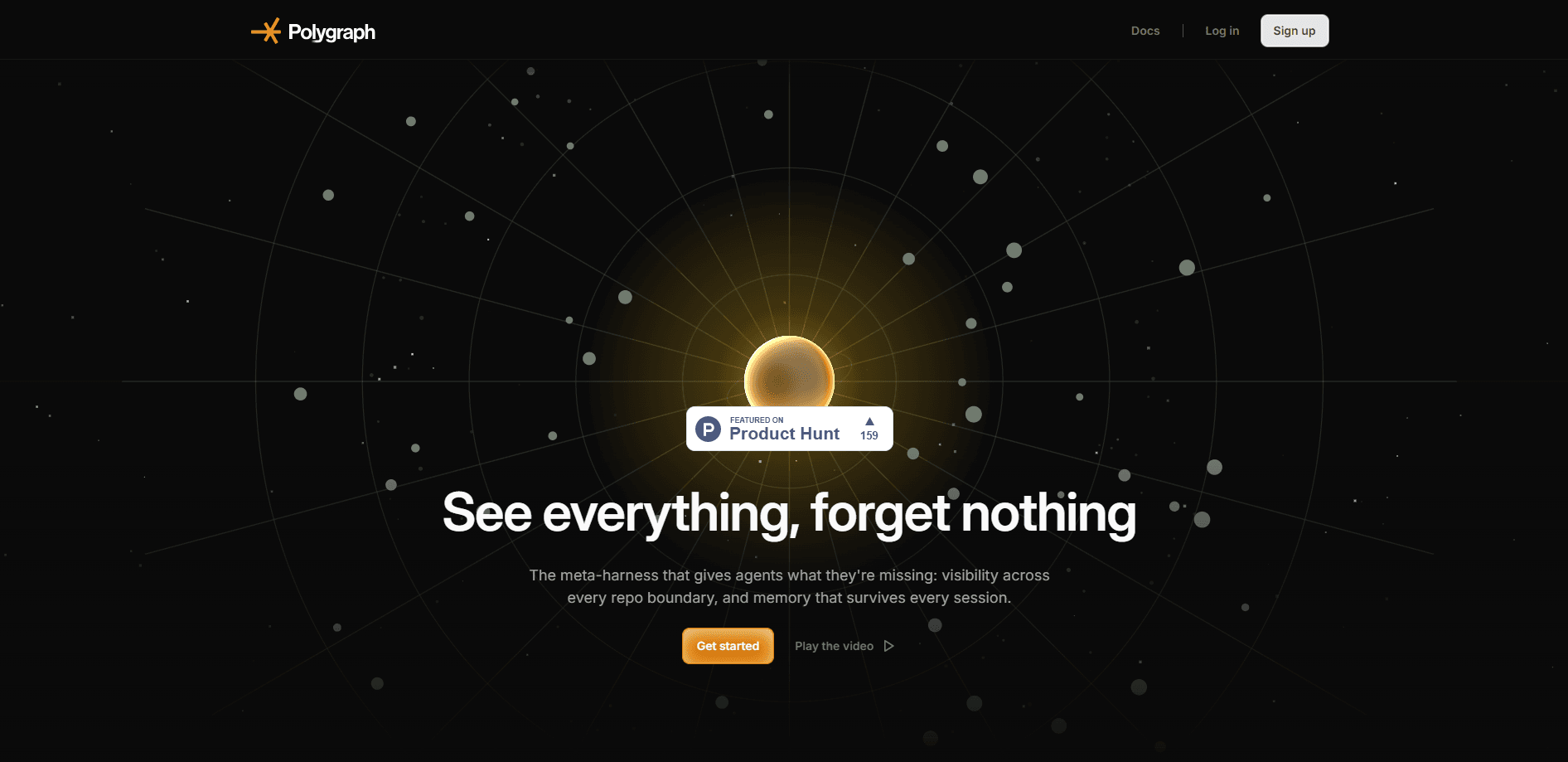
Polygraph is a cross-repo agent tool for AI coding agents that indexes every repo you can access and links them through a dependency graph of packages and APIs. Instead of replacing the agent you already run, it plugs into Claude Code, Codex, or OpenCode and gives that agent two things it normally lacks: visibility across repo boundaries and persistent agent memory that survives each session. The result is cross-repo work that runs as one coordinated change, without migrating your code into a monorepo. The team behind it pitches the setup as an AI agent platform for maximum autonomy, in one layer. The idea is simple. Your agent shouldn't be blind and shouldn't forget. Polygraph handles both.
About Polygraph
What Is Polygraph
Polygraph is a developer tool built by the Nx team to fix two limits that trip up coding agents inside real organizations. The first is space: a normal agent sits inside one repo, can't see how a change affects the wider system, and writes to a single repo at a time. The second is time: sessions start from a blank slate, so a human ends up re-explaining context every morning.
Polygraph connects all your repos, private and open source, into a unified dependency graph. It doesn't move any code. Your agent just reads and writes across every repo you have access to, and it orchestrates the pull requests and CI as one change. According to the company, the goal is monorepo ergonomics without the migration, which they call a synthetic monorepo.
The other half is memory. Polygraph records every agent session, so you can resume, reference, or build on work done by anyone, on any machine, even with a different agent. One limit is worth flagging. This only works inside the repos and CI your account already connects to. And the platform is still in early access, so features and pricing can shift.
Getting Started
- Install the CLI on macOS or Linux with the standalone script, Homebrew tap, or Windows installer from the installation docs.
- Run
polygraphto sign in through the OAuth device flow and pick the account you want to work under. - Confirm the active account with
polygraph whoami, then runpolygraph session startto open your first session. - Add repos up front or as you go. You can describe the task and let Polygraph find the right repos, or name one directly like
vitejs/vite. - Work through your existing agent, then resume or review the session later with
polygraph session resumeorpolygraph session review.
Product Information
A quick look at Polygraph's pricing, supported platforms, and performance.
Best for
The users, tasks, and scenarios where this tool fits best.
Users
- Platform and infrastructure engineers
- Agent power users who already run Claude Code, Codex, or OpenCode
- Engineering teams spread across machines
Tasks
- Cross-repo refactors
- Upstream debugging with OSS repos
- Onboarding onto unfamiliar work
Scenarios
- A package rename that ripples through five internal repos and two open source consumers.
- Picking up a teammate's half-finished branch on a different machine, with the same agent or a different one.
- Adversarial code review, where you ask the agent to attack a change instead of defend it.
Key features
Cross-Repo Agent Sessions
Automatic repo discovery indexes everything you can access and builds a graph of how the repos relate through packages and APIs. Your agent plans work across that graph without being told where to look. You prompt once. The change lands in each repo that needs it. A session isn't locked to its starting repos either, so you can pull in another one mid-task.
Cross-Repo PR and CI Coordination
Polygraph treats your repositories as one working set. It pulls the right repos in for context, coordinates changes across them, and opens a pull request on each. Downstream consumers get updated and tested before anything merges. That's the part that usually goes wrong when you coordinate by hand. Big change, no surprises.
Persistent Session History
Every session is recorded with its description, PRs, and traces. You can reference any past session as context. So fixing a bug doesn't mean digging through commit history to reconstruct what someone was thinking. For teams, this turns individual work into something closer to institutional memory.
Resuming and Handoff
Resume a session tomorrow, continue it on another machine, or hand it to a teammate. When you resume, Polygraph rebuilds the state on your machine with the repos at the relevant SHAs and the matching logs. Start work in Claude and finish it in Codex if you want. The friction is close to zero.
Background Session Capture
Sessions run outside Polygraph still get recorded, which keeps the work behind a pull request reviewable. That matters. Someone ran an agent locally, and you want to know what actually happened before you approve the change.
Code Reviews and Adversarial Mode
Review the session behind a change, ask about the decisions, and run an adversarial review with a single flag. Because the review works off the recorded session, you see the reasoning, not just the diff. That's the difference between trusting a change and guessing at it.
Using Multiple Agents
A parent agent can plan the work while child agents execute it per repo. Roles let several agents share the same repo without stepping on each other. It's aimed at teams that already run more than one agent and want them to cooperate.
Pros and cons
Pros
- Works with the agents you already use instead of forcing a switch, so there's little to relearn.
- No code migration. The synthetic monorepo gives cross-repo reach while your repos stay put.
- Session history survives machines and agents, which cuts the repeated re-explaining between teammates.
- Free during early access, so teams can test it on real repos at no cost.
- Cross-repo PR and CI coordination removes the most error-prone part of multi-repo changes.
Cons
- Limited to the repos and CI you connect, so it can't reach systems your account doesn't cover.
- Early access means pricing and features can change without much notice.
- CLI-first workflow assumes some comfort with the terminal, which won't suit every team member.
- API availability isn't documented yet, so automation outside the CLI is uncertain.
Frequently asked questions
It connects all your repos into one dependency graph and records every AI agent session, so an agent can work across repo boundaries and remember past work. It sits on top of Claude Code, Codex, or OpenCode rather than replacing them. Setup is a CLI install and a sign-in. Integration with your existing stack is light.
Related content
Explore related tools, skills, and articles for Polygraph.
Polygraph Alternatives
Forefront
Forefront · CodingForefront is a web platform for building with open-source AI. It lets you fine-tune leading open-source language models on your own data, evaluate how they perform, and run them through an API or export them to host yourself. Developers who want the convenience of a closed-source platform but insist on owning their models and data are the target audience here.

Startkit
StartKit.AI · CodingStartkit is a boilerplate for building AI SaaS and AI wrapper products. Think of it as an AI startup boilerplate with the boring parts already wired up: authentication, Stripe and Lemon Squeezy payments, usage limits, transactional email, and an AI API starter that talks to OpenAI, Anthropic, Groq, or Llama. You clone the repo, set your price, and start on the part of your product that people actually pay for. It's Next.js under React and Tailwind, so most of the boilerplate code already feels familiar.
Testim
Tricentis · CodingTestim is an AI-powered test automation platform for building and running end-to-end tests across web, mobile, and Salesforce applications. It leans on machine learning to keep tests stable when an interface changes, so teams spend less time fixing broken selectors. Not bad for an automated testing tool you can start using today. You create tests by recording actions in a browser, then optionally add JavaScript when you need more control. It's a solid pick for busy QA teams.