

ProdOps.AI
Revelry Labs (Revelry Ai) · Productivity
ProdOps.AI now resolves to Revelry Ai, an AI agent platform where operations teams connect their own tools, run Skills and Workflows, and approve drafts before anything ships.
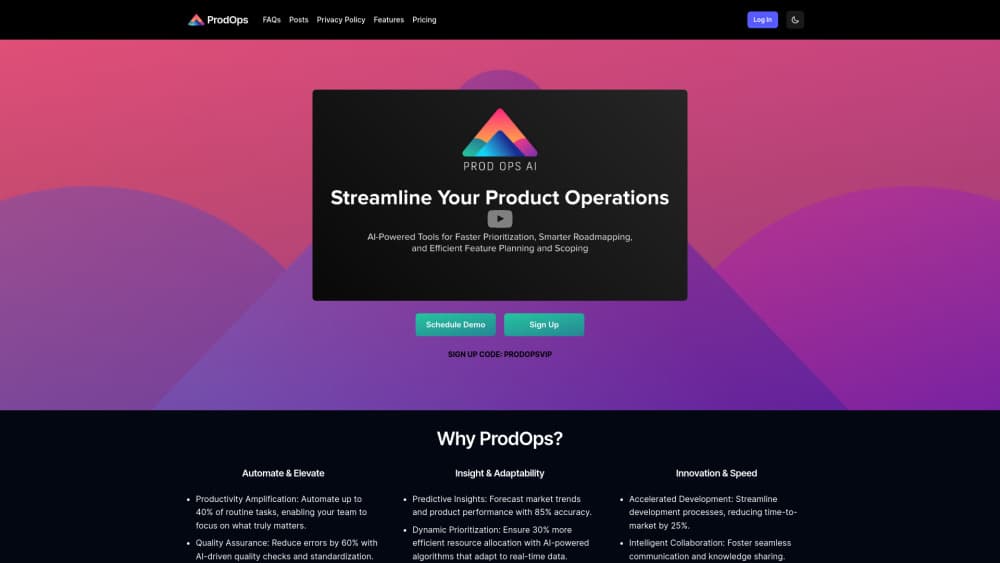
About ProdOps.AI
What Is ProdOps.AI
The address tells most of the story. Type prodops.ai into a browser and you land on revelry.ai, where the product ships as Revelry Ai. Revelry Labs, a software studio that has been building since 2013, launched the platform in 2024 and moved it under the Revelry name.
What it actually does is take the busywork an operations team already has and hand back a finished draft. It connects the systems people log into anyway, Procore, QuickBooks, Xero, Slack, Jira, GitHub, Microsoft, Google and a few others, then works from their documents and templates to produce weekly reports, bid comparisons, client follow-ups, and month-end summaries. Every number comes with the record it came from, so a person can check the source instead of trusting the output. The pitch is AI workflow automation, not another chat box with your files bolted on.
Two limits matter before you sign up. There is no public price list, so a plan number only shows up in a quote. And the industry Kits that would package ready-made Skills and Workflows were still marked as not in the product when we checked the developer page.
Getting Started
- Sign up at revelry.ai and upload a document you already work from. No credit card is needed, and the first answer comes from that first file.
- Connect the tools your team runs. Initial setup help is free, and a system the platform doesn't cover goes onto its build list.
- Add the rules your team writes down once, then sync Google Drive or SharePoint into Knowledge so answers pull from current files.
- Start from a pre-built Agent or describe the one you want in chat. Set approval gates on anything that writes back to a connected system.
- Run it in the chat window, or issue an API key and call the same Agents from your own code.
Product Information
A quick look at ProdOps.AI's pricing, supported platforms, and performance.
Best for
The users, tasks, and scenarios where this tool fits best.
Users
- Operations managers at contractors and subcontractors
- Finance and lending operations teams
- Developers building internal AI features
Tasks
- Weekly project reports
- Bid leveling
- Client follow-ups and status chasing
- Month-end summaries and document review
Scenarios
- A team that already pays for chat tools and gets a different answer from every teammate
- Organizations that want to resell AI under their own brand
- Work that needs an audit trail
Key features
Skills, Agents, and Workflows
Three building blocks cover most of the work. A Skill is a prompt with a model, tools, and data sources attached, and Skills can call each other in a fixed order or when the model decides one is needed. An Agent is a configured chat with a persona, memory, Skills, and tools. A Workflow is a multi-step pipeline with explicit inputs and outputs between steps, which is what you want when a process has to run identically every time. Each step can run on a different model, so a long analysis and a quick triage don't share a price tag. That structure is what separates AI agents for operations teams from a general chat subscription.
Knowledge That Cites Its Sources
Upload documents, sync Google Drive and SharePoint, or pull in web pages, and every Agent on the account can search that library. The part that matters for operations work is the citation: each answer points at the file or record behind the number. When a project manager questions a figure in a report, the check takes seconds.
Approval Gates Before Anything Changes
Before an Agent creates, updates, or deletes a record in a connected service, it stops and asks. You can approve once, allow that action from then on, or deny it. Read-only actions run without interruption, and every action lands in a log. That setup is what makes it safe to point an Agent at a live ERP rather than a copy of one.
MCP in Both Directions
Claude, Cursor, or an internal app can call your Agents and Skills over MCP, so a capability gets built once and every client can reach it. The reverse also works: Agents call outside MCP servers, and GitHub's is the clearest example, since an Agent can read issues, search code, and open a pull request for review.
Sandboxed Workspaces
Workspaces give an Agent a place to read and write files, run code, and work through spreadsheets. Each sandbox is isolated from your production systems, so a half-finished calculation can't touch the real ledger. It is the least glamorous feature on this list and probably the one your security reviewer asks about first.
Per-Task Model Choice and API Access
Each Skill and Agent picks its own model, which keeps expensive reasoning out of cheap jobs. The platform itself is written in Elixir to hold many long-running jobs at once. For engineers, a REST call to the chats endpoint with a Bearer key starts a conversation with a named Agent, and rate limits are tiered by plan.
Pros and cons
Pros
- Every answer carries a citation, so verification is a click rather than a re-check of four systems.
- It runs on the tools a team already pays for, including Procore, QuickBooks, Xero, Slack, Jira, and GitHub.
- Approval gates and action logs make live-system writes defensible to a compliance reviewer.
- The vendor states it doesn't train on customer data, and a SOC 2 Type 1 report is available on request.
- Starting costs nothing, and basic setups have gone live in about two weeks according to the company.
Cons
- No published pricing. Budgeting means a sales call, which slows down anyone comparing tools on a spreadsheet.
- The name now misfires: ProdOps.AI suggests product management software, while the product targets general operations roles like construction and lending.
- The connector list is short. If your system of record isn't among the ten or so named integrations, you wait for the build list.
- Industry Kits that would bundle ready-made Skills and Workflows per vertical were still unreleased, so teams assemble their own starting point.
Frequently asked questions
Yes, as far as the web goes. The prodops.ai domain redirects to revelry.ai, and the platform is documented and sold there under the Revelry Ai name. The company behind both is Revelry Labs.
Related content
Explore related tools, skills, and articles for ProdOps.AI.
ProdOps.AI Alternatives

Base Code
Base44 (Wix) · Coding · ProductivityBase Code is a shared cloud development environment from Base44. Teammates describe changes to an existing GitHub codebase in chat, preview them live and send them back as pull requests.

Knocket
Knocket (Tencent RTC team) · Productivity · Business · ChatbotKnocket is a free live chat and contact page tool that lets visitors message you from your website, app, or a shareable link, with every reply handled from Telegram or one inbox.

FloorGen
Vinit Kumar (FloorGen) · Productivity · China AIFloorGen is a browser-based floor plan maker that turns a sentence or a sketch into an editable 2D plan and a 3D walkthrough. Export to PDF, DXF or video, and draw without an account.