

Revenue-Driven Roadmaps
Ignition GTM, Inc. · AI Assistant · Business
Revenue-Driven Roadmaps is Ignition's AI roadmapping suite, sold at productroadmap.ai. It turns CRM deal data into revenue-based priorities and alerts sales reps when the features they need ship.
About Revenue-Driven Roadmaps
What Is Revenue-Driven Roadmaps
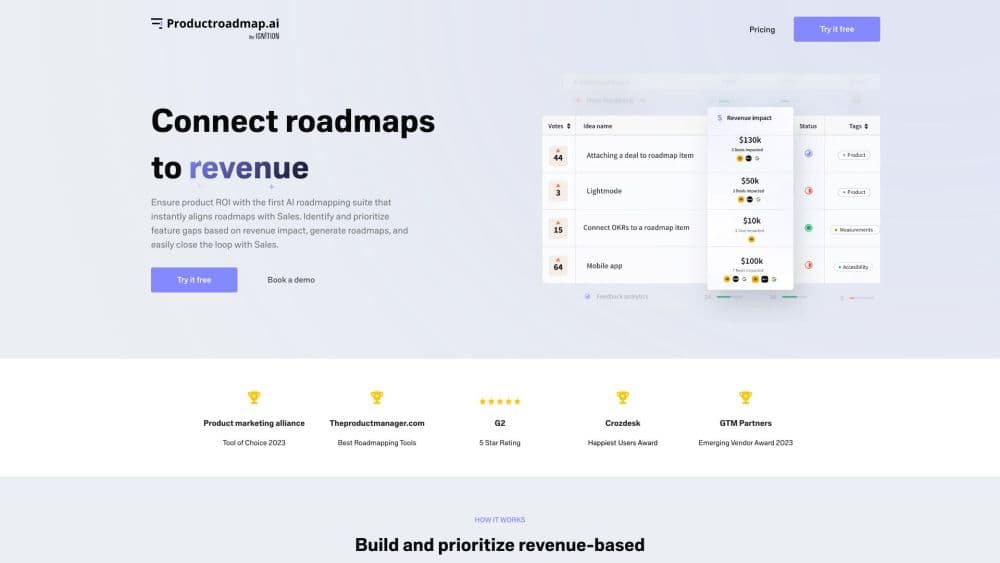
Revenue-Driven Roadmaps is Ignition's AI product roadmap tool. It sits between a CRM and a roadmap: the software reads deal records and customer conversations, finds the features that keep blocking revenue, and ranks them on the roadmap you publish to the company.
The problem it targets is familiar to anyone who ships B2B software. Requests pile up from sales calls, support tickets, and executive asks, and the roadmap gets settled by whoever argues hardest. This product replaces that argument with pipeline data. Each item carries the dollar value of the deals waiting on it, so a feature that unblocks three six-figure contracts outranks a nice-to-have with no revenue attached.
Ignition calls it an AI roadmapping suite rather than a single board, and that's accurate. Roadmaps, feedback boards, changelogs, competitive research, GTM plans, and OKR tracking live in the same workspace, and teams buy the modules they need. The catch is that the revenue math only works when your CRM data is clean. If reps leave deals stale or skip logging lost reasons, the priority scores inherit that noise.
Getting Started
- Create a free account at productroadmap.ai. The Free tier covers automation, AI features, and limited integrations, and viewers are unlimited on every plan.
- Connect your CRM and support tools. The AI needs deal records and customer conversations before it can run a useful feature gap analysis.
- Import existing roadmap items or start from the idea backlog, then pick a list, timeline, or kanban view for the audience you're presenting to.
- Review the gaps the AI extracted and the revenue score attached to each item. Adjust priority where the model has missed context you know about.
- Share the roadmap, then switch on sales notifications so deal owners hear about shipped features without asking.
Product Information
A quick look at Revenue-Driven Roadmaps's pricing, supported platforms, and performance.
Best for
The users, tasks, and scenarios where this tool fits best.
Users
- Product managers
- Product operations leads
- Sales and revenue leaders
- Product marketing managers
Tasks
- Prioritizing by revenue impact
- Collecting feature requests
- Closing the loop after launch
- Planning a release
Scenarios
- An enterprise deal stalls on a missing integration
- Quarterly planning with too many requests
- A launch that needs internal enablement
Key features
AI Feature Gap Detection
The tool reads CRM records and customer conversations, then sorts requests into themes you can act on. Each gap links back to the deals and accounts that asked for it, so you can see who is waiting. That's the difference between a feature gap analysis and a wish list.
Revenue-Based Prioritization
Deal values are mapped onto roadmap items automatically. When you reorder the roadmap, the revenue at stake moves with it, and you can weigh potential business impact against user need and internal value. Teams that run quarterly planning in spreadsheets will feel the difference in the first session.
Sales Alerts When Features Ship
When an item moves to shipped, the deal owner gets a targeted alert. Reps can reopen stalled conversations, pitch an upsell, or close a deal that was waiting on that feature. Nobody has to remember to send the update.
Shared Roadmap Views
The same items render as a list, a timeline, or a kanban board. Executives get the timeline, delivery teams get the board, and customers get a filtered view. Unlimited viewers mean you don't pay per person for read access.
Feedback and Research Hub
Surveys, competitive intel, and customer feedback land in one place, with AI summaries that surface common requests and overall sentiment. It's useful when you need to check whether a request comes from one loud account or a real pattern across the base.
Public Changelogs and Voting Boards
Customers and internal teams can nominate, vote on, and discuss features, and you can publish branded changelogs when work ships. That cuts the number of "when is this coming" messages support has to answer.
GTM Planning Module
Roadmap items turn into GTM plans with tasks, assets, launch calendars, and automated sales rep notifications. Product marketing stops rebuilding the launch list by hand, and product managers stop forwarding screenshots.
Pros and cons
Pros
- Revenue scores come from live CRM data, so prioritization debates start from numbers.
- Unlimited free viewers on every plan make it cheap to share roadmaps widely.
- One workspace covers roadmaps, feedback, changelogs, research, and GTM plans.
- Automatic sales alerts close the loop after release without manual updates.
- A la carte modules let a small team pay for product management only.
Cons
- Priority quality depends on CRM hygiene, and stale deal data produces misleading scores.
- Module pricing stacks up: GTM planning and product management cost $49 per editor each month, research and measurement $19.
- AI summaries can flatten long threads, so someone still has to read the source before a big call.
- It runs in the browser only, with no mobile app for checking a roadmap on the go.
Frequently asked questions
It's Ignition's AI roadmapping software for B2B product teams. You connect a CRM and support tools, and the software links deal value to roadmap items so you can prioritize by revenue and tell sales when features ship.
Related content
Explore related tools, skills, and articles for Revenue-Driven Roadmaps.
Revenue-Driven Roadmaps Alternatives
Agibot
Agibot · Productivity · AI Assistant · ChatbotAgibot is a personal AI agent for Mac that keeps running after you close the window, runs routines on a schedule, and works from Telegram or Slack with your own API keys.

Foley
Hanamori Labs, LLC · Voice & Language · Productivity · AI AssistantFoley is a voice to-do list that turns a spoken sentence into a filed task, complete with project, date and time, then helps you plan the day around what is already there.

Ghost Core
Ghost · Productivity · AI AssistantGhost Core is a $3,499 screenless personal AI computer that runs local AI models on its own hardware, builds context from your apps and devices, and acts without waiting for a prompt.