

Propane
Propane (Copenhagen, Denmark) · Productivity
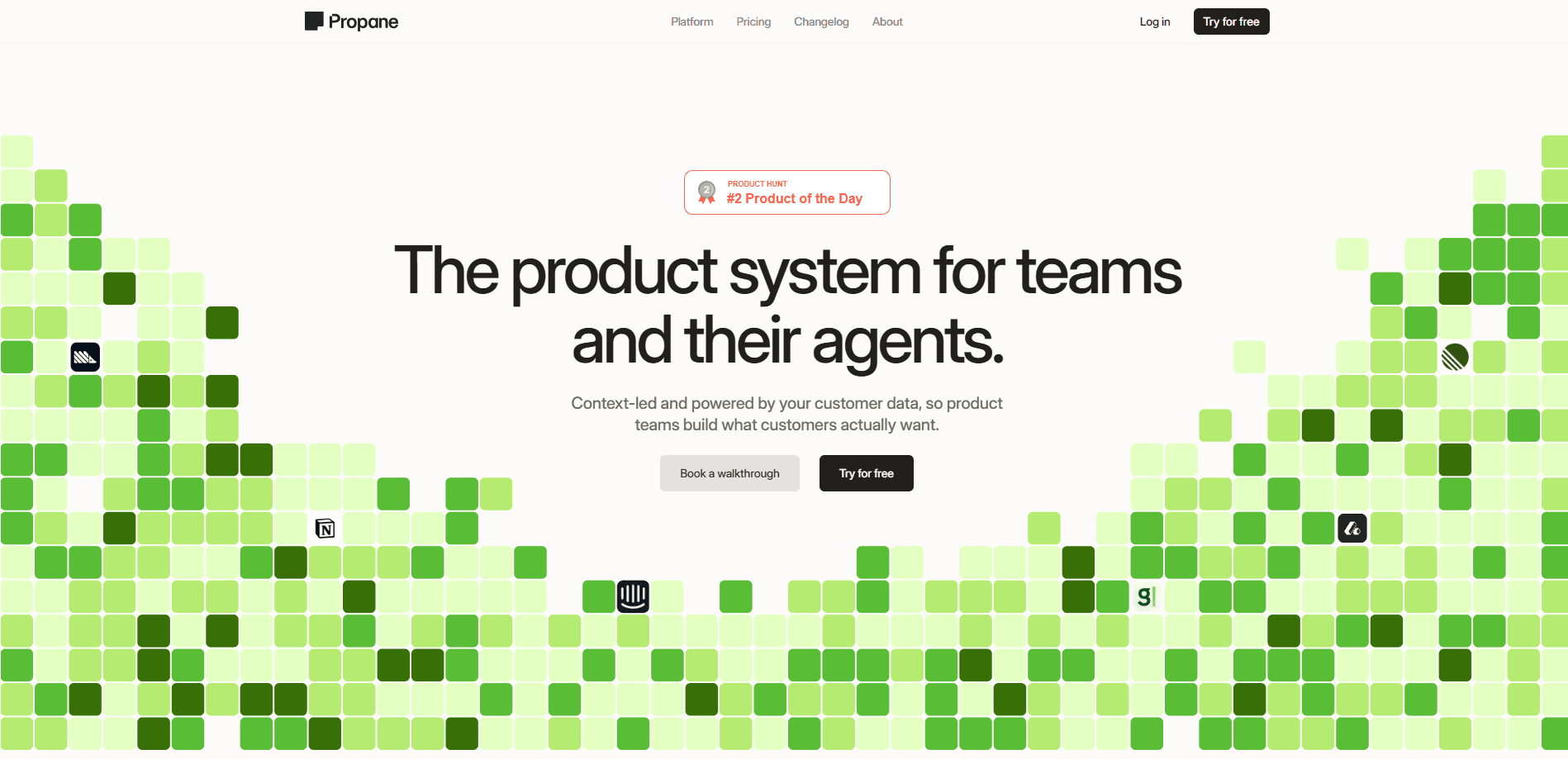
Propane is a customer intelligence platform for product teams that pulls scattered feedback from support tickets, CRM, sales calls, surveys, and analytics into one shared context. It connects to more than 500 data sources, then uses AI to surface patterns and answer questions across every team. Think of it as an AI product management tool with customer feedback analysis baked in. The pitch is simple: your product team and its AI agents should build from the same truth instead of hunting through tools that don't talk to each other.
About Propane
What Is Propane
Propane is an AI-native product system built around customer context. Instead of forcing you to copy insights between a feedback tool, a CRM, and a notes app, it connects all of those sources into a single layer that stays current on its own. Founded in 2025 and based in Copenhagen, the company positions itself as a replacement for the old stack of research and feedback products.
The core idea is that product decisions fall apart when context lives in too many places. Propane collects the signals, organizes them into a live workspace, and makes that context available to both your team and the AI agents writing code for you. That's the whole bet.
It's not a tool for solo makers. Pricing starts at €50 per month plus usage, so it's aimed at funded product teams with real data volume. There's also no free tier beyond a 7-day trial, which matters if you just want to poke around.
Getting Started
- Create a free account at app.usepropane.ai. No credit card is needed to start the 7-day trial.
- Connect your stack. Add sources like HubSpot, Intercom, Zendesk, Slack, and Stripe to pull in your first context.
- Let Propane index those sources and build your initial signal set, usually within minutes.
- Open a Space to collaborate with teammates, sketch ideas, and shape your roadmap in one place.
- Hand the finished context to your agents so they can work from the full picture rather than a stripped-down prompt.
Product Information
A quick look at Propane's pricing, supported platforms, and performance.
Best for
The users, tasks, and scenarios where this tool fits best.
Users
- Product managers
- Product and engineering leads
- Customer success and research teams
Tasks
- Consolidating feedback
- Competitor tracking
- Roadmap prioritization
- Feeding AI agents
Scenarios
- Weekly product reviews
- Churn investigations
- Early-stage research
- Enterprise feature requests
Key features
Spaces and the AI-Powered Canvas
Spaces are shared workspaces where your team and its agents work side by side. Inside a Space you get a canvas for laying out context, sketching ideas, and commenting, so decisions keep the evidence attached instead of drifting into a doc nobody opens. The canvas is where Propane's "one place for the whole product team" claim actually shows up. No more lost context.
500+ Data Source Connections
Propane plugs into HubSpot, Intercom, Zendesk, Slack, Segment, Salesforce, Stripe, PostHog, Linear, GitHub, and hundreds more. Every source feeds the same context layer, which means a support escalation in Intercom and a churn signal in Stripe land in the same view rather than two dashboards. Setup is the usual OAuth flow, and most teams see their first context in minutes. That setup speed is the point.
Signals and Pattern Detection
Signals is Propane's answer to "what are customers actually telling us." It uses AI to surface patterns across connected sources and lets you ask questions in plain language. The chat understands your competitors too, so you can compare what buyers say about you against what they say about the alternative. That last part is genuinely useful.
Agent-Ready Context
The platform is designed to hand full context to AI coding agents. Once your data is connected, you can push that context to agents like Cursor's cloud agents so they work with the real product picture, not a lossy summary. According to Propane, this leads to more accurate and faster output. That's the vendor's own claim rather than an independent benchmark.
Voice and Chat Research Agents
Propane includes optional research agents that can run voice or chat interviews and feed the results straight back into your context. For teams that do regular user research, this removes the manual step of transcribing calls and tagging notes afterward. Big time saver.
Security and Data Policy
Propane is SOC 2 Type II certified and GDPR compliant, and it states that customer data is never used to train AI models. That last point matters if you're feeding in sensitive support tickets or sales calls. The company runs a public trust center with its subprocessors listed. Worth a look before you connect anything.
Pros and cons
Pros
- Connects 500+ sources into one context layer, which cuts the manual work of copying insights between tools.
- Flat €50/month with unlimited users, so you're not taxed per seat as your team grows.
- SOC 2 Type II and GDPR compliance with a stated no-training-on-your-data policy.
- Built for AI agents from the start, not bolted on later.
- Free hands-on onboarding, which lowers the setup hurdle for a data-heavy product.
Cons
- No real free plan. The 7-day trial is short if you want to test it on messy real data.
- Usage pricing is billed per company or competitor you index, so costs climb as you add sources.
- No listed mobile app, so it's browser-only for now.
- API availability isn't clearly documented, which is a problem if you want to build custom integrations.
Frequently asked questions
Propane collects customer and competitor data from your existing tools and turns it into one shared context that your product team and AI agents build from. It's a customer intelligence platform rather than a feedback board.
Related content
Explore related tools, skills, and articles for Propane.
Propane Alternatives

Base Code
Base44 (Wix) · Coding · ProductivityBase Code is a shared cloud development environment from Base44. Teammates describe changes to an existing GitHub codebase in chat, preview them live and send them back as pull requests.

Knocket
Knocket (Tencent RTC team) · Productivity · Business · ChatbotKnocket is a free live chat and contact page tool that lets visitors message you from your website, app, or a shareable link, with every reply handled from Telegram or one inbox.

FloorGen
Vinit Kumar (FloorGen) · Productivity · China AIFloorGen is a browser-based floor plan maker that turns a sentence or a sketch into an editable 2D plan and a 3D walkthrough. Export to PDF, DXF or video, and draw without an account.