

Pullpo.io
Pullpo · Coding · Productivity
Pullpo is a developer experience platform that combines engineering metrics with Slack PR channels. It tracks DORA and SPACE data, speeds up code reviews, and starts at €8 per seat.
About Pullpo.io
What Is Pullpo
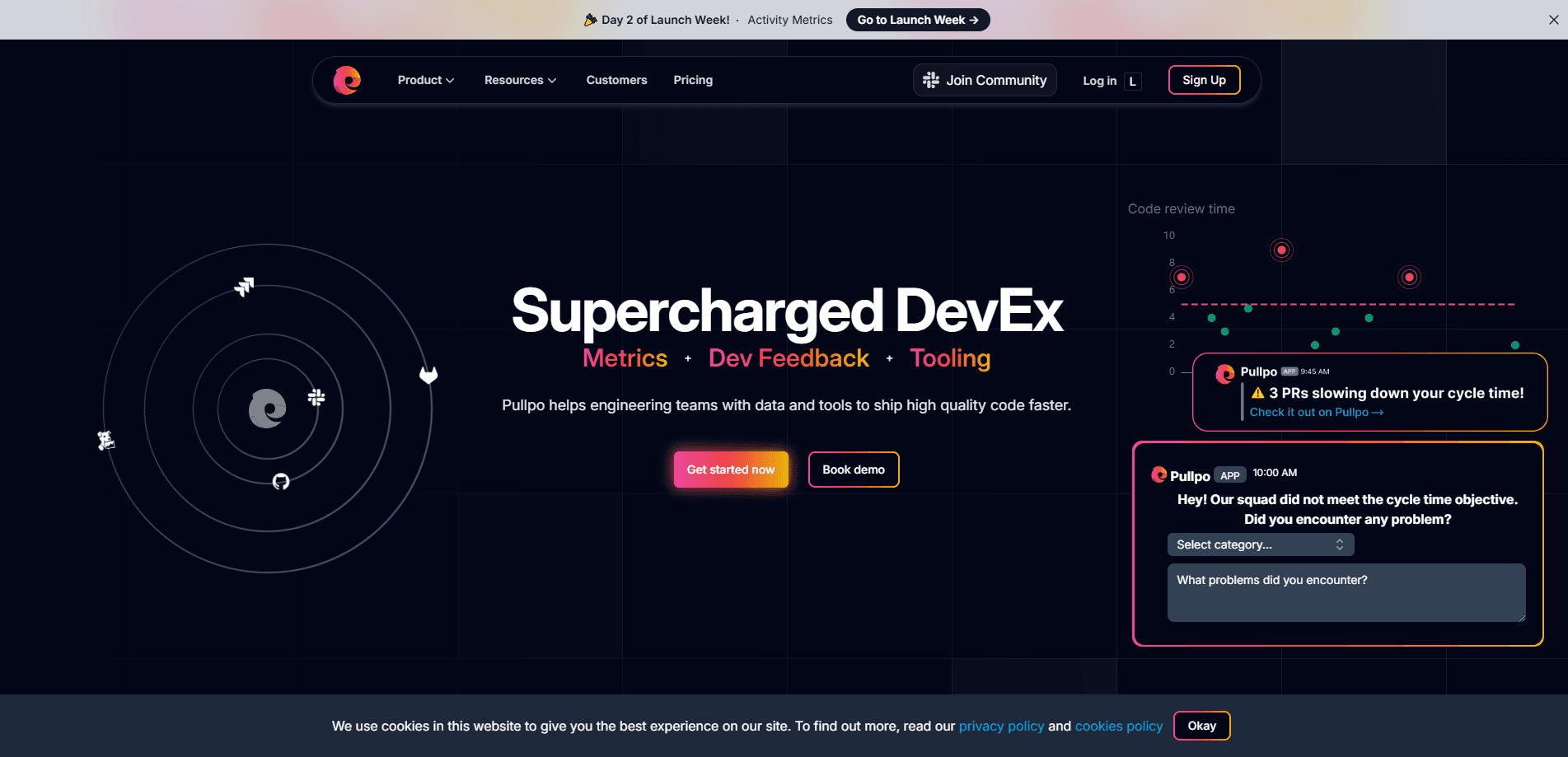
Pullpo is a developer intelligence platform for engineering teams. It does two jobs: it measures how your team ships code, and it cuts the friction that slows that work down. The metrics side shows cycle time, throughput, and change failure rate drawn from the DORA and SPACE framework research, while the tooling side moves code review chatter out of GitHub and into Slack so pull requests don't sit around for days.
The product is built around the idea that gut feelings aren't enough to run a team. Insights pulls together DORA and SPACE style data with survey answers from your developers, so you see both that a squad missed its cycle time target and why. Alerts and reminders then chase the pull requests that have gone stale.
Two things shape how it fits. It lives inside Slack, GitHub, GitLab, Bitbucket, and Jira, so it slots into the tools your team already opens every day rather than replacing them. And it sells per seat, with a 14-day trial, so the cost scales with your headcount instead of a flat enterprise fee.
Getting Started
- Sign up on the Pullpo site and start a 14-day free trial, or book a demo for a larger team
- Install the Slack app and connect GitHub, GitLab, or Bitbucket so Pullpo can read pull request activity
- Turn on PR channels so every pull request gets its own ephemeral Slack channel
- Set cycle time goals, working agreements, and reminders for your squads
- Open Insights to read your DORA and SPACE metrics, then send surveys to dig into the numbers
Product Information
A quick look at Pullpo.io's pricing, supported platforms, and performance.
Best for
The users, tasks, and scenarios where this tool fits best.
Users
- Engineering managers
- CTOs and VPs of engineering
- Developers on fast-moving squads
- Platform and DevEx teams
Tasks
- Track cycle time and throughput
- Speed up code reviews
- Stop stale pull requests
- Run developer experience surveys
- Validate a process change
- Set working agreements
Scenarios
- A squad misses its cycle time target
- Reviewers scattered across time zones
- Justifying a tooling investment
- Scaling past ten engineers
- Reducing context switching
Key features
Engineering metrics from DORA and SPACE
Pullpo's Insights reads your repo activity and turns it into cycle time, throughput, and change failure rate, the measures behind DORA and SPACE research. You get per-squad views rather than one blended number, so a struggling team stands out. The point is to find the bottleneck before it turns into a missed deadline.
Slack PR channels
Every pull request gets its own ephemeral, Git-synced Slack channel. Reviewers get notified in place, comments stay tied to the PR, and the channel archives itself when the work is merged. For developers handling several PRs at once, this keeps each discussion separate instead of buried in a busy team channel.
Reminders and alerts for stale PRs
Pullpo watches how long a pull request waits and nudges the right people when one stalls. A message can flag that a PR has been waiting four days for review, with a snooze option for the day. It's a small feature that targets the single most common complaint in code review, the PR nobody noticed.
PR summaries and AI reviews
An AI assistant drafts PR summaries and descriptions, and reviews incoming changes with suggested fixes. A beta AI reviewer flags problems like a date field that isn't validated before use. It's a first pass that catches the obvious slips before a human spends time on them.
Developer experience surveys
You can send short surveys to engineers about their tools, their process, and where they lose time. Answers attach to the metrics so you can connect a slow cycle time to a real cause rather than guess. Pullpo calls this combining quantitative data with qualitative feedback.
Working agreements and feedback loop
Working agreements let a team publish its own norms, such as how fast a review should happen, and keep them in view. Paired with in-the-moment feedback, this turns a metrics dashboard into a routine the team actually follows instead of a report nobody reads.
Integrations with GitHub, GitLab, Bitbucket, Jira, and Slack
Pullpo connects to the tools teams already use rather than asking them to switch. It hooks into GitHub, GitLab, and Bitbucket for code, Jira for issues, and Slack for everything the team sees. For an engineering org that runs on Slack, the platform lives where the conversations already happen.
Pros and cons
Pros
- Combines hard metrics with survey feedback, so you see why a number moved and not just that it did
- Keeps code review talk in Slack, which cuts the context switching that slows developers down
- PR channels archive themselves, so there's no cleanup work after a merge
- Integrates with GitHub, GitLab, Bitbucket, and Jira without forcing a tool switch
- Starts at €8 per seat with a 14-day trial, low enough to test on one squad before rolling out
Cons
- No free plan, so a solo developer or a tiny team can't try it without a trial or a paid seat
- Pricing is per seat and climbs with headcount, which stings for larger engineering orgs
- The product leans on Slack, so teams that don't run their reviews there get less out of it
- There's no published public API, so custom reporting has to go through the product's own dashboards
Frequently asked questions
Pullpo is a developer experience platform for engineering teams. It tracks metrics like cycle time and throughput, and it runs PR channels in Slack so code reviews move faster and pull requests don't go stale.
Related content
Explore related tools, skills, and articles for Pullpo.io.
Pullpo.io Alternatives

Udon
Udon · Coding · ProductivityUdon turns an Apple Silicon Mac into a home server you run from a browser, with container controls, file shares, and an optional AI sysadmin.

offstage
offstage cloud · Coding · Productivityoffstage gives AI coding agents and CI jobs a real Mac: a fresh macOS account on Apple silicon, driven over an API and billed by the second.

BotBus
Chengdu Tuyang Tusen Technology Co., Ltd. · Coding · ProductivityBotBus lets you control AI coding agents from your phone and watch: approve commands, start tasks and read results while the code stays on your desktop.