

Quantifind Intelligent Financial Crimes Automation
Quantifind · Coding
Quantifind Graphyte is a SaaS platform that automates AML and KYC screening, matching customers and counterparties against news, sanctions and PEP data with AI entity resolution.
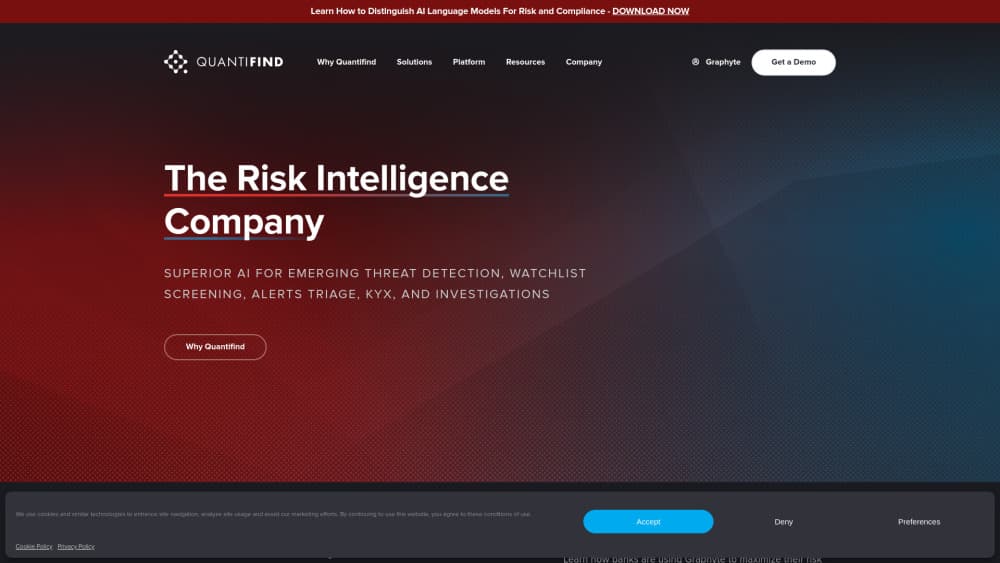
About Quantifind Intelligent Financial Crimes Automation
What Is Quantifind Graphyte
Quantifind builds Graphyte, an intelligent financial crimes automation platform that banks and government agencies use to screen people and companies against public data. The idea is simple to state and hard to do: take every news article, sanctions list, court record and company filing that might mention a risky entity, then work out which of those mentions belong to the customer sitting in front of you.
That matching problem is where most compliance budgets disappear. A common name like "John Smith" pulls thousands of hits, and a human reviewer has to clear each one. Graphyte applies machine learning to entity resolution, so the platform groups mentions by likely identity and ranks the result by risk instead of dumping raw search results into a queue. For buyers comparing AML screening software, the value shows up as cleared alerts per analyst hour. Quantifind says clients see productivity gains around 40% and 10 to 100 times fewer false positives, figures the company publishes from its own customer engagements.
The limits matter as much as the claims. Graphyte is enterprise software sold through a sales cycle, with no published price list and no self-serve trial. Coverage depends on the data sources Quantifind licenses, which lean on English and non-English news plus official lists, so a bank with unusual regional exposure should check source depth during evaluation. Smaller fintechs with a few thousand customers usually find lighter tools cheaper.
Getting Started
- Book a demo with Quantifind. Scoping starts from your alert volumes, the jurisdictions you cover and the systems your analysts already use, and pricing is quoted per engagement.
- Connect delivery. Teams use the GraphyteSearch web application, the synchronous GraphyteAPI, the batch API, or a prebuilt integration into an existing case management platform.
- Configure risk typologies. Compliance leads decide which categories count as material for their book, from financial crime and corruption to sanctions exposure, and set how results get ranked.
- Run screening in production. Alerts flow into analyst queues with supporting evidence attached, and reviewers mark outcomes that feed back into the models.
- Monitor and report. Dashboards and automated reports show alert volumes, clearance rates and the cases that escalated, which is what regulators ask for during an exam.
Product Information
A quick look at Quantifind Intelligent Financial Crimes Automation's pricing, supported platforms, and performance.
Best for
The users, tasks, and scenarios where this tool fits best.
Users
- Compliance teams at banks
- Financial intelligence units and investigators
- Public sector risk and procurement staff
Tasks
- Clearing adverse media alerts
- Sanctions and PEP screening at onboarding
- Enhanced due diligence research
- Periodic customer reviews
Scenarios
- A backlog of false positives
- Onboarding volume spikes
- Multi-jurisdiction expansion
Key features
Adverse Media Screening
Graphyte reads global news in English and other languages, then decides which stories refer to the entity being screened. Each result comes with the article, a short explanation of why it matters and a risk category, so an analyst can judge it in seconds. Quantifind positions this as the core of the platform, since adverse media is where manual review costs the most.
Watchlist and Sanctions Screening
The platform checks names against sanctions lists, blacklists and politically exposed person registers as part of the same workflow. Both checks run inside one KYC compliance platform, so onboarding and ongoing monitoring don't need separate vendors. Matching handles transliteration and name variants, which is the usual source of errors in legacy screening tools. Results return in real time through the API or inside the investigation application.
AI Entity Resolution
Most screening errors come from identity confusion, and this is the piece Quantifind patents and markets hardest. The model weighs co-occurring details such as employer, location and associates to decide whether two records describe one person or two. Reviewers see the reasoning, which matters when a decision has to survive an audit.
GraphyteSearch Investigation Workspace
GraphyteSearch is the web front end where analysts work. It expands a subject into related people and companies with one click, keeps every source citable and produces automated reports. The interface is designed for people who review alerts all day, so the workflow is closer to a research tool than to a database query screen.
GraphyteAPI and Batch Screening
Teams that want screening inside their own systems call the synchronous API for single checks, or the batch API to process a customer book on a schedule. Both return the same risk assessment structure, so an in-house case manager can display results without rebuilding the logic. This is also how daily monitoring of tens of millions of customers becomes practical.
Case Management Integrations
Prebuilt connectors push Graphyte results into established case management platforms, which means analysts keep working in the tool they know. Quantifind sells this as a way to add automation without ripping out systems that already passed validation. Custom integrations run through the API.
Pros and cons
Pros
- Entity resolution is the strongest part of the product, and it directly attacks the false positive problem that eats compliance hours.
- Non-English news coverage widens the net, which matters for banks with customers across Asia, Latin America or Europe.
- Delivery options cover the whole spectrum, from a web app for analysts to batch API calls for high-volume monitoring.
- Risk rankings and citations make alert decisions easier to defend to auditors and regulators.
- Prebuilt case management connectors shorten deployment compared with building a pipeline in house.
Cons
- There is no public pricing and no free tier, so a small team can't test the product without going through sales.
- Data source coverage is set by Quantifind, and a gap in a specific country or industry list means extra due diligence during evaluation.
- Setup requires integration work and tuning of risk typologies, which usually pulls in compliance, IT and data teams at once.
- The platform is built for bank-scale volumes, so a startup with a few hundred customers pays for capacity it may never use.
Frequently asked questions
It screens customers, vendors and counterparties against news, sanctions lists and PEP registers, then ranks each match by risk. Banks use it for KYC onboarding, adverse media review, enhanced due diligence and ongoing monitoring, either through a web app or an API.
Related content
Explore related tools, skills, and articles for Quantifind Intelligent Financial Crimes Automation.
Quantifind Intelligent Financial Crimes Automation Alternatives

Udon
Udon · Coding · ProductivityUdon turns an Apple Silicon Mac into a home server you run from a browser, with container controls, file shares, and an optional AI sysadmin.

offstage
offstage cloud · Coding · Productivityoffstage gives AI coding agents and CI jobs a real Mac: a fresh macOS account on Apple silicon, driven over an API and billed by the second.

BotBus
Chengdu Tuyang Tusen Technology Co., Ltd. · Coding · ProductivityBotBus lets you control AI coding agents from your phone and watch: approve commands, start tasks and read results while the code stays on your desktop.