

Quiver GTM
Built for Devs · Productivity · Marketing · Business
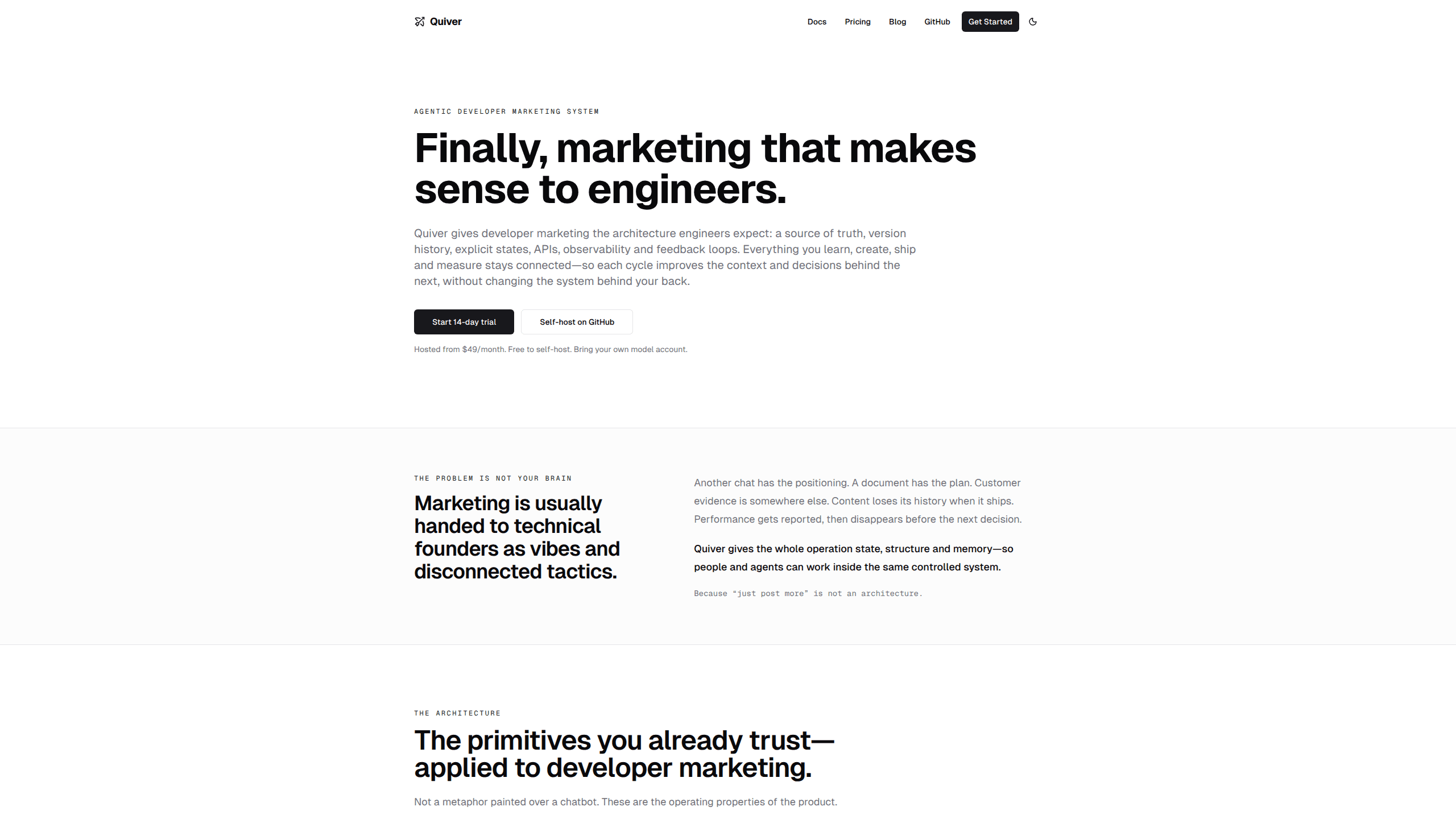
Quiver GTM is an agentic developer marketing system that keeps positioning, research, content and results in one versioned workspace, with approval gates, a Content API and MCP access.
About Quiver GTM
What Is Quiver GTM
Quiver GTM is a developer marketing platform from Built for Devs, available as a hosted app or a self-hosted build. It holds the material a team usually keeps in five different places: positioning, the ideal customer profile, proof points, customer language and the hypotheses still being tested. AI sessions then run on top of that stored context instead of starting from an empty chat.
The pitch is that marketing work should keep its state. A call transcript becomes a research artifact, the research informs a campaign, the campaign produces content, the content ships with a publish state, and the result comes back as a measurement note. Quiver links those steps so the next session starts with what the last one learned.
Three limits matter before you sign up. Quiver is not a CMS, a CRM or an analytics tool, so it sits beside your existing stack rather than replacing it. A model subscription is not included, which means you connect an Anthropic, OpenAI, Google, OpenRouter or OpenAI-compatible account and pay that provider directly. The free self-hosted version puts deployment, database maintenance and upgrades on your team.
Getting Started
- Paste your website or write a short product description. Quiver drafts positioning, audience, messaging, proof and open hypotheses from it.
- Open the context screen and fix every field marked as an assumption. The draft is a starting point, not approved truth.
- Connect your model account and pick a model for each kind of job, such as research synthesis or drafting.
- Create a campaign for work you are actually running, then open a session in the mode that matches the task.
- Save the output as an artifact or content piece, approve it, publish it, and log the result once it goes live.
Product Information
A quick look at Quiver GTM's pricing, supported platforms, and performance.
Best for
The users, tasks, and scenarios where this tool fits best.
Users
- Technical founders
- Developer marketing leads
- Small devrel teams
Tasks
- Turning call transcripts and support threads into themes
- Planning a launch campaign
- Keeping published pages accurate
Scenarios
- A founder who writes the first ten blog posts alone and wants the reasoning stored with them.
- A team that ships to developers and answers the same positioning questions in every sales call.
- An agency or contractor running marketing for a dev tool, where the client wants visibility into drafts and approvals.
Key features
Versioned product context
The core object is a context record with positioning, ideal customer profile, core problem, proof points and active hypotheses. Every save creates a version you can restore, so a rewrite does not erase the earlier thinking. Agents can propose edits, but a person approves what enters the active context.
Sessions built around a job
Quiver splits work into five purposes: strategy, content creation, customer feedback, analysis and follow-up review. Each session opens with the same approved context and writes its output back to the system. The point is that a session ends with a saved artifact rather than a conversation you have to copy out by hand.
Review and publish as separate steps
Artifacts and content pieces carry explicit states, from draft to approved to live. Generation and publishing stay apart, which gives an editor a place to check claims before a page goes out. Version history is kept for both, so an approval can be traced to a specific revision.
Customer research that changes the system
You paste raw material such as a call transcript, a survey response or a review, and the research session pulls out themes, Voice of Customer quotes, product signals and evidence for or against a hypothesis. Featured quotes stay available to later sessions, so the language customers use reaches the people writing copy.
Content records with distribution history
Each piece stores a calendar slot, SEO title and description, social metadata, repurposing links back to the source asset, distribution records and a metric history. That makes repurposing deliberate: you can see which long post produced which short posts and how each one performed.
Content API and MCP server
Approved content is served as structured JSON through a public Content API, so Quiver can hold the source of truth while your own site controls presentation. A hosted workspace exposes an MCP endpoint with OAuth or scoped tokens, and the self-hosted build ships the MCP server code for you to deploy.
Bring your own model
Quiver does not bundle a model subscription. You connect Anthropic, OpenAI, Google, OpenRouter or any OpenAI-compatible account and choose a model per job. Model cost and usage policy stay with your provider account, which also makes the monthly price easier to predict.
Pros and cons
Pros
- Context, research, content and results share one record set, so the same facts do not get retyped in four tools.
- Approval sits between generation and publishing, which suits teams that need a human check on technical claims.
- The MIT-licensed self-hosted build costs nothing and keeps your data on your own infrastructure.
- Content API and MCP access mean agents and your website work from approved material rather than from a chat log.
- Per-job model choice lets you spend on a stronger model for synthesis and a cheaper one for drafting.
Cons
- Bringing your own model account adds a second bill and a second setup step that the $49 price does not cover.
- Self-hosting means you own the database, backups and upgrades, which is real work for a small team.
- Built-in tasks, assignments and reminders are hosted only, so the free build lacks the workflow layer.
- The product assumes you already have customer evidence to feed it, and a new product with no calls or reviews gets less from research sessions.
Frequently asked questions
Quiver GTM is an agentic developer marketing system from Built for Devs. It stores product context, research, campaigns, content and performance in one system, then runs AI sessions and connected agents against that approved material.
Related content
Explore related tools, skills, and articles for Quiver GTM.
Quiver GTM Alternatives

Base Code
Base44 (Wix) · Coding · ProductivityBase Code is a shared cloud development environment from Base44. Teammates describe changes to an existing GitHub codebase in chat, preview them live and send them back as pull requests.

Knocket
Knocket (Tencent RTC team) · Productivity · Business · ChatbotKnocket is a free live chat and contact page tool that lets visitors message you from your website, app, or a shareable link, with every reply handled from Telegram or one inbox.

FloorGen
Vinit Kumar (FloorGen) · Productivity · China AIFloorGen is a browser-based floor plan maker that turns a sentence or a sketch into an editable 2D plan and a 3D walkthrough. Export to PDF, DXF or video, and draw without an account.