
RAGaaS
RAGaaS · Coding
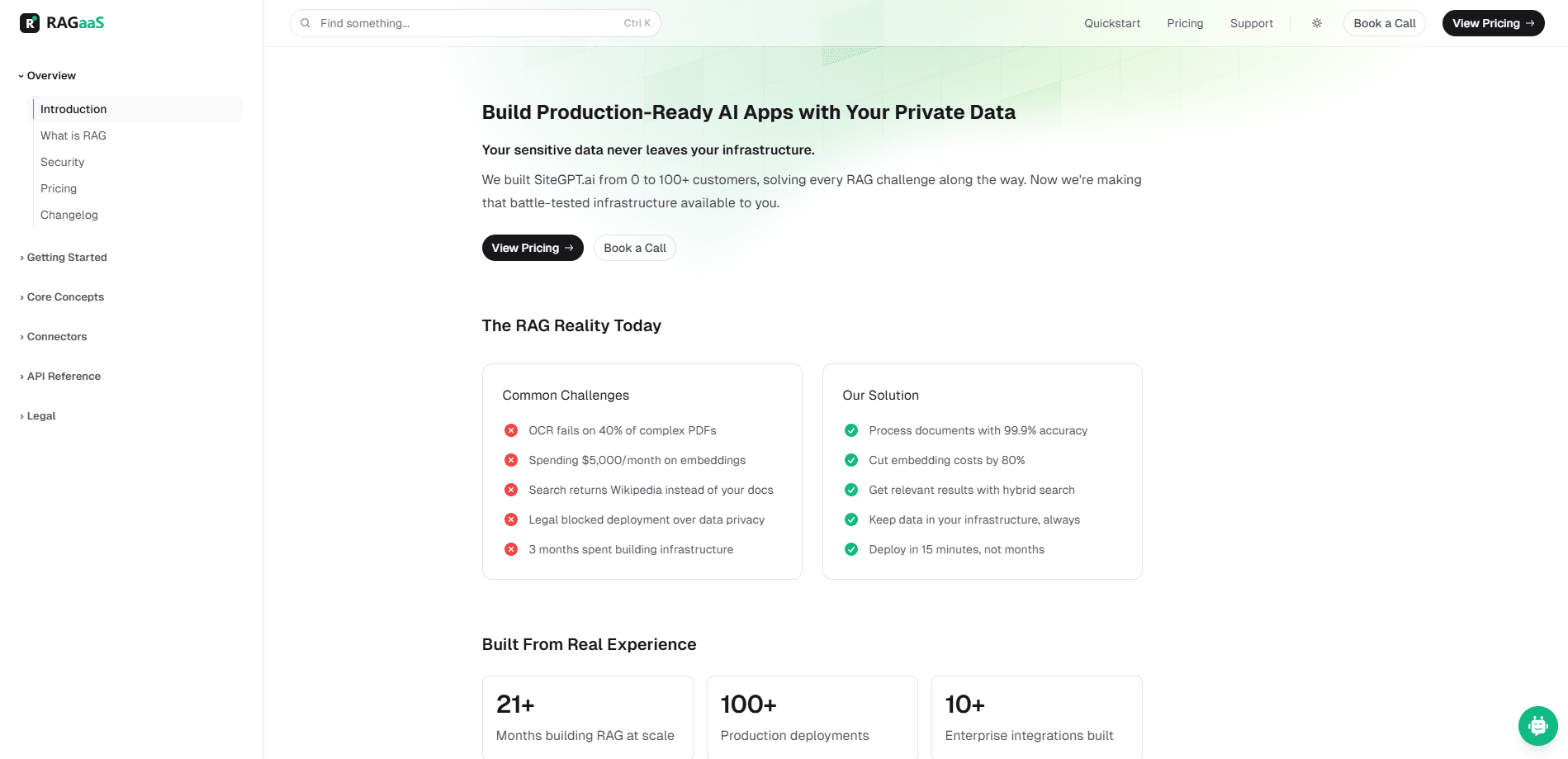
RAGaaS is a privacy-first managed RAG API that connects to your own S3-compatible storage, vector database and LLM keys, then handles chunking, embeddings and search for you.
About RAGaaS
What Is RAGaaS
RAGaaS stands for Retrieval Augmented Generation as a Service. It's a managed API that lets a team build a RAG application without running the plumbing behind it. You point it at documents, and it handles the pipeline: splitting text into chunks, turning them into embeddings, storing vectors and returning relevant passages when a query comes in.
What separates RAGaaS from most RAG as a Service platforms is where your data lives. Instead of copying your documents into a vendor's cloud, RAGaaS works with storage and databases you already control. You bring an S3-compatible bucket, a vector database and your own LLM provider key, and the service orchestrates them through a small API surface. The company frames this as privacy-first AI: your files and your model credentials stay under your account.
The flip side is that RAGaaS assumes you're comfortable wiring infrastructure. You need a working storage bucket, a vector index and an API key before anything runs. That rules out non-technical users. There's also little public documentation today, and the original ragaas.dev domain now redirects to SiteGPT, so teams evaluating it should confirm the product is still actively offered before building on it.
Getting Started
- Set up an account and connect an S3-compatible storage bucket where your documents will live.
- Link a vector database and add your LLM provider API key so the service can generate and query embeddings.
- Call the document processing endpoint to ingest files, which triggers chunking and embedding generation.
- Send search queries through the second API call to retrieve grounded passages for your LLM.
- Feed the returned context into your own app or model to produce answers with citations.
Product Information
A quick look at RAGaaS's pricing, supported platforms, and performance.
Best for
The users, tasks, and scenarios where this tool fits best.
Users
- Backend and ML engineers building RAG features
- Teams with strict data residency needs
- Small product teams without an infrastructure specialist
Tasks
- Ingesting a document set
- Adding search over private documents
- Swapping the LLM behind a RAG app
Scenarios
- An internal knowledge base over confidential files
- A support assistant that must cite sources
- A prototype that needs retrieval fast
Key features
Bring your own storage and vector database
RAGaaS runs on infrastructure you own: an S3-compatible bucket for documents and a vector database you control. The service manages the connection between them rather than hosting your data, which is the core of its privacy pitch and the reason it appeals to regulated teams.
Two-call API for processing and search
The developer surface is deliberately small. One call processes documents, handling chunking and embedding generation, and a second call searches them. Teams that describe the product commonly cite this two-call flow as the main draw, since it removes the glue code a hand-built RAG stack needs.
Managed chunking and embedding generation
The service splits incoming documents into chunks and converts them into embeddings for you. That's the part most teams underestimate, because chunk size and embedding model choices drive retrieval quality long before any prompt is written.
Search optimization over your index
Once documents are embedded, RAGaaS handles retrieval and tunes how results are ranked against a query. You get relevant passages back rather than raw vector matches, so your LLM receives context it can actually use.
Your own LLM keys
You supply the model provider key, so the generation step runs against a provider you chose and pay for directly. This keeps model costs and vendor terms under your control instead of bundling them into a platform subscription.
Maintained infrastructure
The company positions RAGaaS as handling the routine upkeep around a RAG pipeline, such as keeping embeddings in step with source documents and scaling retrieval as content grows. For a small team, that maintenance is often the reason to pick a managed service over a self-hosted one.
Pros and cons
Pros
- Keeps documents in your own S3-compatible storage and vector database, which helps with data residency and compliance reviews.
- The API is small, with one call to process documents and one to search, so there's less integration work than a hand-built pipeline.
- You bring your own LLM key, so model choice and model spend stay in your hands.
- Managed chunking and embedding generation save the effort of building and tuning that pipeline yourself.
Cons
- It assumes technical setup: you need a working bucket, a vector index and provider keys before anything runs, so non-developers can't use it.
- Public documentation is thin, which makes the exact API behavior and limits hard to confirm up front.
- The original ragaas.dev domain now redirects to SiteGPT, so it's unclear whether the product is still actively maintained and risks lock-in on a service with no visible roadmap.
- Pricing isn't published, so you can't compare running costs against a self-hosted stack without asking the company directly.
Frequently asked questions
RAGaaS is a managed Retrieval Augmented Generation API. It ingests your documents, handles chunking and embedding generation, stores vectors in a database you control, and returns relevant passages when you search, so your app can answer questions grounded in your own content.
Related content
Explore related tools, skills, and articles for RAGaaS.
RAGaaS Alternatives

Udon
Udon · Coding · ProductivityUdon turns an Apple Silicon Mac into a home server you run from a browser, with container controls, file shares, and an optional AI sysadmin.

offstage
offstage cloud · Coding · Productivityoffstage gives AI coding agents and CI jobs a real Mac: a fresh macOS account on Apple silicon, driven over an API and billed by the second.

BotBus
Chengdu Tuyang Tusen Technology Co., Ltd. · Coding · ProductivityBotBus lets you control AI coding agents from your phone and watch: approve commands, start tasks and read results while the code stays on your desktop.