

Raijin.ai
Raijin.ai · Productivity · Business
Raijin.ai is a Singapore AI studio that builds bespoke AI workers for small teams, covering inbox triage, CRM updates, finance reports and HR tasks inside the tools a team already uses.
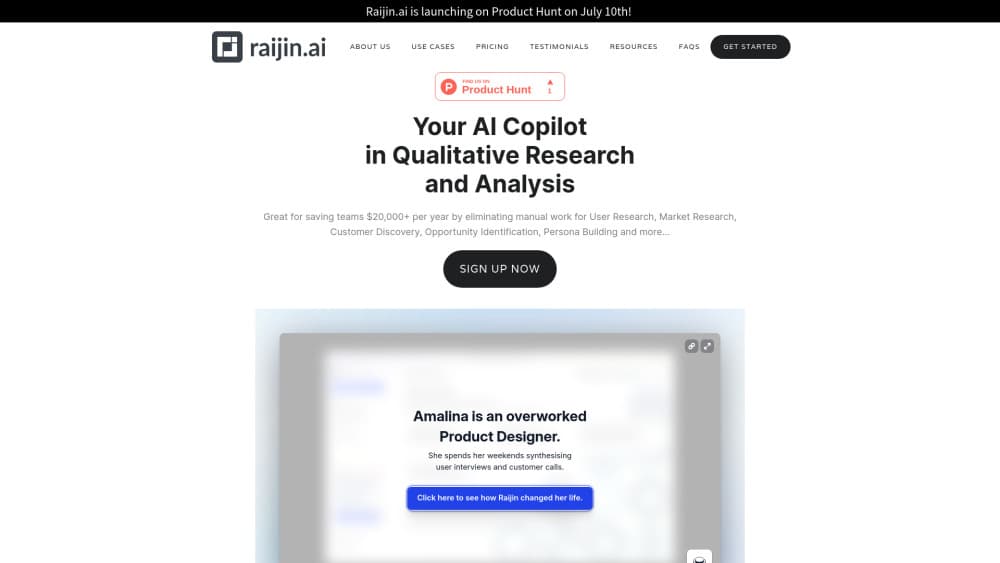
About Raijin.ai
What Is Raijin.ai
Raijin.ai is an AI agent development studio, not a self-serve app. You don't sign up and pick a template. You book a call, walk the team through how your company actually operates, and they build a worker around those workflows. Most clients are small businesses: founders, finance leads, sales heads, agencies and a handful of venture funds.
The work falls into two halves. One is conversation analytics, pulling the useful parts out of sales calls, customer interviews and support threads. The other is autonomous execution, where the agent reads email, books meetings, updates the CRM and posts a status digest into Slack or WhatsApp. The builds run on Claude and Claude Code with OpenClaw handling the agent layer. Buyers deal with outcomes rather than model names.
The limits matter as much as the features. There's no free tier and no self-serve trial, so you can't test anything before you pay. The fee is a one-time build cost, not a monthly subscription, and the Mac mini option that adds iMessage integration is only offered in Singapore. If you want a cheap chatbot for one person, this is the wrong shape of product.
Getting Started
- Book a free 30-minute discovery session through the site's booking form. Bring one concrete workflow, not a wish list.
- Sit through a structured 90-minute mapping session. The team traces your tools, handoffs and decision points.
- Approve the architecture: the role the worker takes, the integrations it touches, and where a person still signs off.
- Go live. Hosted setups are managed remotely, while Singapore clients can choose an on-site Mac mini with iMessage access.
- Iterate after launch. Support is part of the engagement, so the worker gets retuned as your process changes.
Product Information
A quick look at Raijin.ai's pricing, supported platforms, and performance.
Best for
The users, tasks, and scenarios where this tool fits best.
Users
- Founders and CEOs of small companies
- Finance leads without a big team
- Heads of sales at B2B teams
- Agencies and studio operators
Tasks
- Inbox triage
- CRM hygiene
- Finance reporting
- Onboarding and policy questions
Scenarios
- A five-person company where nobody owns operations
- A sales team that never logs notes
- A Singapore office that lives in iMessage
Key features
One worker, one role
Each AI worker is trained on the workflows of a single job: executive assistant, sales, finance, operations or HR. That focus is the point. A generic chatbot answers questions, while a role worker knows which fields belong in a CRM record and which approvals need a human. You can add more roles later at $1,500 each.
Inbox and calendar execution
The assistant triages email daily, drafts replies for you to approve, and books or moves meetings across time zones. It also produces a short briefing before each meeting and pulls action items out of long threads. Execution is the difference here: the worker acts inside your accounts instead of handing you a to-do list.
CRM and workspace integrations
Raijin.ai connects to HubSpot, Salesforce, Notion and Google Workspace, and the team builds against your existing stack rather than asking you to migrate. For sales teams, that means call transcripts become deal records with next steps attached. That kind of AI workflow automation is the reason the build starts with your process, not with a prompt library. For finance, invoices and expense claims get checked against approved budgets.
Messaging where your team already talks
Workers reach people through Slack, WhatsApp, Telegram and Discord, so nobody has to log into a new dashboard. A finance lead can ask for the weekly burn number in Slack and get it in the thread. This is the part that makes SMB AI automation stick, since adoption depends on habit rather than training.
Conversation analytics from calls and interviews
The studio started with qualitative research tooling, and that skill carried over. Workers summarize sales calls, customer interviews and support conversations, then tag themes across a whole set of transcripts. Instead of reading forty interviews, you get the recurring objections and the quotes that back them.
Two deployment paths, one build fee
Hosted setups run in the cloud at $3,000 and are managed remotely. Singapore clients can pay $6,000 for an on-site Mac mini with iMessage integration, which keeps the worker on hardware in your office. Both are one-time costs, and extra agents cost $1,500 each.
Pros and cons
Pros
- Built around your existing tools, so there's no migration project and no new dashboard for the team to learn.
- One-time pricing instead of a per-seat subscription, which suits small teams that hate recurring software costs.
- Workers act inside email, calendar, CRM and chat rather than stopping at suggestions.
- The free 30-minute discovery call gives you a scoped answer before any money changes hands.
- Role-based design keeps each agent narrow enough to audit.
Cons
- No free plan, trial or public demo, so evaluating the product means talking to sales.
- The Mac mini option with iMessage is limited to Singapore, which rules it out for most international buyers.
- Custom builds depend on a good discovery session; a vague brief produces a vague worker.
- There's no API or self-serve tooling, so developers can't wire the agents into their own systems.
Frequently asked questions
It builds custom AI agents for small businesses. Each agent takes on one role, such as executive assistant, sales, finance, operations or HR, and works inside the tools that team already uses.
Related content
Explore related tools, skills, and articles for Raijin.ai.
Raijin.ai Alternatives

Base Code
Base44 (Wix) · Coding · ProductivityBase Code is a shared cloud development environment from Base44. Teammates describe changes to an existing GitHub codebase in chat, preview them live and send them back as pull requests.

Knocket
Knocket (Tencent RTC team) · Productivity · Business · ChatbotKnocket is a free live chat and contact page tool that lets visitors message you from your website, app, or a shareable link, with every reply handled from Telegram or one inbox.

FloorGen
Vinit Kumar (FloorGen) · Productivity · China AIFloorGen is a browser-based floor plan maker that turns a sentence or a sketch into an editable 2D plan and a 3D walkthrough. Export to PDF, DXF or video, and draw without an account.