

ReadPo
ReadPo · Productivity · Leaning
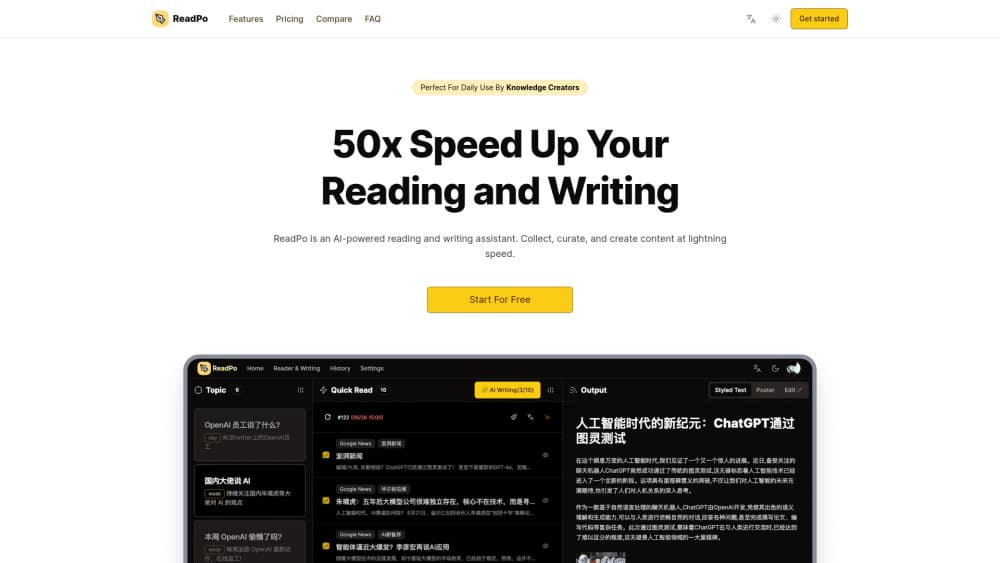
ReadPo is an AI reading and writing assistant that pulls articles from Google News, RSS, and X, scores them, and turns the keepers into newsletters, blog drafts, and posters.
About ReadPo
What Is ReadPo
ReadPo is a web app for people who have to read a lot before they write anything. You give it a topic, it fetches fresh articles from the sources you connect, and it ranks them so the useful ones surface first. From there you read, summarize, and draft in the same window.
Most teams stitch a feed reader, a notes app, and a writing tool together. ReadPo is a content aggregation tool and a drafting surface in one window. The name comes from read plus post. The team built the product around syntopical reading, the idea that you understand a subject by reading several sources side by side instead of one article at a time. Writing is the second half of that loop. ReadPo keeps the source material attached to the draft, so claims can be traced back to the article they came from.
The limits matter before you pay. Credits run the whole system, and reading, scoring, and writing each consume them. Free accounts get 30 credits a month, which covers roughly 900 fetched articles or about 10 generated pieces. Everything happens in the browser, there is no desktop app, and the content generation API is still listed as coming soon.
Getting Started
- Create an account at readpo.com with an email address or a Google login.
- Start a topic and connect sources: a Google News keyword, any RSS feed, or an X account.
- Let ReadPo fetch and score the articles, then open the ones worth your time and read the AI summary.
- Pick a writing prompt or write your own, generate the draft, and export it as an article or a poster.
Product Information
A quick look at ReadPo's pricing, supported platforms, and performance.
Best for
The users, tasks, and scenarios where this tool fits best.
Users
- Newsletter writers
- Solo bloggers
- Content and community managers
Tasks
- Daily news roundups
- Turning reports into plain language
- Repurposing one topic into several formats
- Reading in a second language
Scenarios
- A weekly industry digest with a fixed publishing day, where the source list barely changes and speed matters more than original reporting.
- Launch week for a product, when you need to watch competitors and press coverage across many outlets at once.
- Content research for a longer piece, where you want 15 to 20 articles reduced to a comparison before you outline.
Key features
Topic Feeds From Google News, RSS, and X
A topic is the unit of work in ReadPo. You attach sources to it: a Google News query with keyword filters, any RSS feed URL, or a specific X account. ReadPo then pulls the latest items into one list. The point is coverage without tab switching, and the source list keeps growing as the team adds connectors. Saving an arbitrary webpage as a source is still marked coming soon.
AI Scoring, Sorting, and Translation
Every fetched article gets an AI score against your topic, and the list reorders around relevance instead of publish time. Articles in another language can be translated during the same pass. This is the part that saves the most time in practice: you stop opening ten tabs to find the two pieces that matter. Scores are a filter, not a verdict, and a high score still needs your judgment.
Multi-Article Summaries
ReadPo summarizes across a batch of articles rather than one at a time. The free plan caps a batch at 5 articles, Starter raises it to 10, and Pro to 20. The AI summarizer is where the syntopical reading idea shows up in the interface: you see where sources agree and where they diverge, which is hard to do by hand at that volume.
RAG Writing With Custom Prompts
The writing step runs on retrieval augmented generation. ReadPo feeds your selected articles into the model as context, so the draft cites real reporting from the last few days instead of whatever the model remembers. You can also save your own prompts for recurring formats, such as a three-paragraph digest or a comparison post. Unlimited custom prompts start on the Starter plan.
Articles, Posters, and Other Outputs
Output isn't limited to text. ReadPo renders articles, markdown posters, and image cards, with 24 poster templates on the free plan and the full template library on paid plans. The poster renderer also works as a free standalone tool with a public URL, which is handy if you only need the image half. Video and audio output are mentioned on the site as broader goals, not shipped features.
Plans Built Around Credits
Credits are the meter for everything: fetching, scoring, and generating. Free gives you 30 a month and 2 topics, Starter gives 250 credits and 10 topics at $8 per month, and Pro gives 800 credits and 30 topics at $24 per month. Annual billing takes another 20% off. Heavy users should do the arithmetic before committing, since a busy research week can eat a Starter allowance.
Pros and cons
Pros
- Collection, reading, and drafting live in one place, which removes the usual copy-paste chain between a feed reader, a notes app, and a writing tool.
- RAG grounding keeps drafts tied to current articles, so you get fresher material than a bare chatbot prompt would produce.
- Source connectors cover the three places most niche news actually lives: Google News, RSS, and X.
- Poster templates and a free rendering URL add a visual output step without a second subscription.
- The free tier is real, not a seven-day trial, which makes testing the workflow low risk.
Cons
- Credits disappear faster than the plan names suggest. Reading a large batch and then generating two drafts can burn through a Starter month in a week.
- Only three source types are supported. If your beat lives in Slack communities, paywalled databases, or Chinese-language platforms, you'll be exporting links by hand.
- The generation API is still coming soon, so teams that want ReadPo inside their own product have to wait.
- There's no mobile app. Reading on a phone means using the mobile browser, and the poster editor is cramped on a small screen.
Frequently asked questions
It collects articles on a topic from Google News, RSS, and X, scores and sorts them, summarizes the batch, and drafts an article or poster from what you selected. Think of it as a research desk and a first-draft writer in one browser tab.
Related content
Explore related tools, skills, and articles for ReadPo.
ReadPo Alternatives

Base Code
Base44 (Wix) · Coding · ProductivityBase Code is a shared cloud development environment from Base44. Teammates describe changes to an existing GitHub codebase in chat, preview them live and send them back as pull requests.

Knocket
Knocket (Tencent RTC team) · Productivity · Business · ChatbotKnocket is a free live chat and contact page tool that lets visitors message you from your website, app, or a shareable link, with every reply handled from Telegram or one inbox.

FloorGen
Vinit Kumar (FloorGen) · Productivity · China AIFloorGen is a browser-based floor plan maker that turns a sentence or a sketch into an editable 2D plan and a 3D walkthrough. Export to PDF, DXF or video, and draw without an account.